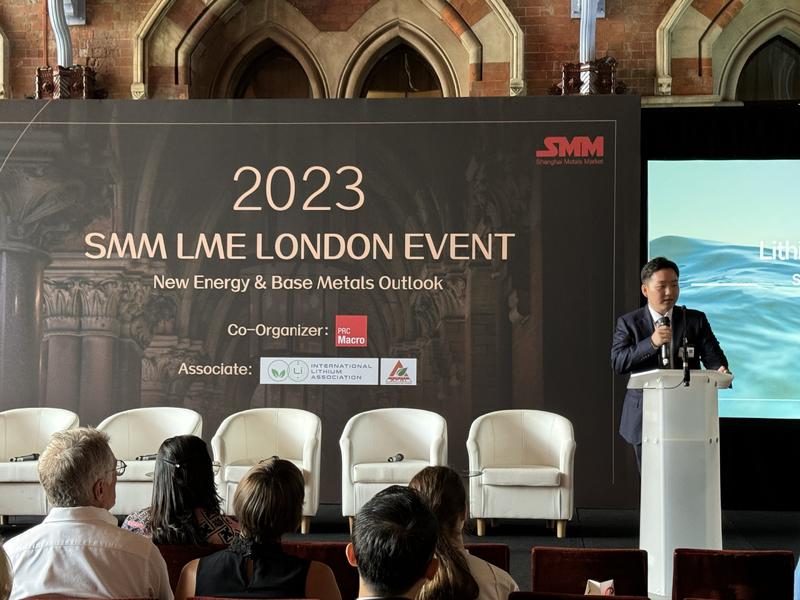
SHANGHAI, Oct 12 (SMM) – The ongoing 2023 SMM LME LONDON EVENT, being held at ST. Pancras Renaissance Hotel London, Euston Rd., London NW1 2AR, has brought together major industry players and commodity experts to share their valuable insights and unique perspectives on new energy and base metals outlook. SMM New Energy Senior Analyst Zhou Zhicheng said that due to the uncertainty caused by the delay of some lithium resource projects around the world and the rapid expansion of lithium production capacity, SMM expects that the oversupply situation on the resource side will gradually weaken in 2025 and a tight balance could emerge in 2026, which will provide certain support for the cost and price of lithium salts. Lithium battery recycling will become the main driver of lithium supply in the next few years. In the event that lithium mining projects fail to meet expectations, the incremental lithium resources brought about by lithium recycling will help fill the supply gap.
At the "SMM LME LONDONE EVENT" held during LME Week, SMM New Energy Senior Analyst Zhou Zhicheng analyzed the lithium carbonate market under the development of new energy industry.
Market overview and supply and demand analysis
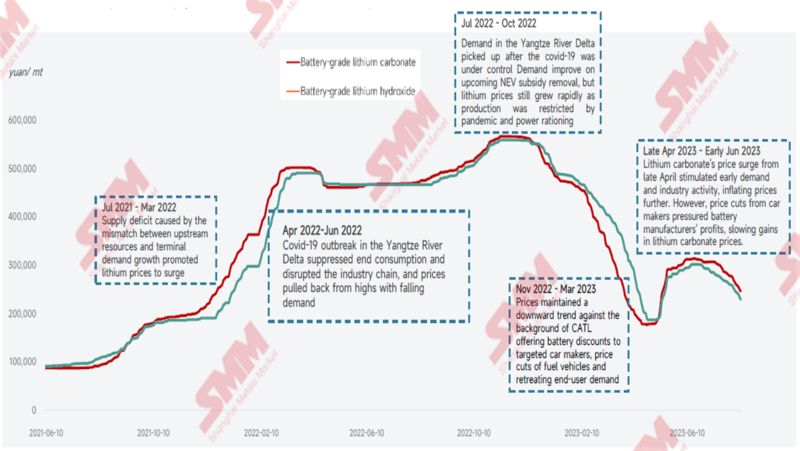
The figure below shows the lithium salt prices and reasons for price changes from 2017 to 2023
Supply-demand balance of lithium carbonate in China (Aug 2022-Sep 2023)
Entering 2023, due to relatively weak downstream demand and the gradual recovery of supply, upstream smelters' lithium carbonate inventories stayed high. Since May, upstream companies have begun to enter a rapid destocking stage. By September, when the price of lithium carbonate fell below the production costs of many smelting companies who rely on externally sourced ore, some upstream lithium salt plants opted to reduce production and further adjust lithium carbonate stocks.
Cathode material output (Jun 2023-Jul2024)
According to SMM research statistics, China's ternary lithium battery production dropped slightly in August 2023 compared with July. It is expected that in November this year, ternary lithium battery production may reach a high level in the next few months.
In terms of demand for lithium iron phosphate, according to SMM research, from June to August 2023, the demand for lithium iron phosphate has declined month by month. It is expected that this situation may be reversed in September, and the market demand for lithium iron phosphate may increase and reach a high in November this year.
Global lithium resource supply 2023-2024
Lithium ore resource analysis:
Overseas spodumene: In the second quarter, production at Australia's Greenbushes mine increased 11% to 396,000 mt due to improved ore grades. The progress of the NAL project is in line with expectations, with output of 29,600 mt in the second quarter; the Goulamina project is still planned to produce the first batch of concentrate products in the second quarter of 2024; the increase in domestic supply comes from the Lijiagou project of Sichuan Energy Investment Lithium Technology Co., Ltd. The project is expected to be put into production by the end of this year. Additionally, production releases from Xinjiang’s Dahongliutan Mine are expected this year and next.
Overseas Salt Lake: There have been several delays in overseas capacity expansion recently. For example, Lake Resources' Kachi project experienced a delay in its phase one production schedule, from 2024 to 2027. Although Argosy's Rincon project started production earlier this year, it has so far produced only 20 mt of lithium carbonate equivalent (LCE). Overall, the performance of some overseas brine deposits is worse than expected, and the incremental supply is expected to be lower than previously forecast.
Note: Due to the high economic benefits of early recycling, overseas lithium resource production capacity is expanding rapidly. In addition, as the production of lithium iron phosphate increases, the recycling of lithium iron phosphate batteries has also increased significantly. Therefore, SMM expects that recycling capacity will be released intensively starting from the second half of 2023.
Global spodumene supply distribution in 2025
SMM predicts that by 2025, the global supply of spodumene will reach about 713,000 mt LCE. Australia will dominate and may provide more than 50% of the lithium resource supply. And with the development of production capacity in Africa and Europe, the concentration of supply will decrease.
Global lepidolite resource distribution in 2025
SMM predicts that global lepidolite production will reach around 210,000 mt LCE by 2025. China will still dominate the supply and may contribute an output of approximately 207,000 mt LCE. As for the rest of the world, it is still in the early stages of development and production will be unstable in the next few years.
Estimated global salt lake supply distribution in 2025
SMM predicts that global salt lake production will reach about 720,000 mt LCE by 2025, mainly distributed in Chile, Argentina, and China.
2022Q1-2024Q4 global lithium resource supply and demand forecast
Global lithium resources supply analysis
Due to uncertainty caused by the delay of some lithium resource projects around the world and the rapid expansion of lithium production capacity, SMM expects that lithium resource oversupply situation will gradually weaken in 2025 and a tight balance could be reached in 2026, thereby providing certain support for the cost and price of lithium salts.
Lithium battery recycling will become the main driver of lithium supply in the next few years.
In the event that lithium mining projects fail to meet expectations, the incremental lithium resources brought about by lithium recycling will help fill the supply gap.
Breakdown of lithium carbonate cost curve in Q3 2023
Current Costs: Extraction costs for smelters externally sourcing spodumene and lepidolite remain relatively high, while integrated smelters have significant cost advantages with minimal cost fluctuations. Salt lakes remain the lowest-cost raw material for producing lithium carbonate. It is worth mentioning that although the price of spodumene continued to fall in the third quarter compared with the second quarter, the strong influence of overseas mines and the delay of some projects drove the rise in ore prices, providing certain support for lithium carbonate prices.
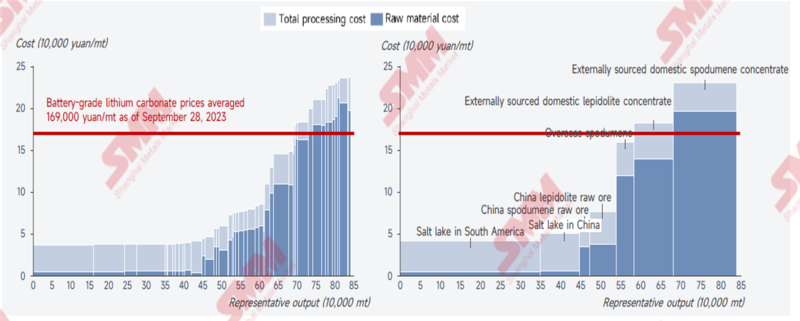
Long-term costs: SMM expects lithium carbonate producers to still have some profit margins in the third quarter. As ore supply increases from new lithium resource projects, mining companies' profitability will come under intense pressure. The increase in lithium ore will significantly reduce the cost of producing lithium carbonate from spodumene concentrate and lepidolite concentrate sourced externally. As manufacturing costs fall significantly, its support for lithium carbonate prices will also weaken.
Global lithium resource cost curve in Q1 2024
Lithium resource cost curve forecast
Raw material costs of salt lake enterprises are relatively stable and will not be affected by the labour force or technology in the short to medium term. Due to years of technology accumulation and equipment improvements, the cost of Australian mines will also remain relatively low. The cost of mining in Africa is affected by a variety of factors including road conditions that affect the use of mining equipment, high hidden costs and additional costs at ports. The cost of mining is much higher than in other mainstream regions.
Under the influence of current lithium prices, some African mines plan to reduce or suspend production in the near future due to excessive hidden costs. There are also rumors that some mines are seeking to transfer ownership. If demand for lithium carbonate continues to be lower than expected in the second half of this year, supply in Africa may continue to decrease, which may alleviate the overall resource oversupply problem.
Future demand from a global perspective
Different types of batteries affect the demand for related materials
There are currently two mainstream battery types on the market: ternary batteries and lithium iron phosphate batteries. Ternary batteries have higher energy density and better low-temperature performance; while lithium iron phosphate batteries have higher safety performance.
Since 2021, soaring battery raw material prices have more than doubled the cost of lithium iron phosphate and ternary batteries. For example, NCM523 ternary prismatic batteries' cost surged from under 0.6 yuan/kilowatt-hour in 2021 to over 1.1 yuan/kwh. This has driven car makers to seek cheaper battery options.
The dual-carbon policy has spurred rapid growth in new energy vehicle production.
From an analysis predicting the sales and market penetration of new energy vehicles worldwide, including China and other regions, from 2019 to 2026, SMM predicts that with policy backing, increased battery and car investment, and growing consumer acceptance, the global compound annual growth rate for new energy vehicles could reach about 24% from 2023 to 2026.
Global lithium battery energy storage market growth slows down in 2023
Chinese market: According to SMM, in the first half of 2023, China’s cumulative installed energy storage capacity exceeded 21GW, a year-on-year increase of more than 200%. Driven by mandatory strategies, the installed capacity of the energy storage market is expected to continue to rise in the second half of the year.
North American Market: In North America, factors like extended project cycles, energy storage component delays, and joint government interest rate hikes have caused some U.S. energy storage projects to be postponed to next year or cancelled. The overall growth rate of energy storage in the European market has slowed this year.
European market: In 2023, European electricity prices will fall, resulting in a decline in household energy storage demand. At the same time, due to the impact of the economic environment, the willingness to invest in energy storage has declined. As growth slows, the market enters a period of destocking.
Other markets: The South African market is dominated by thermal power. Coal power equipment is outdated and power supply is decreasing year by year. With abundant sunlight resources, the demand for energy storage is growing rapidly. In Australia, industrial and commercial sector subsidies implemented in the first half of this year have boosted these sectors' energy storage. Meanwhile, Southeast Asian countries are prioritizing renewable energy deployment, with relevant energy storage policies soon to be enacted.
Global Outlook for Lithium-Ion Battery Energy Storage Market
North America's energy storage market is focused on power generation, while Europe's is consumer-oriented. China is expected to be the future growth engine for energy storage in the power generation field.
Summary
Lithium: Lithium import sources are expanding, yet China remains heavily import-dependent. Lithium chemical technology capacity is mainly domestic but varies significantly in cost due to different raw materials and sources. Direct transactions between upstream and downstream businesses dominate, with an increasing trend of battery cell and end-user participation in purchasing
Battery Material: Domestic production capacity for ternary lithium batteries is growing, with a significant increase in new capacity expected. Lithium iron phosphate battery production, mainly in China, is also expanding rapidly. Cathode Active Material (CAM) production is closely tied to battery cell order and production schedules.
Battery: In the battery sector, due to high costs, the share of ternary power lithium batteries fell in 2022. However, with future cost reductions, ternary lithium batteries' share could still grow. Lithium iron phosphate is the cathode material used in most energy storage batteries
End-user demand: due to subsidy reductions and macroeconomic impacts, China's new energy vehicle growth rate is expected to fall below 30% in 2023. The annual growth rate of new energy vehicles from 2022 to 2026 may be around 25%.