SHANGHAI, Oct 11 (SMM) –
PRC Macro, CEO, William Hess delivered a speech

Roland Chavasse, Secretary General and Co-Founder of the International Lithium Association (ILiA), gave a speech

Keynote Speech: Redrawing the Global Map: US Metals and Minerals Policy
Guest: Andy Home, Thomson Reuters
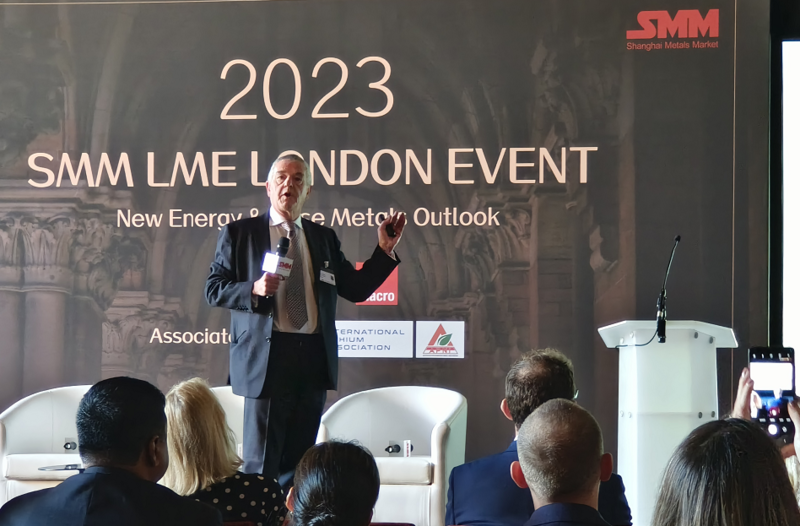
Andy Home said that a more sustainable future requires a variety of critical minerals to build the infrastructure of the green economy.
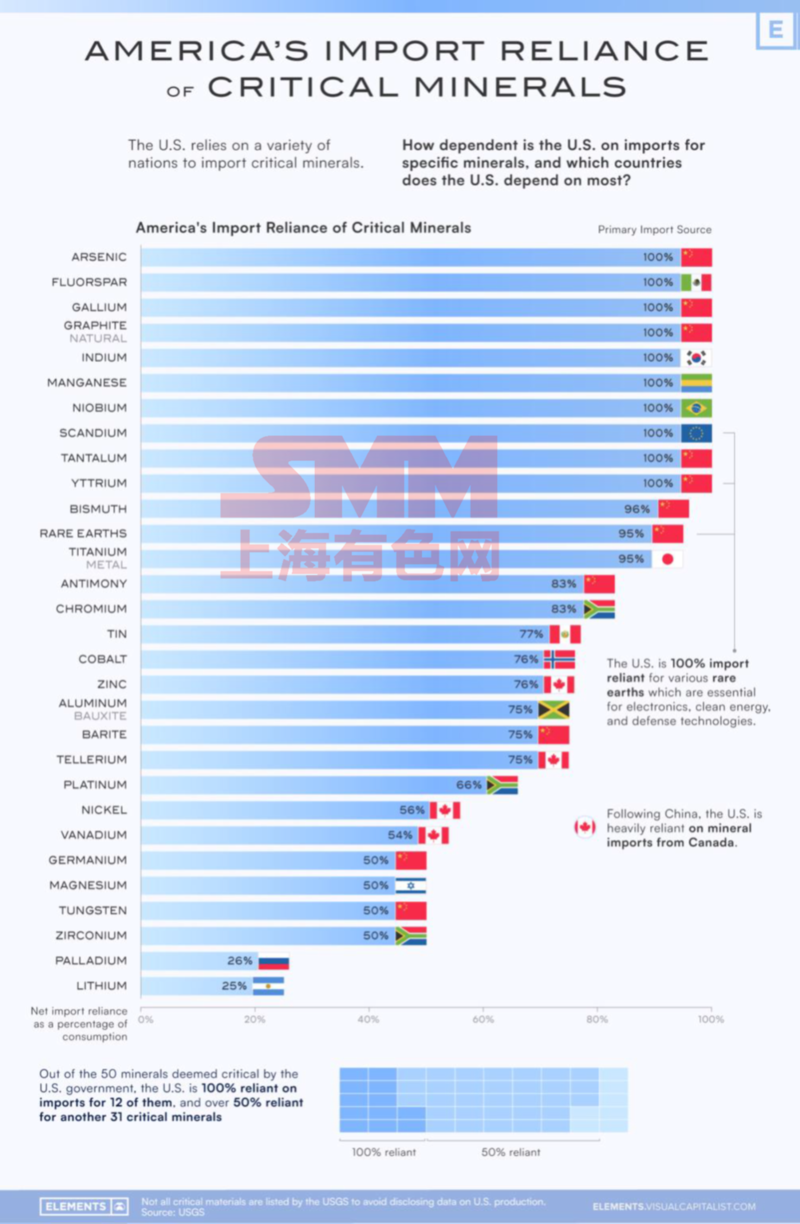
The above-mentioned minerals are on the US government’s critical minerals list. U.S. is 100% import dependent for arsenic, bismuth, fluorspar, gallium, indium, manganese, niobium, scandium, tantalum, titanium, yttrium and rare earths.
China is the dominant supplier in seven out of the top thirteen dependencies.
U.S. is over 50% import dependent for another 31 critical minerals (Visual Capitalist, Aug 2023).
Keynote Speech: China’s Metals Market Outlook after Three Years of Epidemic
Guest: Wang Yanchen, Managing Director of SMM London Office

Although economic recovery still faces challenges, the rising trend already emerges.
Uncertainty over global economic developments drives household savings to grow, but high savings can support future spending.
Auto production rose 7.4% in the first eight months of this year, with the booming of electric vehicle market in particular, supporting demand for nonferrous metals.
Investment in power generation and power grid supports base metals demand, especially demand from renewable energy sector.
Base metal prices were depressed in the first half due to weak demand, but improved after June.
The driving force for China’s copper consumption growth comes from the automotive and renewable energy industries, which require a larger import volume of copper raw materials such as copper concentrate and scrap copper.
The production of primary aluminum with low-carbon emissions is estimated to increase in the future. It is expected that China will export approximately 300,000 mt of semi-finished aluminum to the 27 EU countries in 2023. The actual export volume may be affected by the CBAM (EU Carbon Border Adjustment Mechanism).
In the future, China needs to import more zinc concentrate from other countries to meet demand.
Nickel producers can easily adjust their product mix according to market conditions, leading to more complex pricing of nickel products.
Panel Discussion: Global Commodity Trading Trends and Arbitrage Opportunities
Topics under discussion:
• Which metals possess the biggest upside potential in 2024?
• Potential trade opportunities and risks arising from geopolitical issues and rising nationalism
• Transformation of metals trading processes as emerging markets mushrooming
• New energy, new transactions, new pricing mechanisms and derivatives
Speaker:
Marcus Garvey, head of commodities strategy at Macquarie Group Limited
Natalie Scott Gray, Senior Metals Analyst, StoneX Group
Xu Yulong, Deputy General Manager of China Copper International Trading Group Co., Ltd.
Denny Xu, Head of Business Development, China, Open Mineral
Host:
William Hess, CEO, PRC Macro

Keynote speech: The impact of Chinese real estate on global metal demand
Guest: Wu Ming, Head of Metals and Commodities at PRC Macro

In theory, steel demand should collapse as housing starts and construction went down, but actual demand for steel this year has exceeded market expectations, which deserved to be explored in depth.
New driving forces: energy transformation and manufacturing upgrade
Chinese manufacturers hold a leading position in the global value chain and are capable of providing more high-value-added products. China's energy transition not only boosts infrastructure and domestic consumption but also enhances the competitiveness of Chinese manufacturers.
“Belt and Road” initiative countries boost steel demand through ODI
Robust exports consumed about 8% of steel production, largely offsetting the impact of the slowdown of real estate development.
The surge in exports to the Middle East was driven by a strong rebound in policy-supported RMB overseas direct investment (ODI).
Structural changes in China’s steel market
Manufacturing upgrades, energy transformation, and overseas demand brought changes in the structure of China’s steel market, with flat steel gaining more share.
Copper and Aluminum: Still supportive in the near term
Real estate completion will remain at positive growth least until the second quarter of 2024.
As downstream demand was driven by energy investments, manufacturing upgrades, and real estate completions, manufacturing replenishment may begin in the fourth quarter of 2023.
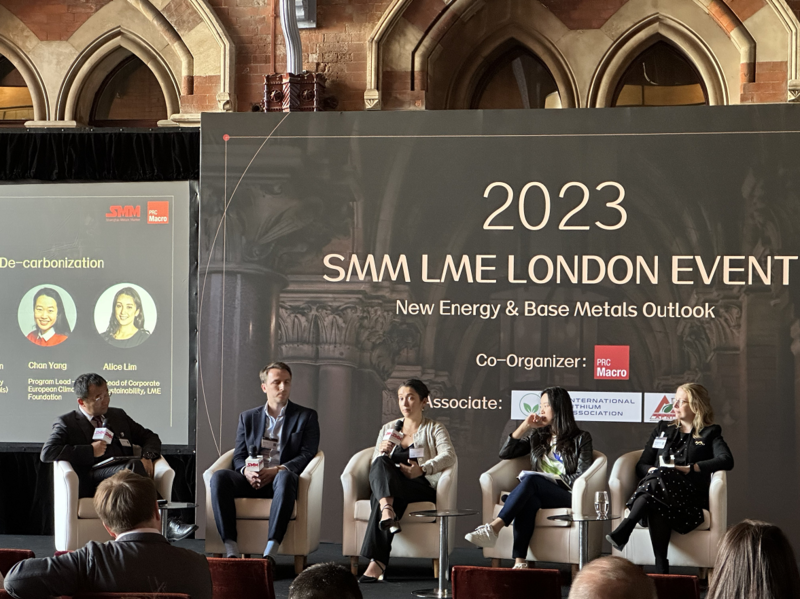
Panel discussion: Opportunities for decarbonization-driven metals
Discussion topics:
• Innovation and development of global aluminum companies in the context of carbon emission reduction
• Establishment of a low-carbon metal spot price system
• Impact of EU carbon border tax on global metals trade pattern
• China’s cases of carbon reduction practice in metal smelting
Speaker:
Sarah Macnotton, Head of Supply Chain Sustainability at Anglo American PLC (Basic Metals)
Minviro, CEO, Robert Pell
Chan Yang, Head of the Steel Program at the European Climate Foundation
Alice Lim, head of corporate sustainability at LME
Host:
Wang Yanchen, Managing Director of SMM London Office
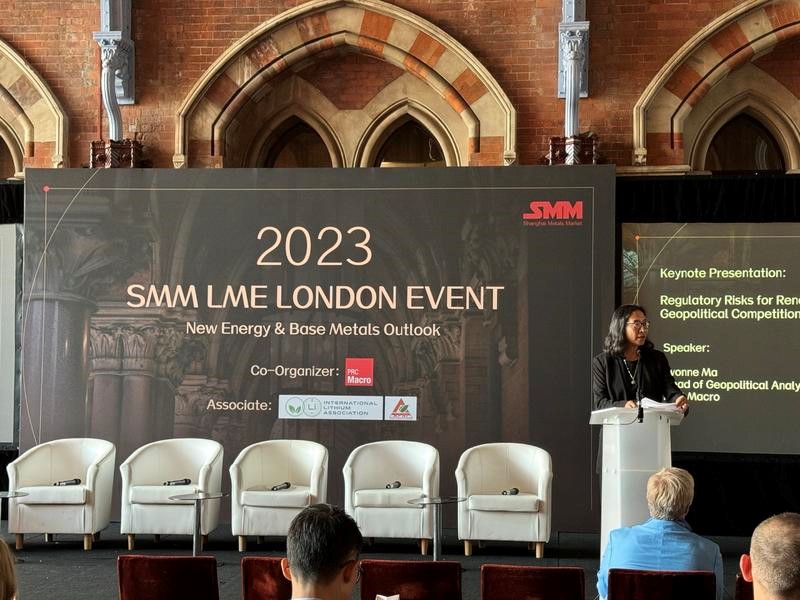
Keynote speech: Renewable energy regulatory risks under the geopolitical competition between US and China
Guest: Yvonne Ma, Head of Geopolitical Analysis, PRC Macro
Evolution of pure electric vehicle industry policies: Focus on US, EU, and China
A critical moment for pure electric vehicles
China has been far ahead (>50%) since 2016.
The EU made consistent commitments, but economic stagnation lingered as an obstacle.
US new energy vehicle sales began to rise, which is impeded by domestic infrastructure.
Penetration rate of pure electric vehicles (early 2023)
US:16
EU:20
China:33

The current state of regulatory competition in renewable energy
Regulatory Review: How Battery Electric Vehicles Developed
Climate change commitment
Government support for the development of pure electric vehicles
Laissez-faire globalization that promotes economic efficiency
Free global trade and relaxed cross-border regulations
China: Start early and fight a protracted war
Driver: Reduced dependence on oil/gas imports
Goal: Create a leap-forward industry and pure electric vehicle ecosystem
Advantages: Large economic scale and strong manufacturing foundation
Consistency of industry policies: continuous experimentation and adjustment to improve the competitiveness of the entire value chain and reduce the cost of pure electric vehicles
Keynote Speech: Global Battery Material Supply and Demand Outlook: Lithium Production Capacity Gains & NEV and ESS Demand Growth Slowdown
Guest: Zhou Zhicheng, SMM New Energy Senior Analyst

Forecast on global spodumene supply distribution in 2025
SMM predicts that by 2025, the global supply of spodumene will reach about 713,000 mt LCE, and Australia is likely to dominate the market pattern and may provide more than 50% of the lithium resource supply. Besides, with the development of production capacity in Africa and Europe, supply region concentration will decrease.
Forecast on global lepidolite supply distribution in 2025
SMM predicts that global lepidolite production will reach around 210,000 mt LCE in 2025. China still dominates supply and may provide an output of approximately 207,000 mt LCE. As for the rest of the world, some are still in the early stages of development and production and face uncertain futures in the next few years.
Forecast on Global Salt Lake Supply Distribution in 2025
SMM predicts that global salt lake production will reach about 720,000 tons LCE in 2025, with a high concentration distribution rate, mainly distributed in Chile, Argentina, China, and other places.
Global Lithium Resource Supply and Demand Forecast 2022Q1-E2024Q4
Global Lithium Resource Supply Analysis
Due to the uncertainty caused by the delay of some global lithium resource projects and the rapid expansion of lithium production capacity, SMM predicts that the oversupply of resources will gradually weaken in 2025 and will reach n a tight balance in 2026, forming certain support for the cost and price of lithium salts.
In the event that lithium mining projects fail to meet expectations, the incremental lithium resources brought about by recycling will narrow the supply gap.