SHANGHAI, Aug 24 (SMM) - Recently, many provinces in China, including Sichuan, Chongqing, Jiangsu, Hunan, and Jiangxi, have successively issued power rationing notices. As a result, many industrial enterprises have been forced to adjust production time or even reduce/cut the production. As of August 19, the estimated production losses of secondary lead smelters are listed as follows:
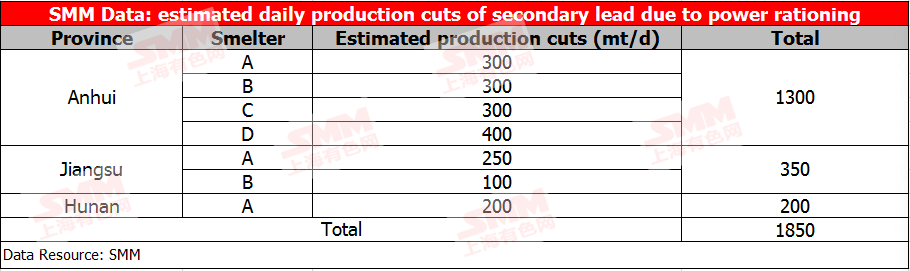
In particular, Anhui, the main producing area of secondary lead, suffered most severely. According to SMM survey, before the end of August, smelters in Anhui will have to suffer daily power outage from 12:00 at noon to 12:00 at midnight, leading to a daily output decline of 1,300 mt.
In Jiangsu, a secondary lead smelter told SMM that the power rationing lasted for three days from August 14th to 16th, and that electricity consumption exceeding 1200KWH would induce overload trip. Therefore, the daily output in Jiangsu is expected to fall 350 mt.
The situation of in Hunan is similar to that in Anhui. In Hunan, secondary lead smelters had to endure power outage from 12:00 at noon to 12:00 p.m. every day. Moreover, when the power rationing will end has not yet been determined. Considering that the number of secondary lead smelters with stable production in Hunan is small, this round of power rationing has a limited impact on the daily output, which is expected to drop by about 200 mt.
Sichuan and Chongqing were also troubled with power rationing. According to SMM survey, a lead alloy plant in Sichuan has been shut down for several days, resulting a daily decrease of 50 mt in lead ingot purchase. At the same time, many secondary lead smelters in Chongqing have already suspended the production due to technical transformation or maintenance. On the whole, the current power restriction in Sichuan and Chongqing had little impacts on secondary lead smelters. In general, many smelters across China had to halt the production for an average of 12 hours a day, and the average daily output of secondary lead is expected to decline about 1,850 mt.
Under these circumstances, how are the fundamentals of the secondary lead market?
SMM survey showed that as of August 19, the weekly average operating rate of secondary lead enterprises dropped significantly to 38.33%, down 7.67 percentage points compared with that in August 5. As a result, the supply of secondary lead tightened slightly.
Meanwhile, the inventory of secondary lead finished products stood at 34,800 mt as of August 19, down 3,100 mt from August 12. The main reason was that the secondary lead smelters in Anhui cut the production significantly due to power rationing, while at the same time, long-term orders needed to be delivered, resulting in a decrease in the finished product inventory of most secondary lead enterprises in Anhui. Although smelters in other regions of China also saw a fall in the finished product inventory, the decrease in Anhui was far more substantial.
On the consumer side, power rationing has also affected downstream lead-acid battery companies. SMM surveys show that lead-acid battery companies in Anhui and Jiangsu were mainly affected, who were required to adopt staggered production. For example, companies in Jiangsu were under power restriction from August 14th to 16th, resulting in a further decline in the weekly average operating rate. As of August 19, the weekly average operating rate of lead-acid battery producers stood at 73.31%, down 0.81 percentage point from August 5. The downstream demand was sluggish.
To sum up, the supply of secondary lead was disrupted by power rationing while the downstream consumption remained weak at the same time. Fundamentally, the secondary lead market suffered both weak supply and demand. SMM will continue to track the impact of high temperatures on the industrial chain of secondary lead. In the future, if the power rationing on secondary lead smelters is lifted first, the increase in supply may weigh on the lead prices. On the contrary, if the power rationing in Jiangsu and Zhejiang, which are major secondary lead consumption provinces, is removed first, the lead prices will be boosted.
![추석 및 국경절이 다가오면서, 2026년 납축전지 기업의 휴가 일정은 어떻게 되나요? [SMM 분석]](https://imgqn.smm.cn/usercenter/mfCMp20251217171721.jpeg)
![폐배터리 재활용 업체들의 2026년 추석·국경절 연휴 기간 휴무 일정과 매입·판매 속도는 어떨까? [SMM 분석]](https://imgqn.smm.cn/usercenter/guTSZ20251217171722.jpg)