

On April 1, market research company SNE Research recently released data on power battery shipments from January to February 2022: shipments totaled 53.5GWh, an increase of more than 100% over the previous year.
Ningde's shipments and market share were 18.4GWh and 34.4% respectively, ranking first in the list.
The battery usage of LG new energy is 7.4GWh, an increase of 37.6% over a year ago, ranking second.
BYD beat Panasonic to third with 11.9% market share
Panasonic slipped to fourth on the list with 5.8GWh and 10.8%.
SK On's battery shipments are 3.5 GWh, with a market share of 6.5%, ranking fifth.
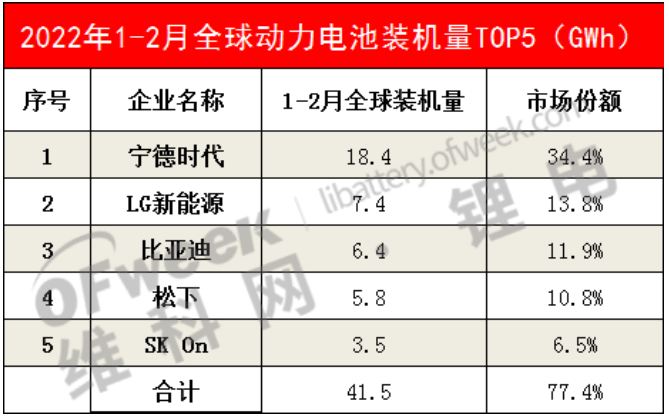
Data source: SNE, charting: Vico Lithium
As can be seen from the above picture, the market share of TOP5 enterprises has reached 77.4%, and the trend of concentration of power battery products to head enterprises is obvious.
In addition, SNE also pointed out that global electric vehicle power battery shipments were 25.9GWh in February 2022, the 20th consecutive month of growth.
Ningde era
In terms of the latest developments, Wu Kai, chief scientist of Ningde Times, revealed at the 2022th meeting that the third generation CTP battery technology, which is internally called "Kirin battery", will be launched in April.
It is reported that under the same chemical system and the same battery package size, Kirin battery power is 13% higher than that of 4680 system, and has the characteristics of extreme speed, non-destructive, safety and high efficiency, and can adapt to lithium iron phosphate and ternary lithium battery systems, with corresponding energy densities above 160Wh/kg and 250Wh/kg, respectively, continuing to lead the industry to the highest level.
In addition, Ningde Times plans to invest $5 billion to build a 80GWh plant in North America, according to Bloomberg. According to people familiar with the matter, executives of the Ningde era have flown to the United States and Mexico in March this year.
On whether to build a factory in the United States, the official reply of the Ningde era is: "the company has more interaction with American customers, including both new forces and traditional car companies, and the two sides have jointly discussed various possible supply and cooperation options. As well as the possibility of localized production, but the specific situation should take into account the impact of workers' training, efficiency, trade unions and other factors on quality and cost."
LG new energy
In terms of the latest developments, there is news in the market that on January 26 this year, LG New Energy and General Motors decided to build a third battery plant in the United States. During negotiations between the two sides, GM asked LG New Energy to hand over the relevant experimental data related to battery output directly related to stability on the grounds of "ensuring battery safety."
The market believes that this will expose the core technology of battery manufacturing and design.
In terms of production expansion plans, according to LG New Energy official news, the company and Stellantis signed an agreement on March 24th to build the first large-scale domestic electric vehicle battery manufacturing plant in Canada to meet most of Stellantis's vehicle production needs in North America. It is reported that the joint venture will invest more than C $5 billion (US $4.1 billion), and the plant is expected to start production in the first quarter of 2024, with an annual production capacity of more than 45GWh.
On the same day, it was reported that LG New Energy said it would spend nearly $1.4 billion to build a second independent electric vehicle battery plant in Arizona. The new plant will be the first plant in the United States to produce columnar batteries. Construction is scheduled to begin in the second quarter of 2022, with annual production planned for 11GWh and scheduled to start production in the second half of 2024.
LG New Energy said that, together with the latest investment plan, the company has now ensured that the annual production capacity of more than 200GWh is converted into 2.5 million high-performance electric vehicles in North America.
BYD
In January this year, BYD ranked first in the world with a sales score of 93263 new energy vehicles, significantly ahead of Tesla.
In February, BYD's sales of new energy vehicles exceeded 88000, up 75.3% from 10400 in the same period last year. From January to February, BYD's cumulative sales of new energy vehicles reached 181500, an increase of 494.28% over the same period last year.
As for battery customers, it has recently been reported that Fudi Battery, BYD's power battery business, is actively opening up the market in the new car camp, including Lailai and Xiaomi cars. Among them, "the fixed-point cooperation between Weilai and Fudi battery has been finalized before the Spring Festival, using BYD's lithium iron phosphate battery."
In terms of production expansion, BYD Xiangyang Base (30GWh) landed in January this year, with a total investment of 10 billion yuan in the first phase, and it is expected that the total investment in the third phase will exceed 18 billion yuan; in February, the construction of Changchun Base (45GWh) was officially completed; and in March, the construction of Huangpi Base in Wuhan began, with a project investment of 10 billion yuan.
Panasonic
According to the latest news, Panasonic has issued a statement announcing that it plans to invest 600 billion yen (31.1 billion yuan) in areas such as power batteries, hydrogen energy and supply chain software. Panasonic says these areas will be at the heart of its future business growth.
Panasonic said in a statement that it would invest 400 billion yen in "growth areas" including power batteries and 200 billion yen in "technical pillar areas" such as hydrogen energy in the next three years to fiscal year 2024.
In addition, at the 202200 meeting, Nan Xionggu, director and president of Panasonic Group, said that Panasonic would achieve mass production of cobalt-free batteries within 3 years. At the same time, 4680 battery will become the main force of circular battery in the future.
It is reported that since 2010, Panasonic began mass production of 1865 prototype batteries for vehicle power batteries; in 2016, Panasonic began mass production of 2170 cylindrical batteries, mainly for customers such as Tesla. Panasonic will mass produce 4680 cylindrical batteries this year after it was reported that the battery would be installed on Tesla's new Model Y model as soon as the end of March.
SK On
According to South Korean media reports, industry insiders revealed that SK On has completed the square battery equipment and production line research, the company plans to set up a trial production line within this year, and then put into mass production. Previously, SK On focused on the production of soft-package batteries.
With regard to SK On's IPO, CEO Kim Jun, vice president of parent company SK Innovation, recently said that they would not consider going public for at least the next two to three years. However, Kim Jun revealed that they will still raise money in other ways, and they will enhance the competitiveness and value of the company before going public.
In addition, SK On faces the same problem as LG New Energy, where SK On is required by Ford to share battery density-related technologies. A source from South Korea's Ministry of Industrial Resources and Trade said: "as far as I know, Ford and SK On are still engaged in a tug-of-war over technology 'sharing'."
![[SMM 분석] 두 달 만에 두 번째 중단: 시그마 리튬, 허가 다시 보류되며 증설 차질](https://imgqn.smm.cn/usercenter/ipFFo20251217171725.jpg)
![[Lake Resources의 Kachi 프로젝트, 환경 승인 획득]](https://imgqn.smm.cn/usercenter/HySQT20251217171731.png)
![[차이나 유니언 홀딩스: 캐나다 FIRES, 리튬 염수 투자 추가 심사 예정]](https://imgqn.smm.cn/usercenter/jZvMC20251217171729.jpg)
