Under the pressure of carbon neutralization, the layout of international car companies in electrification continues to increase, which is mainly manifested in that the investment objectives of international automobile companies in the field of automobile electrification are constantly revised and raised.
South Korea's Hyundai Motor announced on March 2 that it plans to invest about 95.5 trillion won ($79.21 billion) by 2030, of which about 19.4 trillion won ($16.1 billion) will be invested in electric vehicle-related businesses, accounting for about 20% of the total investment. Hyundai's investment of about $16.1 billion in electric vehicle-related businesses will include the construction of new factories, charging stations and strategic cooperation with battery companies, according to people familiar with the matter.
Hyundai aims to reach 7 per cent of the global electric vehicle market by 2030, with an annual sales target of 1.87 million. "1.87 million electric vehicles are expected to need 170GWH batteries, and Hyundai will strengthen cooperation with the world's top battery companies."
Hyundai Motor announced its 2030 strategy one day after the Stellantis Group released a long-term strategic plan called Dare Forward 2030. The Stellantis Group plans to launch more than 75 pure electric models by 2030 and sell more than 5 million pure electric vehicles worldwide.
Stellantis aims to sell all new cars in Europe by 2030; in the US, pure electric vehicles account for more than 50 per cent of new cars.
According to foreign media reports, Ford launched a restructuring plan on March 2 to split the electric vehicle and diesel locomotive business to promote the rapid growth of the electric vehicle business. According to sources, the restructured Ford will invest another $20 billion in the previously announced $30 billion electric investment to speed up the development of its electric vehicle business.
Earlier, in January this year, the Renault-Nissan-Mitsubishi Alliance released a number of joint projects and development initiatives for the future of 2030. In this "road map for common development", the Renault-Nissan-Mitsubishi alliance plans to invest 23 billion euros in electrification over the next five years and plans to launch 90 per cent of 35 new pure electric models on five pure electric platforms by 2030.
Toyota proposed in its 2030 target released in December that it planned to sell 3.5 million electric vehicles a year by 2030, compared with 2 million in Toyota's plan announced in May of that year. this means that its sales target is 75 per cent higher than the original plan.
Driven by the pressure of carbon emission reduction and changes in the automotive industry, since 2020, many mainstream international auto companies, including Tesla, Volkswagen, BMW, Toyota, Honda, General Motors, and so on, have released electrified investment layouts, the scale of which has exceeded 370 billion US dollars, and a number of auto companies have been updating their electrified investment targets and promotion speed.
Investment plans in the field of electric intelligence for some global automobile companies
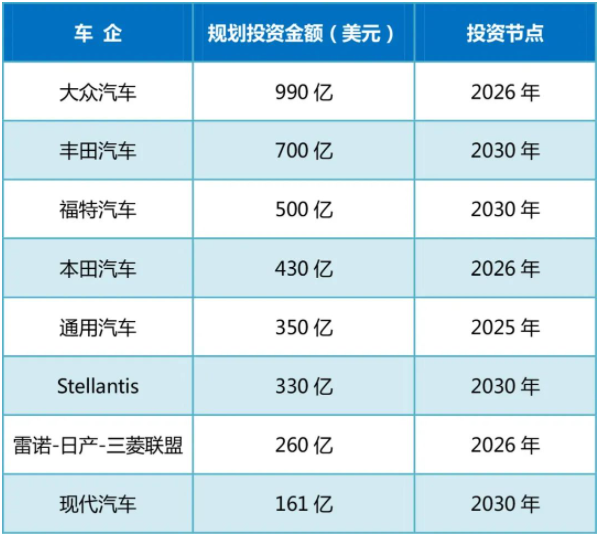
Car companies' adjustment of the promotion target of electric vehicles is also stimulating the growing demand for power batteries and the substantial expansion of production capacity.
Taking the electric vehicle sales target of the above-mentioned several car companies as an example, Hyundai's demand for power battery will reach 170G. Stellantis Group will increase its battery demand from the original planned 140GWh to 400GWh.Ford is also stepping up cooperation with battery companies to build battery joint ventures to increase power battery production capacity. GM announced plans to build two more large power battery plants earlier this year in conjunction with LG New Energy; the Renault-Nissan-Mitsubishi alliance expects to form 220GWh battery production capacity worldwide by 2030.
After Volkswagen announced its comprehensive electrification strategy last year, it also raised its target for power battery demand in Europe, hoping to build six large battery factories in Europe by 2030, with a battery capacity of 240GWh. if you include its layout in Asia, North America and other regions, battery demand is expected to more than double.
A more obvious phenomenon is that since 2020, with the gradual improvement of the permeability of electric vehicles and the maturity of battery technology, under the pressure of carbon emission reduction, mainstream car companies at home and abroad have become more and more "bold" in their goal of electrification. At the same time, the promotion speed of electrification is also accelerating. In turn, the demand for batteries is constantly changing. Last year, Volkswagen, General Motors, Toyota and other car companies have revised their electrification goals; this year, Hyundai, Stellantis and Ford have also made similar moves, and it is believed that there will be many similar actions in the future.
With the rapid promotion of the electrification strategy of the global mainstream automobile enterprises, it will have an impact on the development of the power battery industry in many aspects in the future.
First, the certainty of power battery demand is high, and the electrification of automobile enterprises will gradually absorb the production capacity of battery enterprises.
Data from Minmetals Securities show that according to incomplete statistics, the planned lithium battery capacity of global battery companies will reach 4725GWH by 2025, among which Chinese companies alone will reach 3900GWh. This capacity includes automotive power batteries, energy storage batteries and so on. Among them, power batteries are expected to account for more than 70% of the capacity.
Previously, the industry worried that this scale of capacity planning would lead to a new round of overcapacity. However, from the perspective of the global automotive electrification speed, this worry may be eliminated, Volkswagen, GM, Stellantis, Hyundai, Toyota and other car companies have adjusted the proportion and target of electric vehicle sales, driving the demand for power batteries is expected to increase significantly.
If you look at the market, the penetration rate of new energy vehicles in the Chinese market has exceeded 10% in 2021, with sales reaching 3.52 million units. This year, the industry is generally expected to sell more than 5.5 million vehicles, and there is even an optimistic forecast that it will exceed 6 million vehicles, and the penetration rate may exceed 20% ahead of schedule.
At the same time, considering the influence of many factors, such as battery base construction, capacity climbing and so on, the global supply and demand of automobile power battery will remain optimistic in 2025.
Second, the global layout of power batteries still needs to be speeded up, and the global battery capacity demand of international car companies is obvious.
The vehicle manufacturing of international automobile companies generally has the characteristics of globalization, and the large-scale manufacture of electric models in the future also needs more nearby battery supporting capacity. For example, Stellantis Group said that by 2030, the European market will account for about 250GWH in the 400GWh capacity demand, and the North American market will account for 150GWh.Volkswagen will also have 240GWH battery demand in the European market, as well as considerable demand in Asia and the United States; GM, Ford, Toyota, Hyundai's vehicle production bases in the United States, Europe and China also need suppliers with global layout capacity.
Overseas battery companies such as LG New Energy, Panasonic Battery, SK on and Samsung SDI have all made global capacity layouts and are the first to win cooperative orders from a number of international car companies.
Up to now, domestic battery companies such as Ningde era, Honeycomb Energy, Funeng Technology, and Vision Power have all made capacity layouts overseas. With the acceleration of electrification of global car companies, it is expected that domestic battery companies will go out next. And seek to build large power battery bases in more areas.
Third, the mainstream automobile enterprises join with the core battery suppliers, and the era of battery standardization will come quickly.
From the point of view of reducing manufacturing costs, improving safety and reliability, with the accelerated entry of international mainstream automobile companies, batteries will gradually tend to "standardization", which requires the joint promotion of automobile companies and battery enterprises.
Last year, Volkswagen launched a "standard cell" on its "Power Day". According to Volkswagen's plan, the battery will cover 80 per cent of its models in the future and is compatible with a variety of battery materials, reducing its manufacturing costs by about 50 per cent. Hyundai also said that in the future, the battery system of its electric vehicle platform will change the current battery-module battery process to battery-packaging process in accordance with the standardized design, in order to improve the battery energy density and reduce the cost. In addition, GM and LG New Energy jointly developed Ultium battery system, which will cover most GM models in the future.
In terms of manufacturing efficiency, manufacturing cost and large-scale production, the standardization trend of power battery will accelerate in the next few years. Battery companies that take the lead in battery standardization development in cooperation with car companies are expected to enjoy the first wave of dividends, and even have a greater impact on the industry pattern.
It should be pointed out that battery standardization will be dominated by different car companies in the future, or will produce different "standards", not the same standard. However, this standard will gradually replace most of the current specifications, and several standards will coexist.
In addition, with the acceleration of the electrification of mainstream automobile companies, based on the considerations of safety, cost reduction, supply protection and carbon reduction, the investment and layout of the entire battery industry value chain in the future are expected to be the focus of automobile and battery enterprises.