

SHANGHAI, Feb 10 (SMM) -
Tsingshan’s high-grade nickel matte project calls for new pricing scheme
In March 2021, the nickel and stainless steel futures contracts’ hitting the limit down and Tsingshan Group's announcement of successful conversion from high-grade NPI into high-grade nickel matte caused a sensation in the market. There were intense discussions in the market about the process of converting high-grade NPI into high-grade nickel matte and its cost efficiency. SMM has taken a deep dive into the driving forces and future development of the transformation project in terms of the technological feasibility, the cost efficiency of raw materials, the pricing power of the nickel industry chain, as well as the industrial strategy.
Process
The process of producing high-grade nickel matte from laterite nickel ore is not a new process. Previously, smelting enterprises have used this process to produce high-grade nickel matte. However, Sorowako, a smelter owned by Vale in Indonesia, is currently the only company that is still using this process to produce high-grade nickel matte.

- Process introduction: Laterite nickel ore - drying - crushing and screening - adding sulphur-containing materials (pyrite, gypsum) - blast furnace blowing at 1500-1600℃ (or electric furnace smelting) - low-grade nickel matte - converter blowing - high-grade nickel matte
- Analysis of advantages and disadvantages: This production process is simple, and features low investment, easy operations, and maturity in technology development, and the high-grade nickel matte produced through this process can be processed further into various forms of nickel products. However, the nickel recovery rate is just 70%, which is relatively low, and this process requires high energy consumption and causes heavy pollution.
Tsingshan’s high-grade nickel matte process is developed based on the RKEF high-grade NPI, and the production process is as follows.
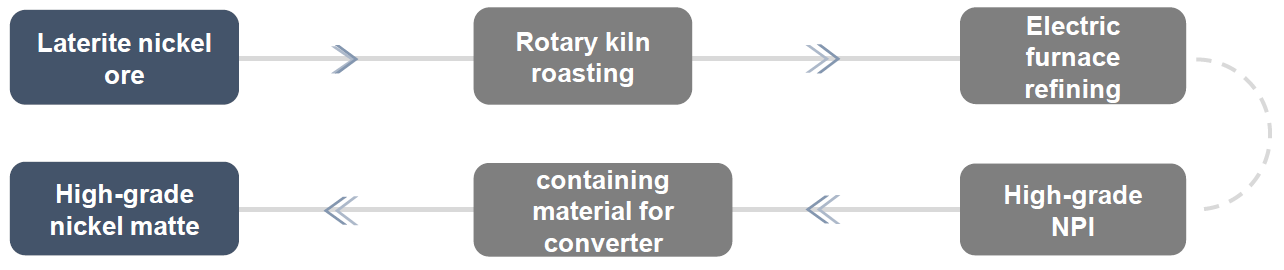
- Process introduction: Laterite nickel ore - RKEF process - high-grade NPI - adding sulphur-containing material for converter blowing - high-grade nickel matte
- Analysis of advantages and disadvantages: Low investment cost, short construction period, low requirement of raw materials, and high production flexibility. However, the energy consumption is high, and it is difficult to recover the iron element, which is a large waste of resources.
Cost efficiency
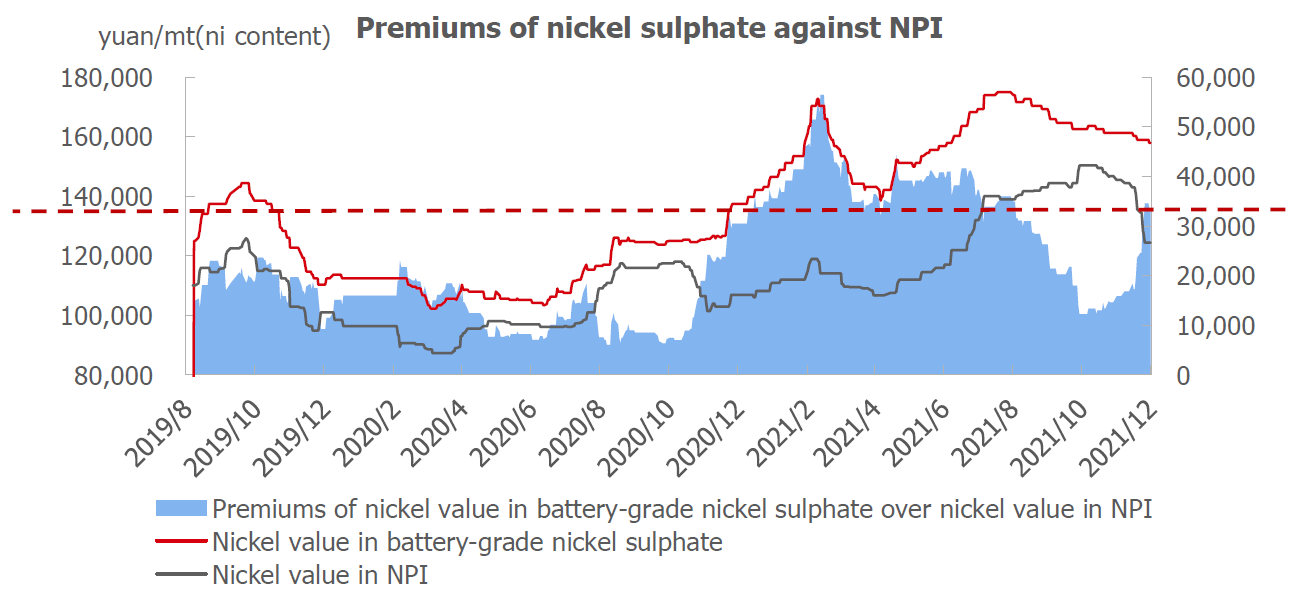
SMM data showed that the full costs of high-grade NPI in the PT Indonesia Morowali Industrial Park was about $9,000/mt (Ni content), based on the benchmark prices of Ni1.8% nickel ore in the Indonesian market in February 2021, which stood at $41/wmt FOB. The costs of converting NPI into high-grade nickel matte was at least $1,000/mt (Ni content), and the costs of producing nickel sulphate from high-grade nickel matte was about $4,000/mt (Ni content). The costs of producing nickel sulphate using this new process were $14,000/mt (Ni content), which were equivalent to 22,600 yuan/mt. The market prices of nickel sulphate were 38,000 yuan/mt when Tsingshan announced this new production process, thus it was profitable to shift to the new process by then.
The full production costs of Vale’s high-grade nickel matte project in Indonesia was $12,000/mt (Ni content) in March 2021. If the high-grade nickel matte is used to produce nickel sulphate that flows to China, the cost of nickel sulphate should be 24,200 yuan/mt. Without considering the premiums of intermediate products, the costs of nickel sulphate using MHP from Ramu project were 20,000 yuan/mt in March 2021. Therefore, it was not cost effective to produce nickel sulphate using this new process in March 2021 based on the nickel prices at that time. The chart below shows when it is profitable to switch to the production of nickel sulphate using the new process.
Pricing power
Pricing power means that the company has the power to set the prices of its products. If the changes in product pricing will not have a negative impact on the demand, the company who possess the pricing power can smoothly pass the additional costs to the downstream through price hikes when the costs are rising and its sales are not affected.
The costs calculated by SMM are the theoretical costs. In the actual business negotiations, supply and demand are the key to pricing. As nickel sulphate in the spot market was in short supply earlier, precursor producers had to accept expensive raw materials. However, the use of high-grade nickel matte as a raw material broke the original demand-supply pattern. If the mass production of high-grade nickel matte leads to an oversupply of raw materials, the pricing power will return to precursor producers, who are users of nickel sulphate. Therefore, the demand for pure nickel from the NEV market may not be as strong as previously expected.
If nickel prices correct down from the excessively high level, the prices of nickel briquette, which have been at high premiums over nickel price, will fall as well. Without consideration of the support created by the stainless steel sector’s demand for Indonesia NPI, nickel briquette can regain its share in nickel sulphate raw materials only when its prices fall below the costs of high-grade nickel matte in Indonesia. SMM regards the costs of nickel sulphate using NPI as the theoretical bottom of nickel prices and takes the estimated costs of Vale's nickel sulphate using high-grade nickel matte as the actual bottom of nickel prices. (The price difference between the theoretical bottom and the actual bottom reflects the cost control of Tsingshan’s NPI-nickel sulphate project. The costs below are calculated based on the market prices in March 2021 when Tsingshan announced the news.
The theoretical bottom of nickel prices: 22,600/22% - 3000 = 99,727 yuan/mt
The actual bottom of nickel prices: 24,200/22% - 3,000 = 107,000 yuan/mt
The prices of nickel may bottom out if it fall below 107,000 yuan/mt. The premiums of nickel briquette will rebound after its inventory is digested, which will push the prices of nickel up until nickel briquette loses its cost efficiency as a raw material for nickel sulphate.
If the nickel prices stand above 107,000 yuan/mt, companies will be incentivised to produce nickel sulphate using high-grade nickel matte instead of nickel briquette, thus weighing on nickel prices. However, when the use of high-grade nickel matte is expanded, the demand and prices of nickel ore will rise as well. The resultant increase in nickel ore costs will push up the prices of high-grade nickel matte, thus triggering the substitution of nickel briquette for high-grade nickel matte.
However, in reality, people who have run the tests of the new process told SMM that it is necessary to consider the costs of building converters in real commissioning and sales. Another issue is the low recovery rate of the process. At present, many nickel sulphate plants do not have the production lines that convert high-grade nickel matte into nickel sulphate, and it takes at least half a year for them to build such production lines. Following Tsingshan’s announcement of the new process, the premiums of nickel briquette over NPI began to narrow, thus giving other companies little incentive to build high-grade nickel matte projects.
SMM believes that the new process represents much greater strategic significance in the long run than the short-term project significance brought about by the high premiums of nickel sulphate over NPI. As an international nickel and stainless steel industry giant, Tsingshan Group has invested massively in entities located in resource-rich Indonesia. If the NPI-stainless steel and nickel briquette-new energy industry chains are not integrated, the increase in investment in Indonesia will be subject to the growth rate of stainless steel demand. The successful conversion of NPI into nickel sulphate will not only alleviate the problem of excess stainless steel raw materials, but also facilitate Tsingshan’s entry into the rapidly growing NEV market. Therefore, when negotiating delivery with downstream buyers, it is a good deal in the long run even if the profits are lost due to the incapability of efficient cost control.
Although the project is still under construction, it is also a good deal for precursor companies that sign the purchase contract. Firstly, from the perspective of new energy power batteries, the purpose of the high-nickel trend is to reduce the costs and increase the efficiency after reducing the use of cobalt to zero. When compared with other alternative raw materials, the disadvantages of high-nickel ternary batteries, except for the high price, can be removed through technology innovation. In the case of a structural contradiction between supply and demand, car makers, who have the pricing power, and mines, who own the resources, will constantly squeeze the profit margins of precursor plants. Therefore, it is an inevitable trend for precursor plants to gain access to high-grade nickel matte so as to re-shape the raw material market. In the futures market, precursor plants can also take hedging strategies through nickel futures contracts to manage raw materials prices.
A growing number of companies began to build high-grade nickel matte projects
In the short term, the cost efficiency of high-grade nickel matte projects may be lower than expected. However, with the expansion of NPI production in Indonesia and the innovation of high-grade nickel matte process (PT.ZhongTsing New Energy's converter side blowing process), more and more companies have invested in high-grade nickel matte projects. The table below is a summary of high-grade nickel matte projects that may be commissioned over the next few years.

The new high-grade nickel matte projects that have been announced so far have a combined capacity of 294,000 mt in nickel content, which are likely to be put into operation over the next four years. More projects may be announced in the future. Some of the new projects are through the conversion of NPI, while some will adopt new process. As Indonesia may raise its threshold for the investment and construction of power plants in the future, the technology of PT.ZhongTsing New Energy may be adopted by many other new projects. If NPI is not used to produce high-grade nickel matte, the correlation between the two nickel industry chains (1. NPI - stainless steel; 2. Nickel briquette - new energy) will weaken again.
Global nickel demand-supply balance and price forecast 2015-2025E
In 2020, nickel prices followed the broad trend of commodities. The nickel prices experienced the negative impact of the COVID-19 pandemic and the subsequent recovery from the pandemic, followed by the unexpected prosperity in the third quarter, and traded at highs in the fourth quarter.
The fundamentals of the nickel market were relatively positive in 2021. The supply of nickel pig iron (NPI) tightened after Indonesia banned the export of nickel ore. The output of China's 300-series stainless steel continued to increase slightly and beat expectations. Although the global primary nickel market was in a surplus, this did not become the focus of market attention. The overseas fundamentals deteriorated severely due to the pandemic. The upward trend of metal prices was mainly driven by the loosening monetary policies in many countries around the world and a weaker US dollar index. In contrast, as the only major economy that is expected to achieve positive GDP growth in 2020, the consumption in China was not bad, which kept nickel prices firm. The downstream consumption of pure nickel was somehow evenly contributed by stainless steel, alloy, electroplating and battery sectors. High nickel prices were underpinned by the rigid demand.
In theory, the fluctuation of NPI prices does not directly affect the prices of pure nickel. However, due to the strong demand for stainless steel, which is the downstream sector of NPI, the consumption of primary nickel showed significant growth as well. Therefore, the NPI-stainless steel industry chain remained as a major contributor to the sound performance of nickel prices in 2021. In 2022, the new energy market will maintain a high growth rate, and the overseas inventories will drop to a low level. The supply of pure nickel will still be tight, and the surplus may be reflected in grade-two nickel and nickel salt.
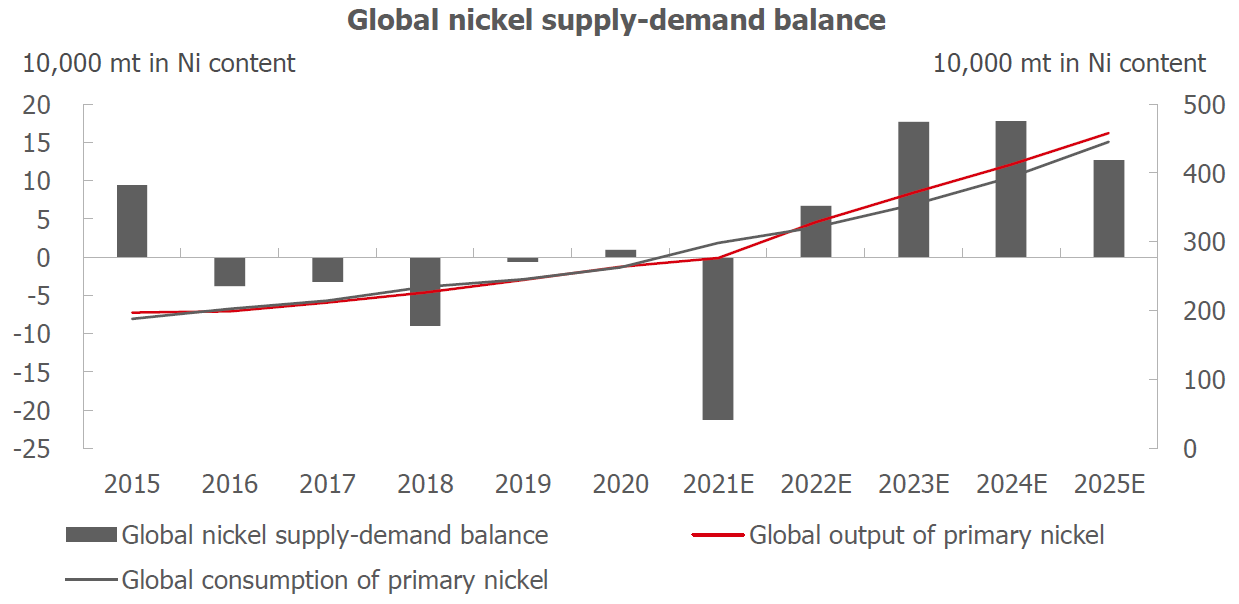
In 2021, the global primary nickel consumption is estimated at 2.98 million mt, a year-on-year growth rate of 13.5%, and growth rate of supply is estimated at 5.1%. The overseas demand was severely hit by the pandemic, but is expected to recover in 2022. The global primary nickel is expected to see a supply deficit of 212,000 mt in 2021. The deficit was caused by the rapid expansion of new energy market, the insufficient supply of raw materials for primary nickel, and the higher-than-expected production of stainless steel in China and overseas, which boosted the demand for nickel. In addition, the production and commissioning of overseas nickel smelters fell short of expectations due to the pandemic.
In 2022, SMM predicts that Indonesia’s NPI production will increase from 885,000 mt to 1.169 million mt, making up for the slight reduction in NPI production in China. In addition, Indonesia’s local stainless steel capacity is also expanding, which will partly digest the higher output. Although the hydrometallurgy projects in Indonesia are proceeding smoothly, it is still unable to meet the downstream demand in 2022.
Under the background of expected recovery of the global economy from the pandemic, positive nickel fundamentals in China, and the cost support of nickel ore for domestic NPI, SMM expects LME nickel to move between $17,000-23,000/mt in 2022.
To access full SMM China Nickel Industry Chain Annual Report 2021-2025, please contact Michael Jiang at michaeljiang@smm.cn or T: +86-21-51666812 |M:+86-1522-1415-920.

![[SMM 니켈 플래시] 극심한 가뭄으로 Nickel Industries의 ENC HPAL 프로젝트 증산 차질](https://imgqn.smm.cn/usercenter/sKmGT20251217171733.jpg)