"SMM South China Annual meeting | an in-depth Analysis of the Global economy, Copper, Aluminum and Zinc fundamentals and Price trend in 2022

SMM12: at the annual meeting of the 2021SMM South China Nonferrous Metals Industry, Chen Xinzhi, group vice president of Foshan Nanhai Yucheng Metal Investment Co., Ltd., shared whether the shortage of recycled copper supply under the weakening elasticity of stock supply could break the situation. He pointed out that the short-term supply of recycled copper continued to be tight. In the long term, the epidemic will be further brought under control, the US infrastructure will be restarted and household appliances will be upgraded, and the global copper supply will accelerate, and the average annual copper regeneration will reach 35-400000 tons after 2022.
Influence split of China's recycled Copper Industry in 2022
The influence of New Policy on recycled Copper Industry
The new solid waste Law was revised twice in 1995 and implemented on September 1, 2020, which improved the system of prevention and control of environmental pollution by industrial solid waste. Implement strict legal liability, and clarify the extension of producer responsibility system, improve the responsibility of producers to bear the benefits of resources and environment, and increase the proportion of production enterprises in the use of recycled raw materials.
The waste metal recycling industry is included in the current "National Economic Industry Classification", "Strategic emerging Industry Classification (2018)" and "Green Industry guidance Catalog (2019 Edition)". However, the names of categories involving recycled metals in the three catalogs are inconsistent. There is confusion in the classification of the recycled metal industry by local governments and enterprises, so that many projects can only choose "32 non-ferrous metal smelting and Calendering processing industry", which is regarded as an unreasonable phenomenon of "two highs". It seriously restricts the construction of new construction, reconstruction and expansion projects in the recycled metal industry.
The tax burden of recycled non-ferrous metal enterprises is too heavy, only 50% of them can get the full amount of deduction invoices, and the enterprises that purchase raw materials from small-scale taxpayers account for a relatively high proportion. This makes the recycled non-ferrous metal industry to avoid the risk of raw material supply chain pressure, industrial cost.
The "carbon Dafeng Action Plan before 2030" proposes to speed up the development of recycled non-ferrous metal industry, improve the recovery, sorting and processing network of waste non-ferrous metal resources, increase the output of recycled metals, and implement and improve preferential tax policies such as comprehensive utilization of resources. Promote the enthusiasm of enterprises in R & D and use of advanced technology, and effectively enhance the motivation of resource recycling.
The policy of "double control" of energy consumption spread to the recycled copper industry.
First, since the outbreak of novel coronavirus, copper mining has been greatly reduced. Goldman Sachs predicts that the growth of global mineral supply will slow in the second half of this year and is not expected to pick up until the second half of 2022. However, with the increase of energy consumption "double control" policy, power restriction and emission reduction, which requires deep decarbonization of electricity, the cost of copper materials continues to rise, leading to a shortage of raw materials in the regenerated copper market.
Second, supply and demand continue to be weak, and prices fluctuate in a wide range, causing great cost pressure on enterprises downstream of the copper industry chain. China, as the largest country in refined copper production and marketing, lacks adequate copper resources and relies on foreign imports for 60% of its raw materials. in recent years, the import policy of recycled copper has become stricter and tighter, affecting the copper concentrate processing fees and the price gap of fine waste to a certain extent, further promoting recycled copper to become an important source of copper output gap in minerals.
Third, the "carbon Dafeng Action Plan before 2030" to promote the non-ferrous metal industry Cundafeng put forward: speed up the development of recycled non-ferrous metal industry, improve the development of waste non-ferrous metal industry, and improve the recovery, sorting and processing network of waste non-ferrous metal resources. increase the output of recycled non-ferrous metals; the 14th five-year Circular economy Development Plan estimates that the output of recycled non-ferrous metals will reach 20 million tons by 2025, including 4 million tons of recycled copper.
International environmental impact on recycled copper industry
Economic side: overseas manufacturing PMI affected by the epidemic has declined slightly, economic development has slowed down, but relative to the domestic is still in a period of expansion. Since October, domestic PMI has fallen below the line of rise and fall for two consecutive months, economic data shows a downward trend, and policy benefits need to be transmitted continuously. At present, the dislocation of economic cycles at home and abroad may bring new opportunities for investment.
Supply side: the COVID-19 epidemic has had a great impact on global copper supply and demand since 2020. According to ICSG data, global copper production fell 1.8 percent in 2020 compared with the same period last year, and global copper production in 2020 was 20 million tons, down 1.8 percent from 2019. The annual copper supply gap is as high as 1.391 million tons. The epidemic in 2021 and stopped at the end of the year due to vaccine and other problems, the epidemic in Europe, the United States and South America could not be controlled, restraining industrial activities, and will continue to affect copper supply in the future and accelerate the development of recycled copper industry.
On the import side: the stability of the Western regime has declined sharply, the dispute between China and the United States has become normalized, global economic growth has been suppressed, affecting the layout of the recycled copper industry chain, and both ends of supply and demand continue to face the impact of "high disturbance".
Market Analysis of recycled Copper Raw Materials in China
This year, under the influence of repeated novel coronavirus epidemic, declining economic growth, geopolitical confrontation, processing overcapacity, high commodity prices, lack of innovative technology, and under the policy and favorable transmission of the country's "double carbon" strategic vision goal, the output of recycled copper in China has increased steadily.
In 2020, although affected by the epidemic, the output of recycled copper still reached 3.25 million tons, accounting for 32.4% of the copper supply, and the output was stable in 2021 and is expected to be 3.42 million tons.
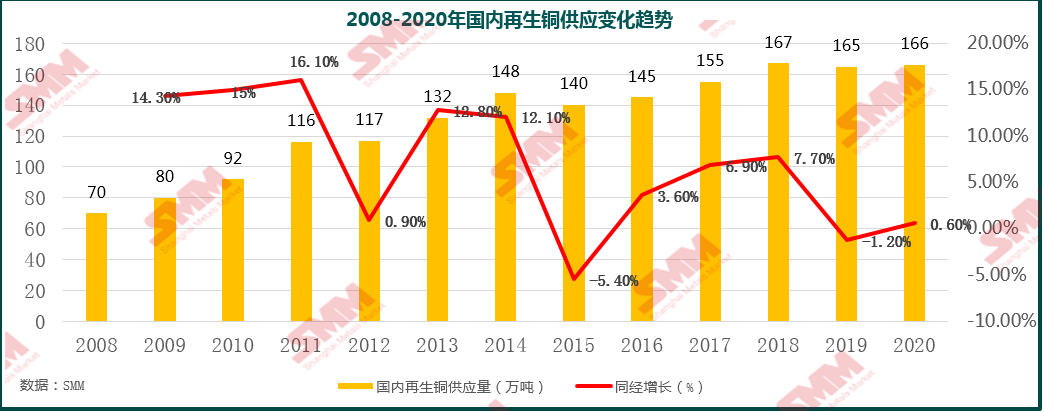
The supply of domestic raw materials has increased steadily, and imported raw materials have gradually recovered: the national thermal coal power, electronics, construction, transportation, home appliances and other industries have been restricted, and waste disposal and disassembly projects have been reduced. coupled with the fact that the epidemic has restricted exports from European and American countries and scrap copper dismantling activities in Southeast Asia such as Malaysia, the domestic supply of recycled copper raw materials has increased in volatility from 2008 to 2020. In 2020, the supply of recycled copper in China was about 1.66 million tons, an increase of 0.6 percent over the same period last year.
According to (ICSG), an international copper research group, China is a big user of recycled copper. The annual consumption of recycled copper accounts for about 30 per cent of the world, and the global output of recycled copper in 2021 is about 3.953 million tons. With the high consumption of China's Electroweb and household appliances and the exuberant foreign real estate industry, the sales volume of refined copper is expected to increase slightly in 2021, reaching 24.821 million tons.
The development of the environmental protection industry has spawned the development of recycling of renewable resources. In 2020, the amount of recycled copper recovered in China was 2.23 million tons, an increase of 3.7 percent over the same period last year, accounting for about 67 percent of the supply of recycled copper raw materials.
The domestic recycling market of recycled copper raw materials is still in an extensive and disorderly state, the recycling enterprises are mainly small and medium-sized enterprises, and the fine sorting ability is insufficient, so it is difficult to meet the needs of the processing end enterprises for the scale and quality of raw materials. The standardization of industrial raw materials and transactions can effectively enhance the hierarchical utilization and high-value utilization of resources.
In recent years, scrap copper from China has shown an increasing trend, the concentration of recycled copper smelting industry has gradually increased, and recycled copper industry clusters have been gradually formed in the Pearl River Delta, Yangtze River Delta and Bohai Economic Circle, and a number of domestic recycling markets have been established. Under the background of the increasing waste of copper newspaper in China, the self-sufficiency rate of recycled copper in China will be further improved in the future.
Investment enthusiasm in the recycled metal industry is high, and many large domestic groups have upgraded the development of recycled copper, aluminum, lead and zinc to the overall strategic level of planning. According to incomplete statistics, in 2021, more than 30 recycled non-ferrous metal projects are under construction or newly built nationwide, with a production capacity of about 6.2 million tons, of which the production capacity of recycled copper is about 470000 tons.
Analysis on Import sources of recycled Copper Raw Materials in China
With the implementation of the two national standards of "recycled copper raw materials" and "recycled brass raw materials" in 2021, the relevant work flow has been gradually improved, and the import of recycled copper has increased significantly compared with the same period last year.
Customs deployment data show that from January to September, China imported a total of 1.234 million tons of recycled copper, an increase of about 85.2 percent over the same period last year, and the import volume for the whole year is expected to reach 1.65 million tons.
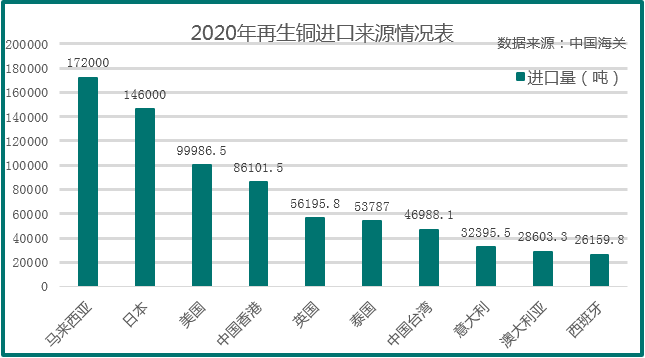
In 2020, Malaysia became the largest source of scrap copper imports in China, accounting for 17.46%, or about 167.1 kilotons. Due to the re-export trade of recycled copper, Hong Kong, China and Taiwan also have a large trade volume of recycled copper with the mainland. Coupled with the supply of Japan and South Korea, Thailand and Vietnam, Asia is the main region of China's scrap copper import trade, accounting for 59.44%.
Asia is the main region for China's scrap copper import trade, accounting for 59.44%. Europe accounts for 21.93% of China's scrap copper import trade, 13.16% in North America, 3.53% in Oceania, 1.17% in South America, and only 1.17 in Africa, which is basically exported by South Africa.
After the implementation of document No. 43 of the General Administration of Customs, there are great differences in raw material standards for imported recycled copper and local customs law enforcement inspection standards, resulting in return and detention of cabinets from time to time, increasing the financial pressure on enterprises.
Customs clearance time extension: imported raw materials are affected by overseas epidemic situation, shipping date, container shortage, containers need to be repeatedly disinfected, experimental inspection and other procedures to extend the customs clearance time.
Limited cooperation and customs clearance: the advantages of sea-rail linkage transportation are insufficient, and the aggregate tax quota is limited, resulting in an increase in operating costs and risks of enterprises.
Morphological Analysis of imported Raw Materials of recycled Copper in China
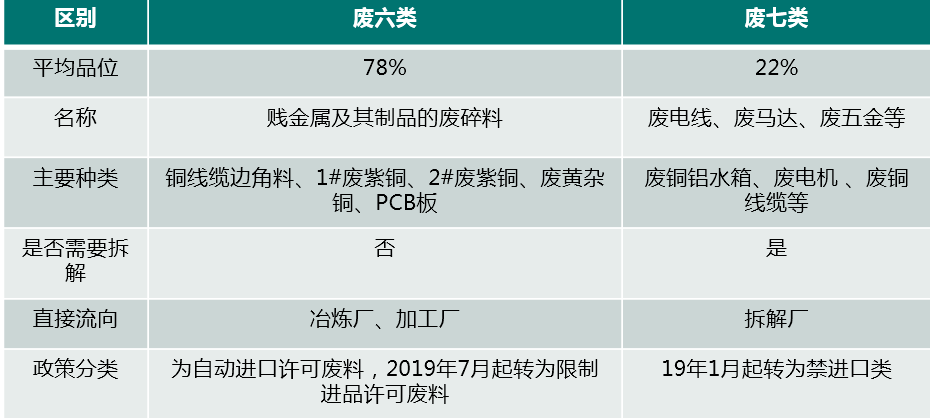
The customs codes of imported solid wastes are divided into ten categories, corresponding to different types of solid waste, including waste paper, waste plastics, waste hardware, etc., among which "seven categories" (7404000010) and "six categories" (7404000090) contain copper metal scrap. The import of "waste seven categories" has been banned from January 1, 2019.
Ban on the import of non-standard products: bright wire, copper, copper, brass, etc., in the form of scrap copper scrap, the average copper content can reach 78%
It is forbidden to import non-standard products: waste cables, waste motors, waste transformers and waste hardware, etc., whose metal copper content is about 22%.
The recycled copper (brass) raw materials that meet the standard can essentially be understood as six types of waste copper with higher copper content and cleaner copper content, which have higher requirements for copper content, inclusion and water yield.
Prospect of China's recycled Copper Raw material Market in the Future
Policy vision to promote the use of recycled copper
The outline of the country's 14th five-year Plan puts forward "speeding up the construction of a new development pattern with the domestic great cycle as the main body and the domestic and international double cycles promote each other". Recycled non-ferrous metals are closely linked with the national economic basic industry, which plays an important role in promoting the concept of circular economy, and will help to realize the brand-new development pattern of domestic great cycle and domestic and international double cycle.
The guidance on speeding up the establishment and improvement of a green and low-carbon circular development economic system encourages local governments to establish regional trading centers for renewable resources. Speed up the construction of a recycling system of waste materials.
The "carbon Dafeng Action Plan before 2030" proposes to speed up the development of recycled non-ferrous metal industry, improve the recovery, sorting and processing network of waste non-ferrous metal resources, and increase the output of non-ferrous metals.
According to the 14th five-year Plan for the Development of Circular economy, by 2025, the output of recycled metals will reach 20 million tons, of which 4 million tons will be recycled copper; in 2030, the output of recycled non-ferrous metals will reach 28 million tons, and the output of recycled copper is expected to reach 8 million tons.
The output of recycled copper has increased greatly, which has become an important source to supplement the output gap of mineral copper, contribute to the reduction of carbon emissions, and help our country to achieve carbon neutralization and carbon peak in 2030. The carbon reduction of recycled non-ferrous metals will be 146.85 million tons in 2025 and 221.97 million in 2030.
The release of overseas recycled copper and other scrap metals will face a release period in the next decade, and the use of cold materials in copper smelting raw materials will increase significantly in 2021. According to the statistics of the Mysteel copper mining team, the domestic output of recycled copper (refined copper) from January to October is 960000 tons, accounting for 11.7% of copper production, further illustrating the increase in the use of crude copper / anode plates. The difference of fine waste will continue in 2021, and the increment of recycled copper rod will increase significantly.
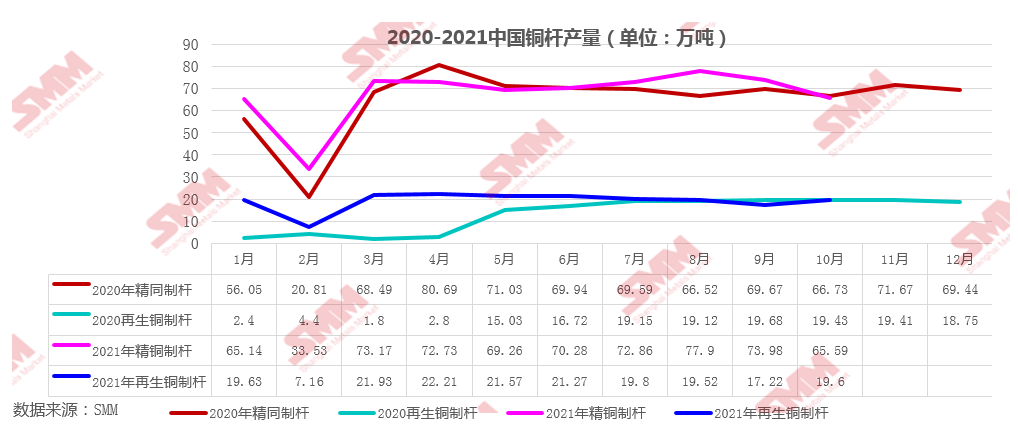
Macro analysis: macro disturbance factors are still strong, limiting the upward space of copper prices, but there are still positive fundamentals, which play a supporting role in prices, making the overall copper prices in a volatile pattern.
Supply analysis: short-term recycled copper supply continues to be tight. In the long term, the epidemic will be further brought under control, the US infrastructure will be restarted and household appliances will be upgraded, and the global copper supply will accelerate, and the average annual copper regeneration will reach 35-400000 tons after 2022.
Demand analysis: the price difference of fine waste continues, and the use of scrap copper in the production of recycled copper rod increases. With the low inventory of electrolytic copper, the supply of recycled copper adjusts the balance between supply and demand and alleviates the supply pressure, coupled with the key tone of environmental protection at home and abroad, and the expected growth of demand in areas such as new energy and new infrastructure, the demand for recycled copper is also increasing.
Import analysis: the customs policy on imported recycled copper has tightened, the import of recycled copper has been continuously restricted, and the supply region of global recycled copper raw materials has been repositioned: Malaysia's role as a global transit country may die, and India will take over; Indonesia's import policy is further tightened, the European Union localizes and changes to the inward circulation.
For more aluminum industry chain data, research information and longer-term trend analysis, please scan the code to subscribe to the SMM Industry chain Annual report:

![구리 가격, 연휴 후 급등; 재생 구리 원료 트레이더, 반등 시 매도 [SMM 재생 구리 일일 리뷰]](https://imgqn.smm.cn/usercenter/pJSbE20251217171713.jpeg)
![[SMM 플래시] 8월 캐나다 황 및 황산 수출입 데이터](https://imgqn.smm.cn/usercenter/EOMNB20251217171709.jpg)