SHANGHAI, Jan 4 (SMM) — The Ministry of Ecology and Environment, the National Development and Reform Commission (NDRC), the General Administration of Customs, the Ministry of Commerce, and the Ministry of Industry and Information Technology (MIIT) jointly issued the "Announcement on Regulating the Import Administration of Secondary Materials for Steel" (hereinafter referred to as the "Announcement") on December 31, 2020, effective from January 1, 2021.
The announcement mentioned that secondary materials for steel that meet the "Secondary Materials for Steel" (GB/T 39733-2020) standard are not solid waste and can be freely imported. At the same time, the announcement also announced the customs commodity code of secondary materials for steel. So far, the concern about the liberalisation of the import of secondary materials for steel has finally settled. So how much steel scrap imports will be brought about by the liberalisation of the import of secondary materials for steel?
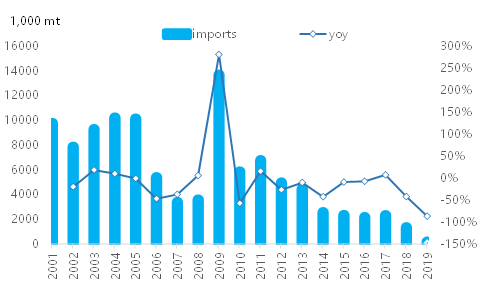
Judging from the data of steel scrap imports in the past 20 years, it reached a peak of 13.69 million mt in 2009, and then the import did not exceed 7 million mt. After 2014, it stood at basically around 2 million mt, and the import in 2020 came in at only 22,000 mt. Undoubtedly, the liberalisation of imports of secondary materials for steel is expected to promote the increase in steel scrap imports. According to media reports, Euro Metallurgical has started the import of 3,000 mt of secondary materials for steel. Judong signed a single import of 2,800 mt of secondary materials for steel with Japan.
Historical scrap imports reached a peak of 13.69 million mt in 2009
Source: China Customs
It is worth noting that whether the import can increase significantly depends on the domestic and overseas price difference. Overseas steel scrap prices have risen rapidly since late November. Take Turkish steel scrap prices as an example. They rose by 35.3% in December alone. The price difference between overseas steel scrap prices and domestic steel scrap prices has almost disappeared at present, and the import advantage has significantly weakened.
Under the regulation of the market mechanism, the volume of imported steel scrap is likely to be lower than previous expectations. It is expected that the import will remain at around 6-9 million mt in 2021, and the impact on the domestic market will be limited.
For more information on the China steel scrap and EAF sector, please subscribe to China Steel Scrap &EAF Monthly.
![9월 30일 폐배터리 시장 거래 요약 [SMM 일일 리뷰]](https://imgqn.smm.cn/usercenter/bAjSC20251217171721.jpg)
![시장 안정적으로 마감, 최다 거래 SHFE 주석 선물 계약 국경절 연휴 앞두고 횡보 [SMM 주석 오전 리뷰]](https://imgqn.smm.cn/usercenter/IyXhW20251217171751.jpg)
![[인도 철도, 오디샤 바르빌-볼라니카단 노선 복선화에 12억 2천만 루피 승인]](https://imgqn.smm.cn/usercenter/zDUFJ20251217171748.jpg)