SMM7 March 24: at the 15th lead and Zinc Summit 2020 held by SMM, Zhu Beiping, general manager of Yunxi Wenshan Zinc and Indium smelting Co., Ltd., brought you a keynote speech on "utilization and demonstration of hematite process in zinc smelting and solid waste recycling".
Present situation of Zinc smelting and solid waste Utilization
Zhu Beiping said that according to data, China has identified zinc reserves of 180 million tons in 2019, global zinc production of 13.75 million tons, China's output of 6.12 million tons, accounting for 44.51 percent of global production; domestic zinc ingot consumption of 6.693 million tons, accounting for 48.12 percent of global zinc consumption of 13.907 million tons.
The annual output of non-ferrous metal smelting is about 50 million tons, while there are many kinds and large amount of solid waste in zinc smelting, including leaching slag, kiln slag, jarosite slag, goethite slag, sulfur slag and so on. Since 2018, the annual solid waste output of zinc smelting in China has reached more than 3 million tons.
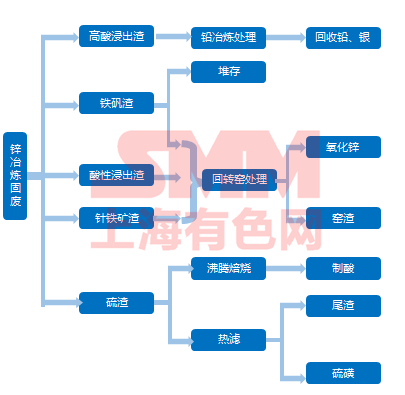
However, the disadvantages of zinc smelting and solid waste utilization include low recovery rate of valuable metals, high energy consumption, large dust, continued production of solid waste, high cost, which is contrary to the policies of energy saving, emission reduction and low-carbon economy.
Advantages of hematite process in solid waste resource utilization
SO2 reduction leaching realizes the complete separation of iron from zinc, indium, copper and other valuable metals in the leaching slag; iron precipitation of hematite separates iron from zinc, indium, copper and other valuable metals in the solution, and obtains 56% iron-containing hematite fine powder, which is sold to cement plants for resource utilization. For example, in 1972, the Akita Iijima smelter in Japan realized the industrial application of hematite process in wet zinc smelting for the first time. After years of process optimization, the production scale of 210000 tons of zinc per year, and the implementation of strict technical blockade.
Bottleneck of hematite process application
It mainly includes two aspects: 1. Technical blockade of process and equipment. The key technologies and equipment of SO2 reduction leaching and hematite iron precipitation are only mastered in a small number of foreign enterprises, and there is no precedent for industrial application in China; high pressure equipment and core technology need to be independently developed, which is difficult, risky and expensive.
2. The difficulty of industrial application. A number of domestic scientific research institutions and enterprises have carried out hematite process research and pilot tests one after another, but they have not been applied industrially due to various reasons.
Significance of hematite for resource utilization of solid waste from zinc smelting
1. Economic benefits
Realization of resource utilization of iron: output of hematite 43300 t, realization of sales
Metal recovery increased: the recoveries of zinc, indium and copper were all greater than 97.5%, 75% and 87%.
Processing cost: 3000mm 3500 yuan / t
2. Environmental benefits
Taking the output of 6.12 million tons of zinc in China in 2019 as an example, the reduction atmosphere of SO2 reduction leaching process is strong, the ratio of zinc concentrate to leaching slag is 50.8%, the reduction of solid waste residue source is 0.3 t t Zn, and the reduction of solid waste source is 1.8 million tons / year; hematite process converts iron in zinc concentrate into hematite powder, no iron-containing solid waste is produced, and the utilization of solid waste resources is 0.4 t Zn, and the utilization of solid waste resources is 2 million tons per year. The comprehensive energy consumption is lower than 700kg ceplet t, the coke consumption is reduced by 0.2kg 0.5tmax tZn, the carbon dioxide emission is reduced by 100kg gamma tZn, the coke consumption is reduced by 1 million tons per year, and the carbon dioxide emission is reduced by 500000 tons per year.
3. Significance of hematite process to zinc hydrometallurgy in China
The main contents are as follows: 1. It breaks through the technical blockade and fills the gap of zinc smelting process in China. All zinc smelting processes have been industrially applied in China.
2. It provides a new technical path for resource utilization and source reduction of solid waste from zinc smelting in China.
3. It provides the best smelting process with benefit, environmental protection and green for China's rich high-iron sphalerite.
4. Hematite process is more suitable for raw materials with low iron content, high recovery of valuable metals, no waste residue and lower investment.
Conclusion
China is not only the largest country of zinc production and consumption, but also the largest producer of zinc smelting solid waste, so it is urgent to seek efficient, green and low-carbon zinc smelting solid waste resource utilization technology.
On the basis of the research of other domestic scientific research institutes and smelting companies, Wenshan Zinc Indium, China Enfei and Kungong have broken through the core technology of sulfur dioxide reduction leaching-hematite process which has been blocked abroad for a long time through the combination of production, learning and research. the problem of combining efficient utilization of leaching slag from wet zinc smelting with environment-friendly was solved, and wet zinc smelting without iron waste residue was realized. It provides a new technical choice for source reduction and resource utilization of solid waste in zinc smelting.
Scan the code to apply to join the SMM industry communication group:

![Ningbo Zinc: Downstream Cautious Amid High Prices, Trading Sluggish [SMM Midday Comment]](https://imgqn.smm.cn/usercenter/nGzXc20251217171754.jpg)
![톈진 아연: 선물 급등, 시장 부진 [SMM 정오 코멘트]](https://imgqn.smm.cn/usercenter/kdRPs20251217171754.jpg)