SMM4, March 7: recently, the rapid spread of the global epidemic, according to data, nearly 1.35 million people worldwide infected with new crown pneumonia, of which more than 360000 confirmed cases of new crown pneumonia in the United States has not improved. All industries are affected, especially steel enterprises. Recently, the production of steel enterprises in China has been almost unaffected by the epidemic, but many iron and steel enterprises in the world have reduced or even stopped production.
America
X.US, the US steel company, said it would leave steel pipe mills in Ohio and Texas idle indefinitely by the end of May because of plummeting oil prices and a surge in the number of confirmed outbreaks in the US.
ArcelorMittal's (ArcelorMittal) said it was taking steps to cut its North American steel production in response to weaker demand for steel downstream after the COVID-19 outbreak.
ArcelorMittal said it would stop its No. 3 blast furnace at the Tubar ã o steel plant in San Esprito, Brazil, for 45 days as a result of the outbreak. The annual output of crude steel in No. 3 blast furnace is 2.8 million tons.
The Middle East
In the Karabuk region of northern Turkey, Kardemir is a crude steel comprehensive long material producer with an annual capacity of 2.5 million tons / year, which has partially reduced its production since April 1.
Izmir Demir Selick (IDC), one of Turkey's largest producers of billets and bars in the Aegean region of western Turkey, stopped rolling mills completely from April 1. The company is expected to lose 2300 metric tons per day;
Ege Celik, a long-term steelmaker in the Aegean region, suspended production at its smelters and rolling mills for 15 days. The production capacity of the smelter is 2 million tons / year, and the rolling capacity of wire rod and rebar is 1 million tons / year.
Koc Metalurji, a long steel producer in Ottomaniya, southern Turkey, will suspend production at its smelter for a month from April 7. The annual production capacity of Koc Metalurji liquid steel is 1.2 million tons / year, and the annual production capacity of rebar is 500000 tons.
The Middle East has become an important steel producer because of population growth and local supplies of raw materials such as iron ore and natural gas. The Middle East produced 45.3 million tons of crude steel in 2019, up 19.2 per cent from 2018, according to the World Iron and Steel Association.
Southeast Asia
To prevent the spread of Xinguan pneumonia, South Korea's Posco Iron has closed its overseas coil processing centers in Italy, Malaysia, the Philippines and India. JFE Steel had previously said it would cut crude steel production by 13 per cent, while Nippon Steel had also said it would cut production by 10 per cent.
Europe
At the end of March, Tata Steel European companies (Tata Steel Europe) and Free Steel said they were about to cut production in Europe because of concerns about the steel demand side. Tata said it would continue to operate its four blast furnaces in IJmuiden, the Netherlands, and Port Talbot, Wales.
Liberty Steel said it had suspended production at several small rolling mills in Belgium, Luxembourg and Italy, but Liberty did not disclose how much it would cut production. Liberty Steel operates in 10 countries and regions around the world with an annual output of about 18 million tons.
ThyssenKrupp (Thyssenkrupp), Germany's largest steelmaker, says it is cutting steel production because of the impact of the coronavirus on the steel industry. The company also said it was likely to cut production further, but did not disclose specific figures.
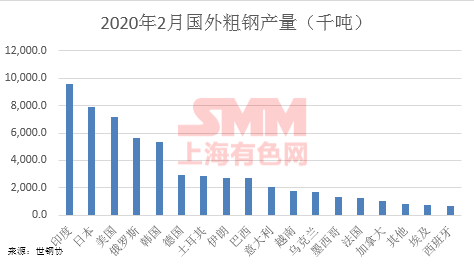
SMM believes that the suspension of production by foreign steel enterprises is mainly due to the sharp drop in demand, which has a direct impact on the import and export business of steel. However, in mid-March, the Ministry of Finance issued the "announcement on improving the Export tax rebate rate of some products" in which some steel products, such as plating and stainless steel, raised the export tax rebate rate to 13%, reducing the cost of imports and exports. However, on the whole, the reduction of foreign demand or the original expected export of steel to domestic sales, for the current inventory is still high steel market has a negative impact is inevitable. At this stage, the pressure on the domestic supply side intensifies, suppresses the spot price of steel, and continues to pay attention to the recovery of downstream demand such as infrastructure and manufacturing in the later stage.
To apply for entry into the SMM Iron and Steel Industry Exchange Group, please scan the QR code below: