Aluminum Foil Exports Down 13% YoY in March; Middle East Blockade Creates "Export Rush" Window

Published: Apr 30, 2026 22:29
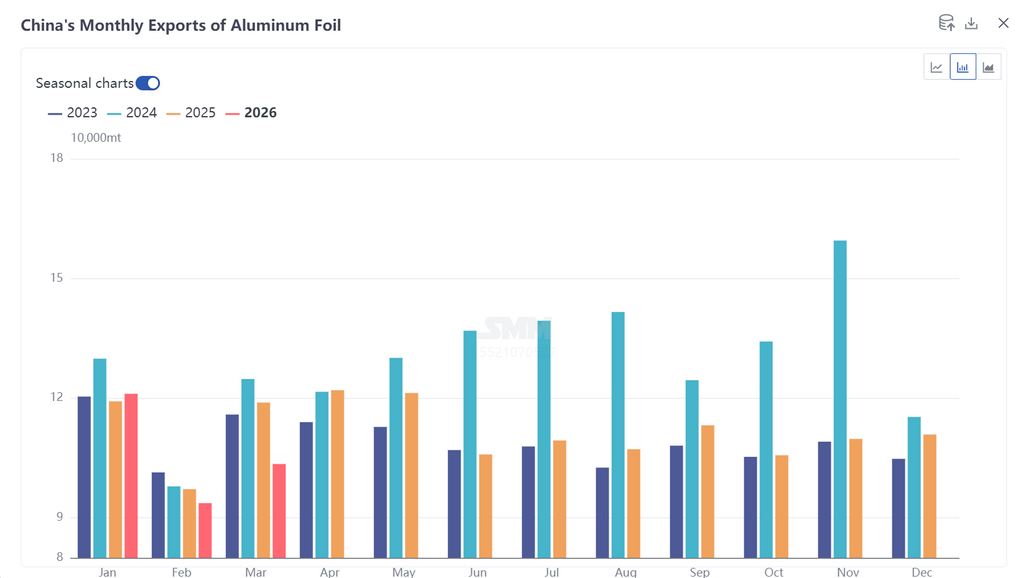
According to customs data, China's aluminum foil (tariff codes 76071110, 76071120, 76071190, 76071900, 76072000) total exports in March 2026 reached 103,500 mt, up 10% MoM but down 13% YoY. The share of exports to the UAE plunged from 6.8% in January-February to 2.5% in March, with the Middle East trade chain nearly severed.
SMM, April 30, 2026:

According to customs data, China's aluminum foil (tariff codes 76071110, 76071120, 76071190, 76071900, 76072000) total exports in March 2026 reached 103,500 mt, up 10% MoM but down 13% YoY. The share of exports to the UAE plunged from 6.8% in January-February to 2.5% in March, with the Middle East trade chain nearly severed.

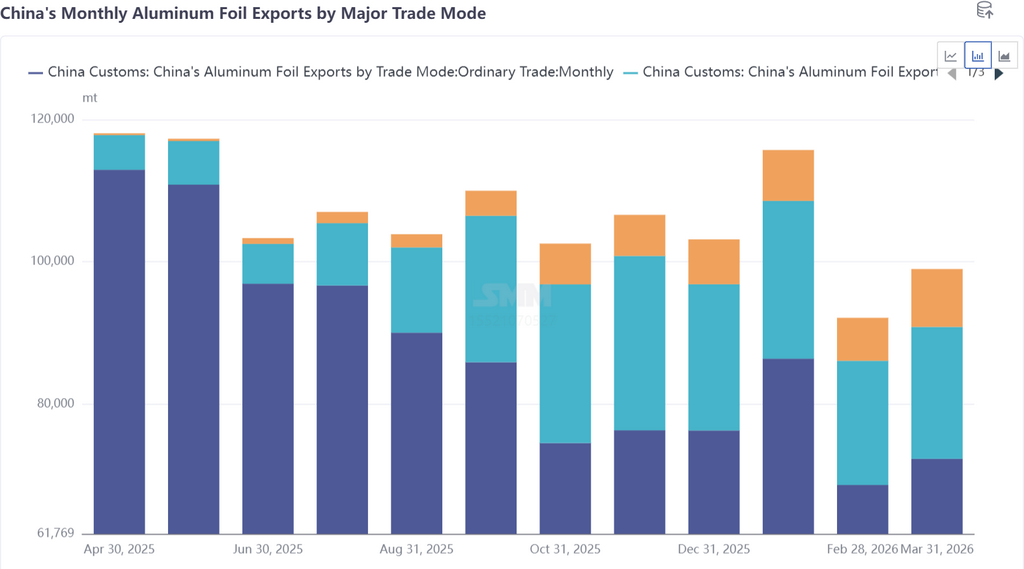
Trade mode: In March 2026, China's aluminum foil exports via processing trade with imported materials were approximately 18,500 mt, accounting for about 17.8%; exports via processing trade with supplied materials were approximately 8,000 mt, accounting for 7.7%.
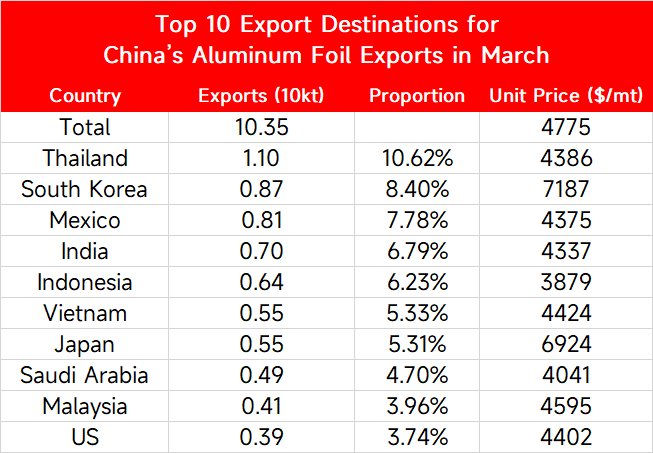
By country, the top 5 destinations for China's aluminum foil exports in March 2026 were Thailand (11,000 mt, 10.62%), South Korea (8,700 mt, 8.4%), Mexico (8,100 mt, 7.78%), India (7,000 mt, 6.8%), and Indonesia (0.64 mt, 6.2%), with the remaining countries accounting for approximately 60% in total.
Since March, the outbreak of the Israel-Iran conflict and the sharp deterioration of the Strait of Hormuz situation have become the most direct shock affecting March and subsequent exports. According to an SMM survey, export schedules of China's aluminum foil enterprises have extended to late June through July, with capacity essentially fully booked. There are two core reasons: first, some double zero foil production lines have shifted to higher-margin power battery foil, creating a gap in traditional packaging foil supply; second, overseas clients, concerned about prolonged strait blockade leading to global aluminum supply tightening, have placed orders in advance to secure supplies. These factors have jointly pushed double zero plain pouch export processing fees to a historically relatively high level of $1,000-1,200/mt. However, feedback suggests that high processing fees themselves have been slowing the rate of additional orders from some clients. Overall, in Q2 2026, China's aluminum foil exports, driven by both the export rush and capacity mismatch, will exhibit a phase of prosperity characterized by full production schedules and elevated processing fees. However, it is worth noting that this round of growth has pronounced geopolitical drivers, and its sustainability remains questionable. Whether full-year exports can recover the ground lost from the 13.4% YoY decline in 2025 (approximately 150,000 mt in incremental volume) remains highly uncertain.

Data Source Statement: Except for publicly available information, all other data are processed by SMM based on publicly available information, market communication, and relying on SMM‘s internal database model. They are for reference only and do not constitute decision-making recommendations.

For any inquiries or to learn more information, please contact: lemonzhao@smm.cn
For more information on how to access our research reports, please contact:service.en@smm.cn
Related News
Guinea to Introduce Bauxite Export Controls Next Month, Alumina Rises in Night Session
7 hours ago
Guinea to Introduce Bauxite Export Controls Next Month, Alumina Rises in Night Session
Read More
Guinea to Introduce Bauxite Export Controls Next Month, Alumina Rises in Night Session
Guinea's Minister of Mines confirmed that the country will introduce a bauxite export control plan next month (June), with the core objective of "controlling exports and rebounding prices." Previously, Guinea's bauxite exports reached 183 million mt in 2025, surging 25% YoY, yet prices nearly halved from the early-year highs, with officials explicitly stating that "supply should not exceed demand." Driven by this news, during the night session on the 25th, the most-traded alumina futures contract on SHFE rose by over 4% at one point, with prices reaching a high of 2,837 yuan/mt.
7 hours ago
[SMM Aluminum Flash News] Vietnam’s THACO Plans USD 4.4 Billion Bauxite and Alumina Expansion
12 hours ago
[SMM Aluminum Flash News] Vietnam’s THACO Plans USD 4.4 Billion Bauxite and Alumina Expansion
Read More
[SMM Aluminum Flash News] Vietnam’s THACO Plans USD 4.4 Billion Bauxite and Alumina Expansion
[SMM Aluminum Flash News] Vietnam’s THACO Plans USD 4.4 Billion Bauxite and Alumina Expansion
Vietnamese industrial group THACO is accelerating plans to expand its bauxite and alumina business in Lam Dong Province with proposed investments worth about USD 4.4 billion. The Lam Dong 2 alumina project, valued at around USD 1.9 billion, is designed to produce 2 million tones of alumina annually, with the first 1 million-tone phase targeted for commissioning by 2030. THACO also plans a USD 2.5 billion bauxite mining project with annual ore extraction capacity of about 12 million tones. In addition, the company is studying downstream industrial parks covering aluminum smelting, titanium processing and chemical production. If approved, the projects could turn Lam Dong into one of Vietnam’s largest integrated aluminum industry hubs.
12 hours ago
[SMM Aluminum Flash News] China Studies Coal Waste as New Source of Critical Metals
12 hours ago
[SMM Aluminum Flash News] China Studies Coal Waste as New Source of Critical Metals
Read More
[SMM Aluminum Flash News] China Studies Coal Waste as New Source of Critical Metals
[SMM Aluminum Flash News] China Studies Coal Waste as New Source of Critical Metals
China is exploring the recovery of critical metals such as germanium, aluminum, lithium and gallium from coal waste to strengthen domestic strategic mineral supply. Research shows that fly ash and gangue generated during coal mining, washing and combustion may contain recoverable metals used in batteries, semiconductors, electric vehicles and defense industries. With China’s large coal sector and mature industrial network, existing coal washing plants, chemical facilities and power stations could potentially be adapted for metal extraction. However, differences in coal waste composition across regions continue to create challenges for large-scale and standardized recovery.
12 hours ago
Register to Continue Reading
Gain access to the latest insights in metals and new energy
Already have an account?sign in here