SMM April 28 News:
Metal Market:
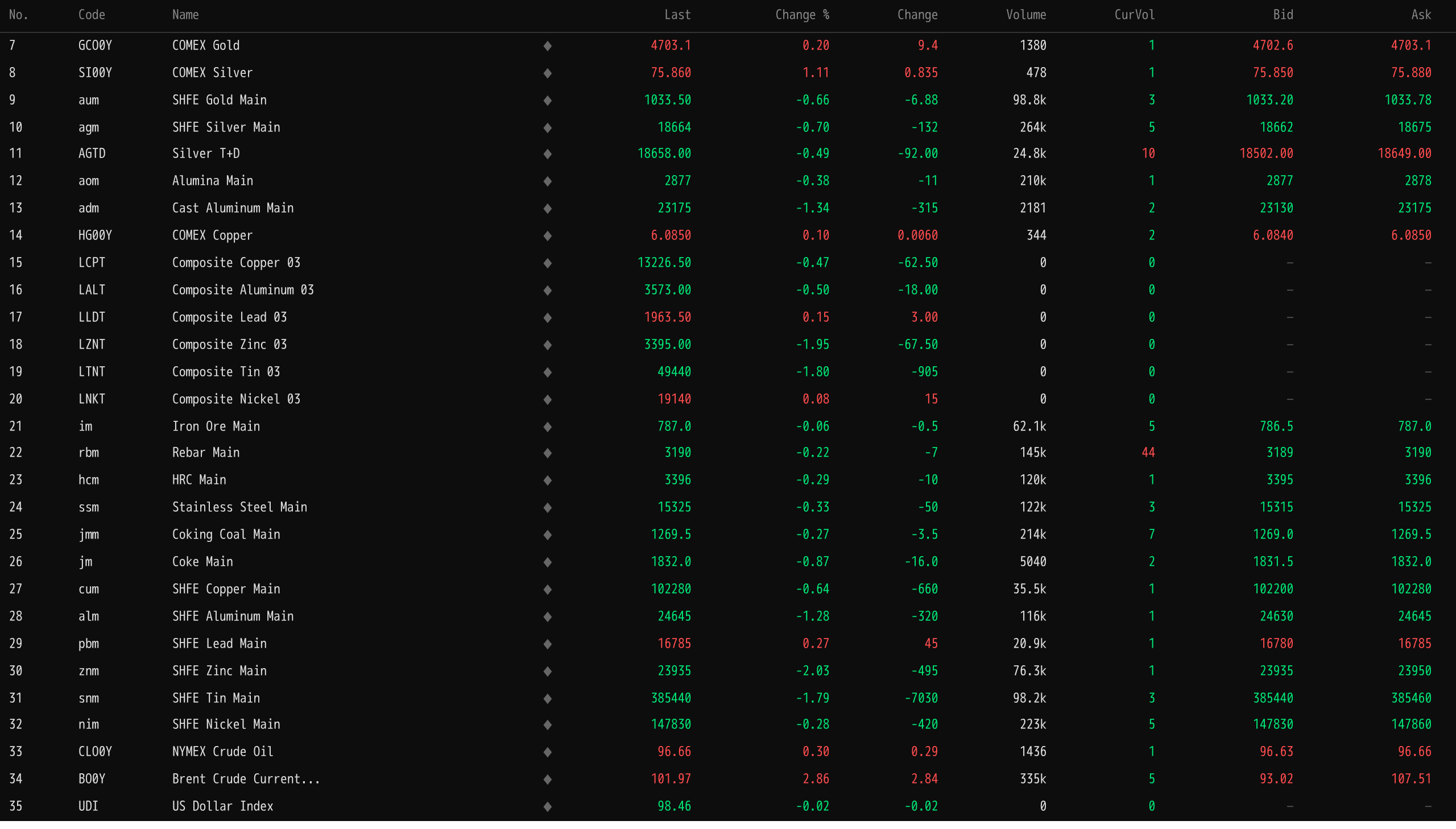
Overnight, domestic market base metals fell nearly across the board. SHFE copper fell 0.64%. SHFE aluminum fell 1.28%, SHFE lead rose 0.27%. SHFE zinc fell 2.03%. SHFE tin fell 1.79%. SHFE nickel fell 0.28%. In addition, the most-traded alumina futures contract fell 0.38%, and the most-traded foundry aluminum continuous contract fell 1.34%.
Overnight, ferrous metals all fell. Iron ore fell 0.06%, stainless steel fell 0.33%, rebar fell 0.22%, and hot-rolled coil fell 0.29%. Coking coal and coke: coking coal fell 0.27%, coke fell 0.87%.
Overnight, overseas market metals saw LME base metals generally decline. LME copper fell 0.47%. LME aluminum fell 0.5%, LME lead rose 0.15%. LME zinc fell 1.95%. LME tin fell 1.8%. LME nickel fell 0.08%.
Overnight Precious Metals:COMEX gold fell 0.91%, COMEX silver fell 1.25%. Overnight SHFE gold fell 0.66%, SHFE silver fell 0.7%.
As of 7:15 AM on April 28, overnight closing prices:
Macro Front
China:
[National Energy Administration: Formulating the 2026 New Energy Consumption Work Plan]The National Energy Administration held its quarterly press conference on April 27. Liu Mingyang, Deputy Director of the Electricity Department of the National Energy Administration, stated that the administration is currently formulating the 2026 new energy consumption work plan, fully implementing new energy consumption and regulation policy measures, coordinating all parties for implementation, and ensuring stable new energy consumption and utilization nationwide, especially in key western regions.
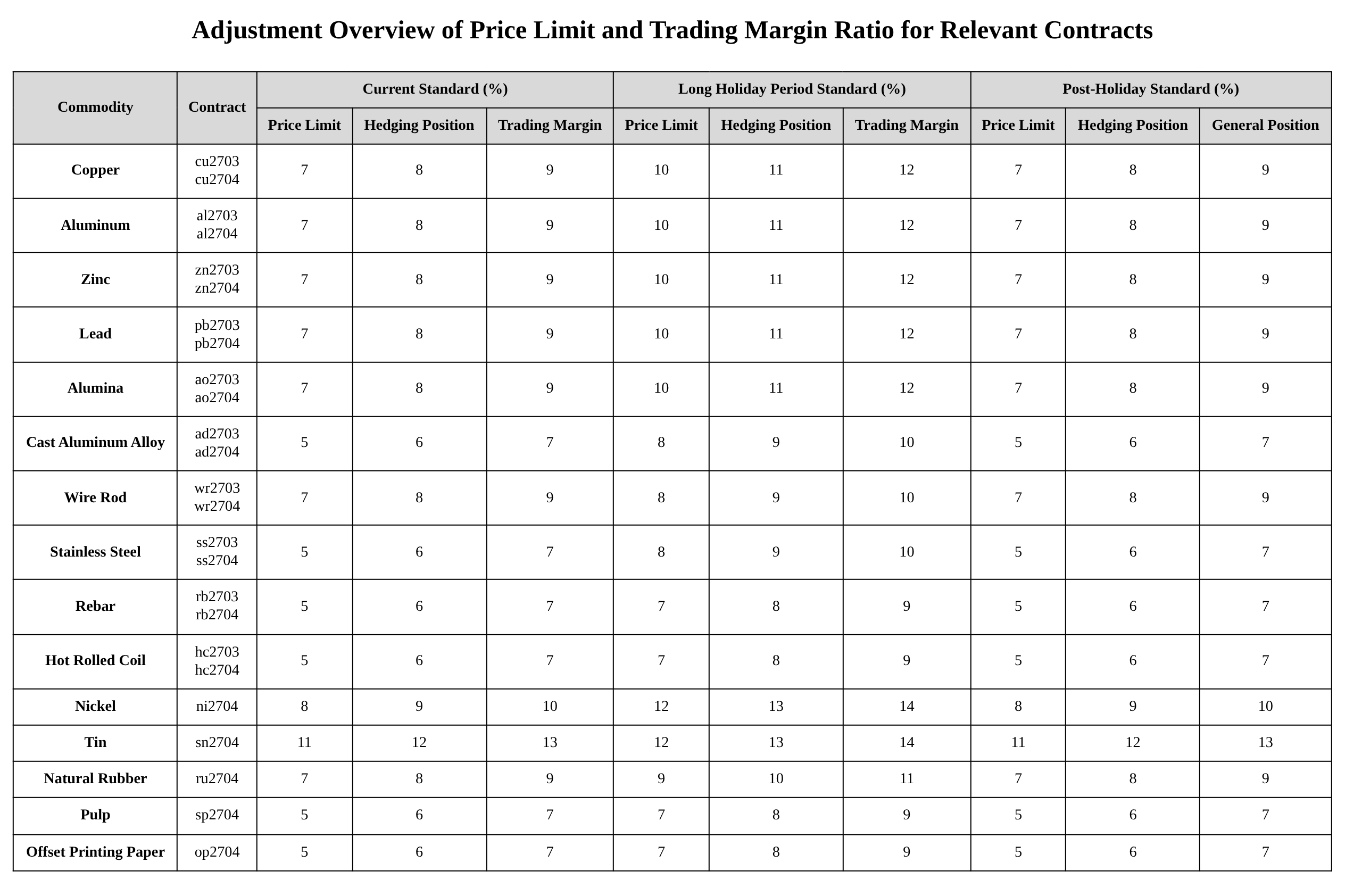
[SHFE Issued Notice on Adjusting Trading Margin Standards and Price Limit Ranges for Certain Futures Contracts During the 2026 Labour Day Holiday]According to the "Announcement of Shanghai Futures Exchange on 2026 Market Closure Arrangements" (SHFE Announcement [2025] No. 157), the work arrangements during the Labour Day holiday are as follows: 1. No night session trading will be conducted on the evening of April 30, 2026 (Thursday). The market will be closed from May 1, 2026 (Friday) to May 5, 2026 (Tuesday). On May 6, 2026 (Wednesday), call auction for all futures and options contracts will be held from 08:55 to 09:00, and night session trading will resume that evening. 2. Starting from the closing settlement on April 29, 2026 (Wednesday), the price limit ranges and trading margin ratios will be adjusted as follows:
[Shanghai International Energy Exchange Issued Notice on Work Arrangements During the 2026 Labour Day Holiday]Shanghai International Energy Exchange announced to all relevant entities: According to the "Announcement of Shanghai International Energy Exchange on 2026 Market Closure Arrangements" (Shanghai International Energy Exchange Announcement [2025] No. 114), the work arrangements during the Labour Day holiday are as follows: 1. No night session trading will be conducted on the evening of April 30, 2026 (Thursday). The market will be closed from May 1, 2026 (Friday) to May 5, 2026 (Tuesday). On May 6, 2026 (Wednesday), call auction for all futures and options contracts will be held from 08:55 to 09:00, and night session trading will resume that evening. 2. Starting from the closing settlement on April 29, 2026 (Wednesday), the price limit ranges and trading margin ratios will be adjusted as follows: For international copper futures bc2703 and bc2704 contracts, the price limit range is 10%, the hedging position trading margin ratio is 11%, and the general position trading margin ratio is 12%; for TSR 20 rubber futures nr2704 contract, the price limit range is 9%, the hedging position trading margin ratio is 10%, and the general position trading margin ratio is 11%.
US Dollar:
Overnight, the US dollar index fell 0.04%, closing at 98.49. As obstacles to Kevin Warsh's confirmation as the next Fed Chairman appear to be diminishing, the market is reassessing what this change could bring. AMP Chief Economist Shane Oliver stated that Warsh is committed to maintaining the US Fed's independence and that he may place greater emphasis on AI transformation while placing less emphasis on employment. Oliver said he may also favor trimmed mean inflation over core PCE, though this could be seen as cherry-picking. Oliver added that his stance may be slightly more dovish than Powell's, but not fundamentally different. Bridgewater Associates founder Ray Dalio said on April 27 local time that persistent inflationary pressures combined with slowing economic growth require policymakers to remain cautious. Dalio said on Monday, "We are undoubtedly in a period of stagflation," warning that the US economy has fallen into a stagflationary environment and noting that if incoming Fed Chairman Kevin Warsh chooses to cut interest rates, it would be a policy mistake. According to CME "FedWatch": The probability of the US Fed keeping rates unchanged in April is 100%. The probability of a cumulative 25-basis-point interest rate cut by June is 4.5%, while the probability of keeping rates unchanged is 95.5%. (Jin10 Data)
Other Currencies:
PIMCO portfolio manager Constantin Veit noted in a report that the European Central Bank is expected to keep rates unchanged at its April meeting, maintaining a vigilant stance amid a highly uncertain environment. Ahead of the ECB's policy decision on Thursday, Veit said: "At this stage, we still believe the ECB will remain vigilant rather than take action." Veit said that if the ECB were to respond to inflation risks, any measures are expected to be gradual rather than aggressive. Veit stated that the likelihood of more than two rate hikes is relatively small. With risks to both economic growth and inflation having risen, policymakers may wait until the next round of staff projections in June before adjusting policy. (Jin10 Data)
Berenberg economists noted in a report that the Bank of England may keep rates unchanged at 3.75% in 2026 before restarting interest rate cuts later. London Stock Exchange data showed that due to high global energy prices and inflation concerns, the market has fully priced in two 25-basis-point rate hikes by the Bank of England this year. Berenberg economists stated that the UK faces economic weakness and a slowing labour market, factors that could restrain a significant rise in inflation. The economists also said that Bank of England Monetary Policy Committee members may wait for data indicating weakening demand and inflation before resuming interest rate cuts. (Jin10 Data)
Macro:
Data to be released today include the US ADP employment change for the week ending April 11, the US February FHFA house price index MoM, the US February S&P/CS 20-city non-seasonally adjusted home price index YoY, the US April Conference Board consumer confidence index, the US April Richmond Fed manufacturing index, and the Bank of Japan target rate as of April 28. Also worth watching: Bank of Japan Governor Ueda Kazuo will hold a monetary policy press conference; the Bank of Japan will release its interest rate decision and economic outlook report.
Crude Oil:
Overnight, both oil futures rose, with WTI up 2.42% and Brent up 2.86%. Iran proposed a phased negotiation plan, suggesting reopening the Strait of Hormuz to shipping while deferring nuclear discussions, but an Iranian official subsequently stated that its military should maintain control over the strait. US Secretary of State Rubio responded immediately, saying the US cannot tolerate Iran normalizing its control over the Strait of Hormuz, pushing oil prices further higher. (Wallstreetcn)
According to research firm Kpler, Iran's crude oil storage capacity is rapidly diminishing, which could force the country to accelerate production cuts. Kpler analysts said in a report released on Monday that Iran's remaining unused storage capacity could hold 12 to 22 days of supply, potentially forcing Iran to cut production by an additional 1.5 million barrels per day before mid-May. Goldman Sachs said last week that Iran had already cut daily average crude oil production by as much as 2.5 million barrels. Since the outbreak of conflict on February 28, neighboring countries such as Saudi Arabia, Iraq, Kuwait, and the UAE have also been forced to reduce production. Kpler wrote: "Despite Iran's bleak oil production outlook, it may be months before the Iranian government truly feels the economic pressure." Kpler said that due to reduced shipping through the Strait of Hormuz, Iran's oil exports had recently fallen to about 567,000 barrels per day. The average exports in March were about 1.85 million barrels per day. (Jin10 Data)
![Metals Mostly Fell; SHFE Zinc and Coke Dropped Over 2%; Lithium Carbonate and SHFE Tin Led Declines; Polysilicon Fell for Four Consecutive Sessions [SMM Midday Review]](https://imgqn.smm.cn/usercenter/OQqCm20251217171736.jpg)
![SHFE Tin Tested the 380,000 Level, Bargain Buying Drove Spot Trades to Recover [SMM Tin Midday Review]](https://imgqn.smm.cn/usercenter/fMkfI20251217171752.jpg)
![Copper Prices Weakened as Downstream Maintained a Wait-and-See Stance, Spot Premiums Under Pressure [SMM North China Spot Copper]](https://imgqn.smm.cn/usercenter/arNnt20251217171714.jpeg)