Brief Analysis of Production Changes in China's Phosphorus-Based New Energy Materials, 2025

Published: Apr 15, 2026 15:41
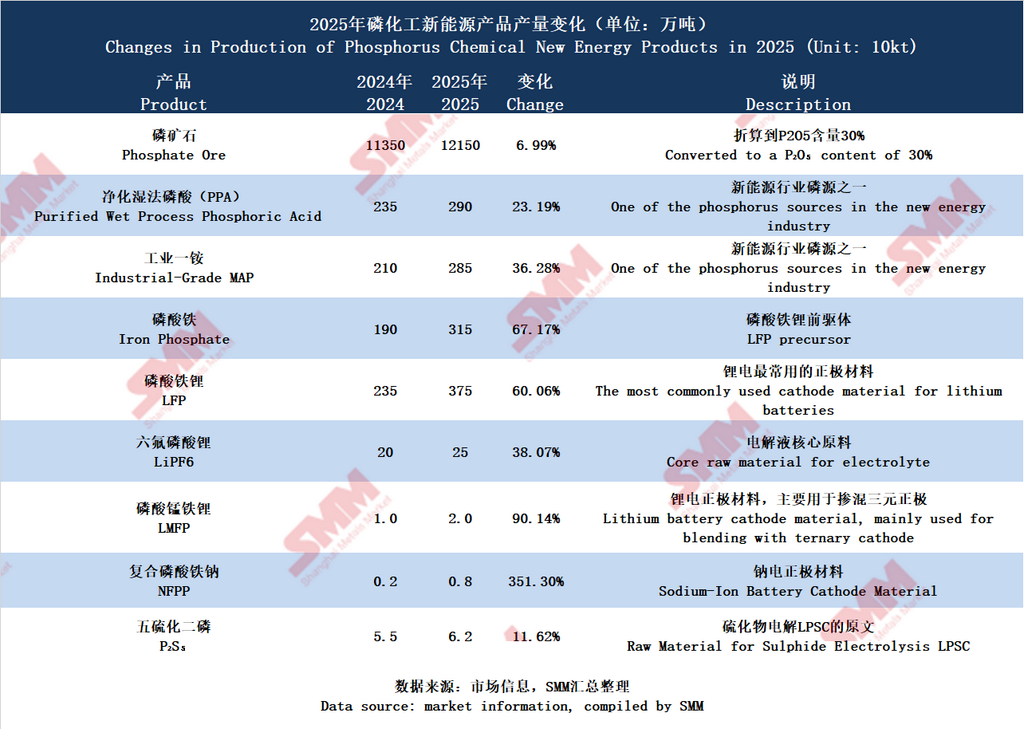
Key takeaways: Rapid growth: LFP cathode materials (+60%), iron phosphate (+67%), and LiPF6 (+38%) saw significant production expansion, reflecting strong demand from power batteries and energy storage. New-type materials such as LMFP and composite sodium iron phosphate grew by over 90%, entering the commercialisation phase.

Key takeaways: Rapid growth: LFP cathode materials (+60%), iron phosphate (+67%), and LiPF6 (+38%) saw significant production expansion, reflecting strong demand from power batteries and energy storage. New-type materials such as LMFP and composite sodium iron phosphate grew by over 90%, entering the commercialisation phase. Solid-state battery lag: P₂S₅ production remained stable at 60,000 mt, up only 11.62%, indicating that sulphide solid-state batteries are still in the R&D stage and large-scale industrialisation will take time. The new energy transformation of phosphorus chemicals is accelerating, but volume breakthroughs for next-generation materials are yet to come.

From 2024 to 2025, phosphorus-based chemical products closely linked to the new energy industry generally exhibited rapid growth.

Among them, cathode material and precursor iron phosphate (+67.17%) and LFP (+60.06%) posted the most significant increases, directly reflecting strong demand for LFP cathode materials from the power battery and ESS sectors. Raw materials industrial-grade MAP and purified wet process phosphoric acid grew by 36.28% and 23.19% respectively. As key phosphorus sources for LFP, their growth was broadly in line with the downstream expansion pace. LiPF6 grew by 38.07%, corresponding to the continued expansion of the electrolyte market. Although LMFP and composite sodium iron phosphate had relatively small bases, their growth rates were extremely high (exceeding 90% and 350% respectively), indicating that new-type cathode materials (blended ternary, sodium-ion battery) are entering the commercialisation phase. Solid-state battery side, P₂S₅ production remained stable at around 60,000 mt over the two years, increasing by only 11.62%. As a core raw material for sulphide solid electrolytes (e.g., LPSC), P₂S₅ production did not experience explosive growth, suggesting that sulphide all-solid-state batteries are still in the R&D or pilot-scale stage and have yet to generate large-scale industrialisation demand. Additionally, the growth of P₂S₅ applications in traditional industries was limited. Overall, phosphorus chemicals are accelerating their shift towards the new energy sector, while large-scale volume ramp-up of next-generation battery materials will still take time.

Note: If you have any additions or corrections to the details mentioned in this article, please feel free to contact us at any time. Contact information is as follows:

Tel: 021-20707860 (or add WeChat 13585549799) Yang Chaoxing, thank you!

Data Source Statement: Except for publicly available information, all other data are processed by SMM based on publicly available information, market communication, and relying on SMM‘s internal database model. They are for reference only and do not constitute decision-making recommendations.

For any inquiries or to learn more information, please contact: lemonzhao@smm.cn
For more information on how to access our research reports, please contact:service.en@smm.cn
Related News
Japan Revises Battery Strategy
39 mins ago
Japan Revises Battery Strategy
Read More
Japan Revises Battery Strategy
According to a report by the Yomiuri Shimbun on June 2, Japan’s Ministry of Economy, Trade and Industry will hold an expert meeting on the same day to discuss and announce a revised version of its “Battery Industry Strategy.” The new strategy is based on a detailed forecast that the global battery market will roughly double from 2025 to 2035, reaching JPY 46 trillion. Accordingly, the Japanese government has set a target to increase the global battery-related revenue of Japanese battery manufacturers to JPY 6 trillion, about three times the current level of less than JPY 2 trillion.
39 mins ago
Samsung SDI converts part of U.S. battery joint venture plant to LFP for ESS
40 mins ago
Samsung SDI converts part of U.S. battery joint venture plant to LFP for ESS
Read More
Samsung SDI converts part of U.S. battery joint venture plant to LFP for ESS
Samsung SDI is converting part of the production lines at StarPlus Energy, its U.S. electric vehicle battery joint venture plant, to produce lithium iron phosphate (LFP) batteries for energy storage systems (ESS). The conversion applies to part of the lines at StarPlus Energy Plant 1. Rather than adding a separate new production line, Samsung SDI is modifying existing high-nickel nickel-cobalt-aluminum (NCA) battery lines to accommodate LFP battery production.
40 mins ago
[Lithium Battery: Wanrun New Energy Adjusts Repurchase Plan For 100,000-Ton Cathode Material Project]
1 hour ago
[Lithium Battery: Wanrun New Energy Adjusts Repurchase Plan For 100,000-Ton Cathode Material Project]
Read More
[Lithium Battery: Wanrun New Energy Adjusts Repurchase Plan For 100,000-Ton Cathode Material Project]
[Lithium Battery: Wanrun New Energy Adjusts Repurchase Plan For 100,000-Ton Cathode Material Project]
On June 1, Wanrun New Energy issued an announcement stating that it plans to sign a supplementary agreement on asset repurchase with Hubei Shiyan Haoshuo New Energy Technology Co., Ltd. This agreement will adjust the repurchase period, amount, and payment method for assets related to its annual 100,000-ton battery cathode material project, aiming to optimize project financing costs through bank replacement financing. The asset delivery for this project was completed in May 2024. Based on a comprehensive evaluation conducted by Kunyuan Asset Appraisal Co., Ltd., the total value of the project's assets is approximately 1.076 billion yuan. As of now, Wanrun New Energy has paid 360 million yuan in repurchase investment, with an outstanding balance of approximately 716 million yuan.
1 hour ago