Key Copper Export Corridor in the DRC Disrupted; Rising Transport Costs May Affect Logistic Flows

Published: Mar 3, 2026 18:25
According to Bloomberg, flooding has caused the collapse of a key bridge located south of the Zambian border in the Democratic Republic of Congo (DRC), cutting off the main copper export route to the Kasumbalesa border post and disrupting outbound shipments from the world’s second-largest copper producer.

According to Bloomberg, flooding has caused the collapse of a key bridge located south of the Zambian border in the Democratic Republic of Congo (DRC), cutting off the main copper export route to the Kasumbalesa border post and disrupting outbound shipments from the world’s second-largest copper producer. In a statement released on Sunday, the Zambia Revenue Authority noted that traffic to and from the Kasumbalesa border crossing has been affected due to bridge damage and advised transporters to use alternative routes. According to SMM, this corridor accounts for roughly one-third of the DRC’s refined copper export shipments. At present, cargoes from the southern copper-cobalt belt are being rerouted via the Jiu–Sakania and Mokambo border crossings.

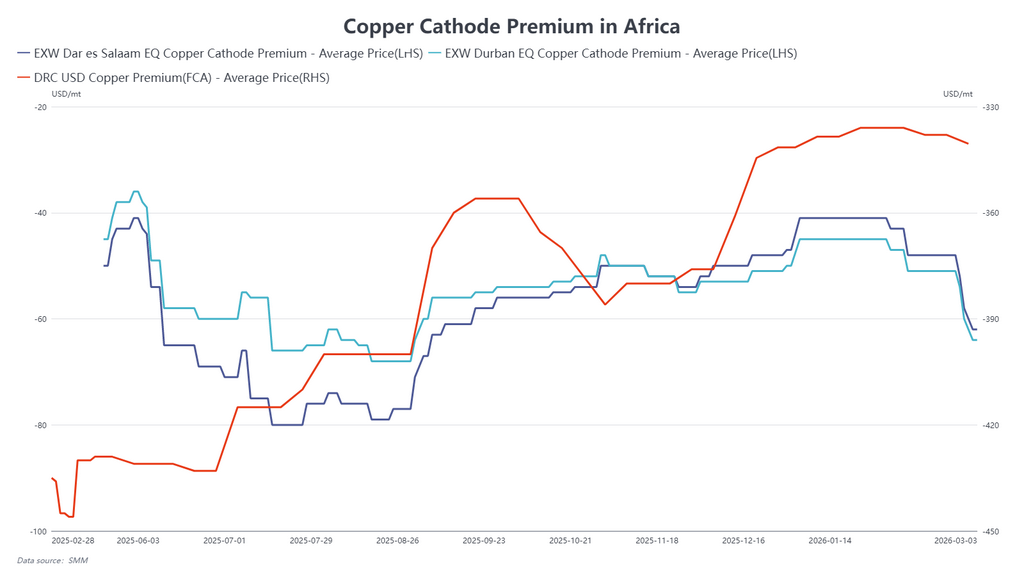
The disruption has had a direct impact on the regional logistics system. Approximately one-third of export volumes that previously transited through Kasumbalesa are now being diverted to the Jiu–Sakania and Mokambo routes. However, these alternative corridors have a daily vehicle capacity of around 1,000 trucks, making it difficult to fully absorb the additional traffic in the short term. Inland freight rates within the DRC are therefore expected to rise, leading to a temporary increase in transportation costs. At the same time, Africa’s smelting structure is predominantly hydrometallurgical and heavily reliant on sulfuric acid imports from Zambia. Any cross-border transport disruptions may further heighten operational risks for hydrometallurgical copper production, increasing localized supply uncertainty. Given that African refined copper premiums have been trending downward recently, this disruption may temporarily slow the pace of premium declines.
From an inventory perspective, reduced transport efficiency may cause refined copper to accumulate at mine sites, smelters, and ports, leading to a short-term buildup of regional “hidden” inventories. As these stocks are not reflected in LME or other visible inventory statistics, they may distort short-term market assessments of global inventory levels and influence expectations regarding the broader supply-demand balance.

For the Chinese market, if logistical bottlenecks persist beyond mid-April, arrivals in the second half of April may slow, potentially resulting in a modest decline in import volumes. However, alternative routes are already in operation, and further developments will depend on improvements in detour efficiency and customs clearance speed. Overall, the incident appears to represent a temporary logistical disruption, with its broader impact on the annual supply-demand structure still to be assessed.

Data Source Statement: Except for publicly available information, all other data are processed by SMM based on publicly available information, market communication, and relying on SMM‘s internal database model. They are for reference only and do not constitute decision-making recommendations.

For any inquiries or to learn more information, please contact: lemonzhao@smm.cn
For more information on how to access our research reports, please contact:service.en@smm.cn
Related News
Zambia to Reopen Key DRC Mineral Export Route After Rain Damage Disrupted Transport
2 hours ago
Zambia to Reopen Key DRC Mineral Export Route After Rain Damage Disrupted Transport
Read More
Zambia to Reopen Key DRC Mineral Export Route After Rain Damage Disrupted Transport
Zambia’s Minister of Infrastructure said the main corridor for the DRC’s exports of copper, cobalt, and other minerals was expected to reopen after transport was disrupted by road damage.The DRC is Africa’s largest copper producer and the world’s second-largest copper producer by production. The DRC is also the world’s leading supplier of cobalt, with cobalt production accounting for more than 70% of global production, and most cobalt is exported together with other critical battery minerals.Kasumbalesa is the busiest transit point for the DRC’s metal cargo (mainly bound for China and the US). On Sunday, traffic at the crossing was suspended after heavy rains washed away parts of the road.So far, no mining company has reported that shipments of copper or cobalt have been impeded.
2 hours ago
Capstone Copper said on Monday that its Q4 revenue hit a record high, exceeding analysts’ expectations
2 hours ago
Capstone Copper said on Monday that its Q4 revenue hit a record high, exceeding analysts’ expectations
Read More
Capstone Copper said on Monday that its Q4 revenue hit a record high, exceeding analysts’ expectations
Capstone Copper said on Monday that its Q4 revenue hit a record high, exceeding analysts’ expectations.The company’s adjusted Q4 earnings before interest, taxes, depreciation, and amortization (EBITDA) fell short of analysts’ expectations, despite record copper production.The company’s Q4 2025 copper production reached a record high, driven by improved operations at the Mantoverde and Mantos Blancos mines.Capstone Copper expects 2026 copper production to be 200,000-230,000 mt. It expects 2026 C1 cash cost to be $2.45-2.75 per pound.
2 hours ago
Drone Attack on US Embassy in Riyadh; Israel Strikes Tehran and Beirut, Trump Promises Response Measures
2 hours ago
Drone Attack on US Embassy in Riyadh; Israel Strikes Tehran and Beirut, Trump Promises Response Measures
Read More
Drone Attack on US Embassy in Riyadh; Israel Strikes Tehran and Beirut, Trump Promises Response Measures
The US Embassy in Riyadh, Saudi Arabia, was attacked by a drone on the 3rd local time, causing a fire and partial damage to the building. Meanwhile, the Israeli military announced that it was simultaneously carrying out airstrikes on Tehran, the capital of Iran, and Beirut, the capital of Lebanon, further escalating the intensity of the conflict in the Middle East. In response to the embassy attack, US President Trump said Washington would announce response measures “soon,” and revised his remarks to say that “there is no need to deploy ground troops.” On the same day, Trump claimed on social media that the US has “almost unlimited” ammunition reserves, and that “with these reserves alone, we can keep fighting forever and win very beautifully.”
2 hours ago