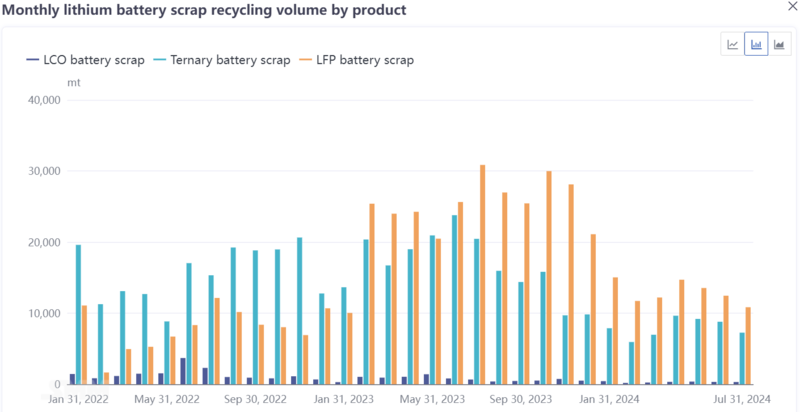
According to SMM research, the total volume of recycling in the domestic market continued to decline in July, with the monthly recycling volume (converted to black powder) amounting to only 18,388 tons, marking a new low since February of this year. This represents a month-on-month decrease of approximately 15% and a year-on-year decline of 59%. Among this, the total battery recycling volume (converted to black powder) was 7,450 tons, reflecting a month-on-month decrease of 14% and a year-on-year decrease of 60%. Meanwhile, the total electrode recycling volume (converted to black powder) saw a month-on-month decrease of 15% and a year-on-year decline of 58%.
Breaking it down by material, the total volume of ternary waste material (converted to black powder) recycled for the month reached 7,250 tons, reflecting a month-on-month decrease of 17% and a year-on-year decline of 60%.
In the case of lithium iron phosphate (LFP) waste, the total volume of LFP waste material (converted to black powder) recycled reached 10,829 tons, representing a month-on-month decrease of approximately 13% and a year-on-year decline of 58%.
Based on an overall analysis of the data for July, nickel and cobalt prices gradually stabilized after a previous continuous decline. Although lithium carbonate prices showed some stabilization around the 90,000 yuan mark in the first half of July, they returned to a downward trend after mid-month.
From the perspective of waste generation, in July, some powder processing plants and traders became less firm on prices due to the continued decline in lithium salt prices, leading some traders to sell at reduced prices. However, since the rate of price decline for lithium salts was still higher than that for waste generation, most wet process manufacturers remained in a state of deep loss. Consequently, the wet process market exhibited a pronounced polarization: those focused on OEM orders or capable of self-supplying waste maintained high levels of operation with stable production schedules; whereas those heavily reliant on external purchase of waste saw low overall production, frequent shutdowns, significant production cuts, and the external sale of previously accumulated waste inventories. This situation further contributed to a decline in waste recycling volumes.
![[Energy Storage: India proposes mandatory co-located storage for new solar and wind projects from July 2027]](https://imgqn.smm.cn/usercenter/ZLcBf20251217171731.jpg)
![[SMM Tinjauan Mingguan Pasar Sel Baterai Penyimpanan Energi 9.3] Pasokan foil tembaga yang ketat membatasi jadwal produksi September, harga sel baterai penyimpanan energi tetap stabil](https://imgqn.smm.cn/usercenter/tKgKv20251217171725.png)