SHANGHAI, Mar 27 (SMM) -
Macro
China
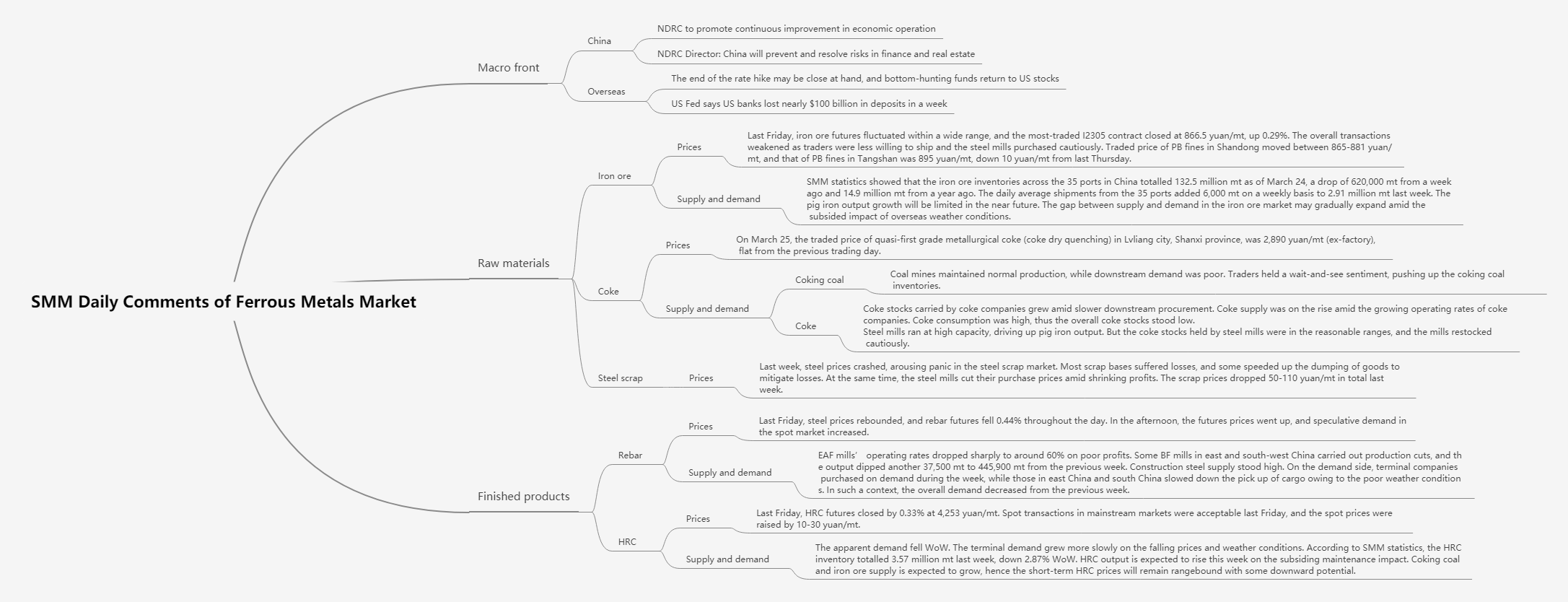
NDRC to promote continuous improvement in economic operation
NDRC Director: China will prevent and resolve risks in finance and real estate
Overseas
The end of the rate hike may be close at hand, and bottom-hunting funds return to US stocks
US Fed says US banks lost nearly $100 billion in deposits in a week
Raw materials:
Iron ore
Last Friday, iron ore futures fluctuated within a wide range, and the most-traded I2305 contract closed at 866.5 yuan/mt, up 0.29%. The overall transactions weakened as traders were less willing to ship and the steel mills purchased cautiously. Traded price of PB fines in Shandong moved between 865-881 yuan/mt, and that of PB fines in Tangshan was 895 yuan/mt, down 10 yuan/mt from last Thursday.
SMM statistics showed that the iron ore inventories across the 35 ports in China totalled 132.5 million mt as of March 24, a drop of 620,000 mt from a week ago and 14.9 million mt from a year ago. The daily average shipments from the 35 ports added 6,000 mt on a weekly basis to 2.91 million mt last week. The pig iron output growth will be limited in the near future. The gap between supply and demand in the iron ore market may gradually expand amid the subsided impact of overseas weather conditions.
Coke
On March 25, the traded price of quasi-first grade metallurgical coke (coke dry quenching) in Lvliang city, Shanxi province, was 2,890 yuan/mt (ex-factory), flat from the previous trading day.
Coal mines maintained normal production, while downstream demand was poor. Traders held a wait-and-see sentiment, pushing up the coking coal inventories.
Coke stocks carried by coke companies grew amid slower downstream procurement. Coke supply was on the rise amid the growing operating rates of coke companies. Coke consumption was high, thus the overall coke stocks stood low.
Steel mills ran at high capacity, driving up pig iron output. But the coke stocks held by steel mills were in the reasonable ranges, and the mills restocked cautiously.
Steel scrap
Last week, steel prices crashed, arousing panic in the steel scrap market. Most scrap bases suffered losses, and some speeded up the dumping of goods to mitigate losses. At the same time, the steel mills cut their purchase prices amid shrinking profits. The scrap prices dropped 50-110 yuan/mt in total last week.
Finished products:
Rebar
Last Friday, steel prices rebounded, and rebar futures fell 0.44% throughout the day. In the afternoon, the futures prices went up, and speculative demand in the spot market increased.
EAF mills' operating rates dropped sharply to around 60% on poor profits. Some BF mills in east and south-west China carried out production cuts, and the output dipped another 37,500 mt to 445,900 mt from the previous week. Construction steel supply stood high. On the demand side, terminal companies purchased on demand during the week, while those in east China and south China slowed down the pick up of cargo owing to the poor weather conditions. In such a context, the overall demand decreased from the previous week.
HRC
Last Friday, HRC futures closed down by 0.33% at 4,253 yuan/mt. Spot transactions in mainstream markets were acceptable last Friday, and the spot prices were raised by 10-30 yuan/mt.
The apparent demand fell WoW. The terminal demand grew more slowly on the falling prices and weather conditions. According to SMM statistics, the HRC inventory totalled 3.57 million mt last week, down 2.87% WoW. HRC output is expected to rise this week on the subsiding maintenance impact. Coking coal and iron ore supply is expected to grow, hence the short-term HRC prices will remain rangebound with some downward potential.

![[Afrika Selatan Usulkan Bea Antidumping Sementara hingga 28,11% untuk Baja Lapis Warna Asal Tiongkok]](https://imgqn.smm.cn/usercenter/FFFrV20251217171719.jpg)
![[Suriah Mencapai Kesepakatan dengan Arab Saudi untuk Menghidupkan Kembali Pabrik Baja Hama]](https://imgqn.smm.cn/usercenter/ntiFA20251217171719.jpg)