Sales of NEVs Totalled at 896,000 Units Worldwide in June, and BYD Ranked First in the First Half

Telah Terbit: Jul 29, 2022 11:24
Sumber: SMM
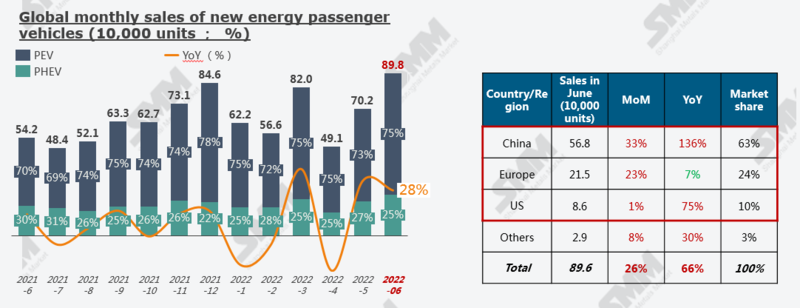
A total of 896,000 new energy vehicles were sold worldwide in June, up 26% MoM and 66% YoY. Among them, 672,000 pure electric cars were sold, an increase of 30% month-on-month, accounting for 75% of the total sales, while 225,000 plug-in hybrid electric cars (PHEVs) were sold, an increase of 15% month-on-month, accounting for 25%.

SHANGHAI, Jul 29 (SMM) – A total of 896,000 new energy vehicles were sold worldwide in June, up 26% MoM and 66% YoY. Among them, 672,000 pure electric cars were sold, an increase of 30% month-on-month, accounting for 75% of the total sales, while 225,000 plug-in hybrid electric cars (PHEVs) were sold, an increase of 15% month-on-month, accounting for 25%. As the biggest NEV market in the world, China sold 568,000 NEVs in June, an increase of 33% MoM and accounting for 63% of the global market. Europe sold 215,000 NEVs in June, an increase of 23% MoM. The top seven countries in Europe were Germany, France, Britain, Norway, Italy, Sweden and Belgium, which together accounted for over 80% the sales in Europe. The United States sold just 86,000 NEVs in June, up 1% MoM.
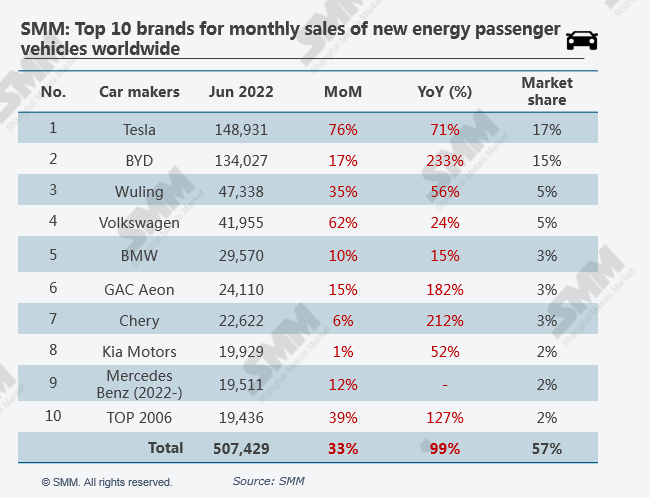
Tesla, the top car company in terms of sales, sold 148,931 unit in June, an increase of 76% month-on-month and 71% year-on-year. According to Tesla's Q2 financial report, its Shanghai and California factories both reached their highest monthly output in the second quarter. The California factory had an annual production capacity of over 650,000 units, and the Berlin Gigafactory had an annual production capacity of over 250,000 units. Tesla's four major factories all reported increasing production capacity. Elon Musk, Tesla's CEO, said that Tesla's car production might grow higher in the second half of this year. In June, BYD's global sales totalled 134,027 units, an increase of 17% month-on-month and a year-on-year increase of 233%, ranking second. BYD has sold more than 100,000 units for four consecutive months. Unlike Tesla that only sold electric vehicles suach as Model Y and Model 3, BYD's sales varied in terms of car models, and pure electric cars and plug-in hybrid electric cars were both included. In the new energy market, BYD's sales in the first half of 2022 exceeded 640,000 units, surpassing Tesla to rank first in the world. According to BYD's official estimates, BYD's total sales in 2022 will reach 1.5 million units, and are expected hit 2 million units if the supply chain is well established.
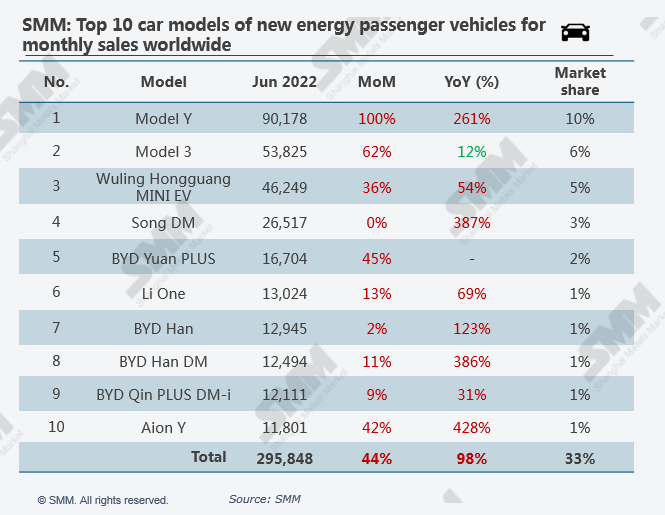
In terms of car models, Model Y, Model 3 and Wuling Hongguang MINI still remained the top three. The sales of Model Y were 90,000 units in June, an increase of 100% month-on-month and a year-on-year increase of 261%, while the sales of Model 3 in June were 54,000 units, up 63% on the month and down 12% on the year. The decline was attributed to the pandemic which led to suspended production at Tesla's Shanghai factory and reduced overseas exports. According to Der Spiegel, the German Ministry of Economic Affairs plans to end the subsidies for PHEV purchases earlier at the end of this year, and reduces the cash subsidies for purchasing electric vehicles by one-third from 2023. The Times also reported that the British government in June cancelled the policy of providing 1,500 pounds of subsidies for electric vehicles purchases. All these policies had affected the sales of electric vehicles. In June, five BYD models made it to the top ten list. Among them, Qin PLUS, whose sales had declined due to the rectification of production lines in its Changsha plant, sold 12,111 units after the rectification, an increase of 9% month-on-month and 31% year-on-year. 
At the same time, NEVs sales in Germany, Britain, France and Italy, who contributed most of the sales in Europe, fell by 10%, 1%, 9%, and 10% year-on-year respectively despite of increase on the month. This was mainly due to the impacts of Russian-Ukrainian war and subsiding subsidies. At present, the improved supply in the Chinese market and the rising oil prices have boosted the new energy market. The month-on-month increase in NEV sales in June was also significantly driven by favourable policies. In particular, some subsidies and new car consumption vouchers are effective only for first comers or may expire at the end of June, further boosting the sales of automobiles in June.
 

Pernyataan Sumber Data: Kecuali informasi yang tersedia untuk publik, semua data lainnya diproses oleh SMM berdasarkan informasi publik, komunikasi pasar, dan mengandalkan model database internal SMM. Hanya untuk referensi dan tidak menjadi rekomendasi pengambilan keputusan.

Untuk pertanyaan atau informasi lebih lanjut, silakan hubungi: lemonzhao@smm.cn
Untuk informasi lebih lanjut tentang cara mengakses laporan penelitian kami, hubungi:service.en@smm.cn
Berita Terkait
[Analisis SMM] Portugal Membatalkan Pembangunan Industri Terpadu Penambangan dan Pengolahan Litium
18 jam yang lalu
[Analisis SMM] Portugal Membatalkan Pembangunan Industri Terpadu Penambangan dan Pengolahan Litium
Baca Selengkapnya
[Analisis SMM] Portugal Membatalkan Pembangunan Industri Terpadu Penambangan dan Pengolahan Litium
[Analisis SMM] Portugal Membatalkan Pembangunan Industri Terpadu Penambangan dan Pengolahan Litium
18 jam yang lalu
[SMM Flash] SADC Didorong Beralih dari Ekspor Mineral Mentah ke Pengolahan, Larangan Ekspor Litium Zimbabwe Dijadikan Model
23 jam yang lalu
[SMM Flash] SADC Didorong Beralih dari Ekspor Mineral Mentah ke Pengolahan, Larangan Ekspor Litium Zimbabwe Dijadikan Model
Baca Selengkapnya
[SMM Flash] SADC Didorong Beralih dari Ekspor Mineral Mentah ke Pengolahan, Larangan Ekspor Litium Zimbabwe Dijadikan Model
[SMM Flash] SADC Didorong Beralih dari Ekspor Mineral Mentah ke Pengolahan, Larangan Ekspor Litium Zimbabwe Dijadikan Model
Sekretaris eksekutif Komisi Ekonomi PBB untuk Afrika, Claver Gatete, menyerukan Komunitas Pembangunan Afrika Selatan (SADC) untuk beralih dari ekspor mineral mentah menuju pengolahan lokal dan peningkatan nilai tambah, serta menyebut kawasan tersebut sebagai ajang uji coba bagi strategi mineral Afrika yang lebih luas. Permintaan mineral kritis untuk transisi energi, termasuk litium, dapat meningkat lebih dari tiga kali lipat pada 2030 dalam skenario net-zero, dengan Afrika memiliki sekitar 30% cadangan global tetapi hanya 1% produksi litium—porsi terkecil di antara mineral yang disebutkan. Zimbabwe disebut sebagai pemilik sumber daya litium utama di SADC, bersama RDK (kobalt), Afrika Selatan (platina, mangan), dan Zambia (tembaga), dengan Gatete menyoroti larangan ekspor litium tanpa pengolahan dari Zimbabwe sebagai model kebijakan bagi kawasan. Mineral menyumbang sekitar 10% PDB SADC, 25% ekspor, dan 20% pendapatan pemerintah, tetapi hanya 7% lapangan kerja langsung. Pandangan SMM: Pernyataan Gatete menambah bobot kebijakan regional bagi dorongan hilirisasi Zimbabwe yang sedang berjalan, memperkuat alasan di balik larangan ekspor konsentrat seiring kapasitas sulfat domestik mulai beroperasi.
23 jam yang lalu
Pabrik Litium Sulfat Bikita Milik Sinomine Mulai Dibangun, Target Rampung 2027 di Tengah Dorongan Larangan Ekspor Zimbabwe
14 Aug 2026 23:09
Pabrik Litium Sulfat Bikita Milik Sinomine Mulai Dibangun, Target Rampung 2027 di Tengah Dorongan Larangan Ekspor Zimbabwe
Baca Selengkapnya
Pabrik Litium Sulfat Bikita Milik Sinomine Mulai Dibangun, Target Rampung 2027 di Tengah Dorongan Larangan Ekspor Zimbabwe
Unit Zimbabwe milik Sinomine Resource Group, Masingo Lithium Technology, telah memperoleh persetujuan EIA untuk pabrik litium sulfat berkapasitas 100.000 ton/tahun di Bikita, sehingga proyek tersebut memasuki tahap konstruksi penuh dengan kontraktor China Railway No. 9 Group dan Shandong Dadi yang kini berada di lokasi. Penyelesaian ditargetkan pada pertengahan 2027. Izin ini meresmikan rencana yang pertama kali diungkapkan pada September 2024 dan ditegaskan kembali melalui penggalangan dana Sinomine sebesar RMB5,2 miliar (US$764 juta) pada Mei 2026, alih-alih menandakan komitmen modal baru. Bikita menjadi proyek litium sulfat ketiga di Zimbabwe yang didukung Tiongkok, bergabung dengan pabrik Arcadia milik Huayou berkapasitas 50.000 ton/tahun yang mulai beroperasi pada Juli 2026 dan berjalan mendekati 60% dari kapasitasnya pada akhir Juli, serta fasilitas Kamativi milik Yahua yang konstruksinya dimulai pada Februari 2026 dengan kapasitas yang belum diungkapkan. Total kapasitas gabungan yang diumumkan dari ketiga proyek tersebut mendekati 200.000 ton/tahun atau lebih setelah selesai, menjelang larangan ekspor konsentrat Zimbabwe pada Januari 2027. Pandangan SMM: Peningkatan produksi Arcadia yang lebih lambat dari kapasitas terpasang menjadi tolok ukur utama di sini. Jika Bikita mengikuti kurva serupa dengan kapasitas dua kali lipat, produksi pada laju penuh kemungkinan mundur ke 2028 meskipun target penyelesaiannya pertengahan 2027. Dengan ketiga pabrik yang kini telah melewati tahap peletakan batu pertama, dorongan benefisiasi Zimbabwe telah bergeser dari kebijakan menjadi pembangunan fisik. Sinyal berikutnya yang perlu dicermati adalah seberapa ketat larangan ekspor ditegakkan terhadap jadwal komisioning aktual masing-masing pabrik, bukan hanya jadwal yang diumumkan.
14 Aug 2026 23:09
Sales of NEVs Totalled at 896,000 Units Worldwide in June, and BYD Ranked First in the First Half - Shanghai Metals Market (SMM)