Study on extraction and recovery of germanium from secondary germanium resources [Conference on small Metals]

Telah Terbit: Oct 19, 2021 16:10
Sumber: SMM

"Click to view details

At the 2021 small Metal Industry Summit hosted by (SMM) of SMM Information & Technology Co., Ltd., Tan Fatang, Associate Professor of School of Materials Science and Engineering, Huazhong University of Science and Technology, introduced the research on the extraction and recovery of germanium from secondary resources containing germanium. Tan Fatang pointed out that although China's reserves are second to those of the United States, China is the country with the largest output of germanium, especially after 2008, China's germanium production surged to 100 tons, accounting for about 72% of the global germanium supply. It can be said that the output of germanium in China affects the total supply of germanium in the world.

Background and significance

Germanium is chemically stable, does not interact with air at room temperature, and is easy to store. Germanium has good semiconductor properties. Like most metals, germanium can be recycled.

Global germanium reserves and distribution

Germanium resources in the world are relatively poor, and the world's proven germanium reserves are only 8600 tons.

The country with the largest germanium reserves is the United States, with reserves of about 3870 tons, accounting for 45 percent of the world's total.

China's germanium reserves are about 3500 tons, accounting for 41 per cent of the world's germanium reserves.

The United States and China together account for 86% of the world's reserves.

Reserves and distribution in China

There are about 35 germanium mineral deposits in China, with reserves of about 3500 tons and prospective reserves of about 9600 tons.

Germanium-bearing mineral resources are mainly distributed in Yunnan, Inner Mongolia, Guangdong, Guangxi and Guizhou.

Yunnan is the province with the largest proven germanium metal reserves in China. Except for the germanium metal resources associated with lignite, Yunnan accounts for about 32% of the country's proven resources reserves, ranking first in the country.

Xilinhot, Inner Mongolia, is known as the germanium capital of China.

Although the United States has the largest germanium reserves in the world, because it is mainly associated with lead and zinc, the output of germanium is limited by the production of lead and zinc. In recent years, the annual output of germanium in the United States has stabilized at about 4.6 tons, accounting for only 3% of the global output.

Although China's reserves are second to those of the United States, China is the country with the largest output of germanium, especially since 2008, China's germanium production has surged to 100 tons, accounting for about 72% of the global germanium supply. It can be said that the output of germanium in China affects the total supply of germanium in the world.

Typical germanium extraction and recovery technology
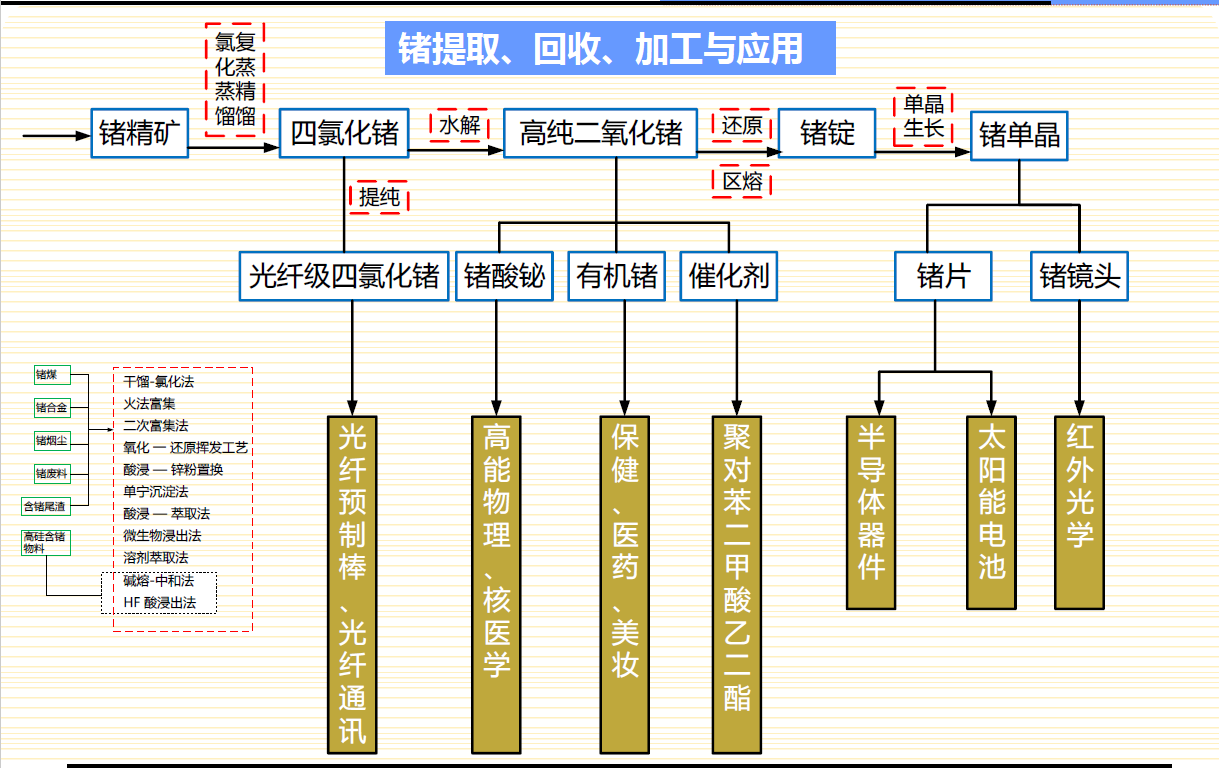
Main influencing factors of germanium extraction and recovery

The influencing factors of reduction volatilization process:

i. Particle size of germanium slag and pulverized coal; contact area with reducing atmosphere; II. Atmosphere control (reducing atmosphere, vacuum); III. Roasting and reduction temperature, the interaction between IV.SiO2 and GeO2.

The influencing factors of fire enrichment and chlorination distillation process are as follows:

i. Particle size of germanium slag and pulverized coal; II. Roasting temperature 700C-1200 ℃; III. Roasting method; IV. Roasting time.

Acid leaching process of zinc replacement residue:

i. Particle size of zinc replacement slag; II. Acid concentration, type, oxygen pressure, etc., of oxygen pressure acid leaching; III. The influence of system SiO2; IV. Iron ion masking agents (); V., such as tartaric acid, oxalic acid, citric acid, etc.) The dosage and concentration of precipitant tannin and the pH value of the solution.
Pernyataan Sumber Data: Kecuali informasi yang tersedia untuk publik, semua data lainnya diproses oleh SMM berdasarkan informasi publik, komunikasi pasar, dan mengandalkan model database internal SMM. Hanya untuk referensi dan tidak menjadi rekomendasi pengambilan keputusan.

Untuk pertanyaan atau informasi lebih lanjut, silakan hubungi: lemonzhao@smm.cn
Untuk informasi lebih lanjut tentang cara mengakses laporan penelitian kami, hubungi:service.en@smm.cn
Berita Terkait
Perdagangan Koltan Afrika di Bawah Mikroskop: Bagaimana Pembayaran Distrukturkan dan Risiko Dikelola
19 jam yang lalu
Perdagangan Koltan Afrika di Bawah Mikroskop: Bagaimana Pembayaran Distrukturkan dan Risiko Dikelola
Baca Selengkapnya
Perdagangan Koltan Afrika di Bawah Mikroskop: Bagaimana Pembayaran Distrukturkan dan Risiko Dikelola
Artikel ini mengkaji struktur pembayaran dalam perdagangan koltan Afrika. Artikel ini menilai bagaimana setiap pengaturan mendistribusikan risiko pembeli dan penjual serta menyoroti pentingnya inspeksi independen, pengujian kadar, dokumentasi, ketertelusuran, penyaringan sanksi, dan uji tuntas terhadap pihak lawan. Koltan digunakan di sini sebagai studi kasus, dengan pendekatan yang dibahas berpotensi dapat diterapkan pada perdagangan mineral lainnya.
19 jam yang lalu
Guangxi Yusheng Germanium Industry Akan Mengadakan Tender Umum untuk Produk Germanium pada Tanggal 31 [Laporan SMM]
31 Aug 2026 10:52
Guangxi Yusheng Germanium Industry Akan Mengadakan Tender Umum untuk Produk Germanium pada Tanggal 31 [Laporan SMM]
Baca Selengkapnya
Guangxi Yusheng Germanium Industry Akan Mengadakan Tender Umum untuk Produk Germanium pada Tanggal 31 [Laporan SMM]
31 Aug 2026 10:52
Risiko Mineral Konflik Tetap Ada dalam Rantai Pasok Coltan di RDK Meski Diawasi Secara Internasional
28 Aug 2026 15:00
Risiko Mineral Konflik Tetap Ada dalam Rantai Pasok Coltan di RDK Meski Diawasi Secara Internasional
Baca Selengkapnya
Risiko Mineral Konflik Tetap Ada dalam Rantai Pasok Coltan di RDK Meski Diawasi Secara Internasional
[SMM Flash] Risiko mineral konflik yang menyelimuti rantai pasok coltan di wilayah timur Republik Demokratik Kongo (DRC) tetap signifikan meski pengawasan internasional dan upaya diplomatik meningkat. Rubaya, wilayah penghasil coltan utama di Kivu Utara yang berada di bawah kendali AFC/M23, telah menjadi sumber pendapatan penting bagi kelompok bersenjata tersebut. Investigasi terbaru menunjukkan coltan dari wilayah itu masih mengalir melalui Rwanda sebelum masuk ke rantai pasok internasional, memicu kekhawatiran atas efektivitas sistem ketertelusuran mineral dan pengadaan bertanggung jawab yang ada. Investigasi pada Juni 2026 menemukan bukti bahwa setidaknya lima dari tujuh eksportir coltan terbesar Rwanda telah membeli material yang berasal dari wilayah DRC yang dikuasai M23. Material tersebut dilaporkan dijual kembali kepada pedagang dan peleburan di Tiongkok dan Kazakhstan sebelum masuk ke rantai pasok elektronik hilir. Temuan ini memperkuat penilaian PBB sebelumnya bahwa mineral dari Rubaya dapat dicampur dengan produksi Rwanda yang sah, sehingga asalnya semakin sulit diverifikasi. Tekanan internasional kian meningkat. Departemen Keuangan AS menjatuhkan sanksi pada Juni terhadap jaringan di Rwanda terkait perdagangan mineral ilegal yang terhubung dengan M23, sementara mekanisme pemantauan DRC–Rwanda במסגרת Washington Accords berlanjut pada Agustus. Pada saat yang sama, perwakilan DRC dan AFC/M23 menempuh proses perdamaian Doha yang terpisah. Bagi pembeli tantalum dan coltan, perkembangan ini menegaskan kebutuhan yang kian besar akan verifikasi asal yang lebih kuat, audit independen, dan pengendalian rantai pasok, seiring risiko geopolitik semakin menjadi faktor dalam pengadaan mineral kritis
28 Aug 2026 15:00