SMM News: sulfuric acid, as a basic industrial chemical raw material, is widely used in various fields of the national economy. Statistics from the National Bureau of Statistics and related literature data show that China's sulphuric acid consumption was 92.1292 million tons in 2017, 96.859 million tons in 2018, and slightly dropped to 89.357 million tons in 2019. The main sulfuric acid production methods in China are sulphuric acid production from sulfur, non-ferrous smelting flue gas and pyrite, accounting for 45.8%, 36.1% and 17.1%, respectively. Due to the high demand and the shortage of sulfur data, China needs to import tens of millions of tons of sulfur every year to meet the market demand for sulphuric acid. At the same time, a large amount of waste sulfuric acid is produced in industrial production. If the industrial waste acid can be treated as resources, it is not only conducive to the green development but also conducive to the sustainable development of China's sulphuric acid industry.
Source of waste acid
In the sulphuric acid consumption structure, although the chemical fertilizer industry uses the largest amount, it basically does not produce waste acid in the production process. The main industries with an annual output of more than 10 million tons of waste acid in China are titanium dioxide industry, iron and steel industry, non-ferrous smelting industry and so on.
The waste acid in titanium dioxide industry mainly comes from the production process of hydrolyzing metatitanic acid, and about 6 tons of waste sulfuric acid is produced for every 1 ton of titanium dioxide. From 2016 to 2019, the production capacity of titanium dioxide in China tends to be stable, with an annual output of about 2.8 million tons and an annual output of 16.8 million tons of waste acid, which is mainly composed of waste sulfuric acid and valuable metal ions such as titanium and iron.
The waste acid in the iron and steel industry mainly comes from the surface pickling process of sulfuric acid, which produces about 0.5 tons of waste sulfuric acid for every 1 ton of stainless steel produced. From 2017 to 2019, the production capacity of stainless steel in China is basically stable at 28 million tons, and the annual output of waste sulfuric acid is about 14 million tons, which is mainly composed of waste sulfuric acid and valuable metal ions such as iron and chromium.
In the non-ferrous smelting flue gas washing, the amount of waste acid from the washing flue gas produced by tons of copper in the copper smelting process is about 0.2m3 / 0.3m3, the concentration of waste acid is about 8% / 15%, the amount of waste acid in the zinc smelting process is about 0.3m3 / 0.5m3, and the amount of waste acid in the lead smelting process is about 0.6m3~1.0m3. According to the statistics of China Nonferrous Metals Industry Association, the total production capacity of copper, zinc and lead in China's minerals fluctuated slightly between 17 million and 20 million from 2017 to 2019. In 2017, the production capacity of copper, zinc and lead in China was 6.59 million tons, 6.22 million tons and 4.72 million tons respectively, with a total mineral capacity of 17.53 million tons. In 2018, the production capacity of copper, zinc and lead in China was 6.34 million tons, 5.68 million tons and 5.11 million tons respectively, with a total mineral capacity of 17.13 million tons. In 2019, the production capacity of copper, zinc and lead in China is 7.43 million tons, 6.24 million tons and 5.8 million tons respectively, and the total mineral capacity is 19.47 million tons. According to conservative estimates of production capacity, the amount of waste acid from flue gas washing in non-ferrous industries is about 4.8 million to 10.2 million tons, which is mainly composed of sulfuric acid, hydrochloric acid, hydrofluoric acid and copper, lead and zinc, and the acidity is about 2% to 10%. In the process of non-ferrous smelting and electrolysis of cathode copper, it is necessary to regularly remove waste acid and reduce the concentration of impurity ions to ensure product quality. For every 1 ton of valuable metals such as cathode copper, it is necessary to regularly eliminate 0.6m3 electrolytic waste acid. According to the statistics of China Nonferrous Metals Industry Association, the total production capacity of copper, zinc and lead in China's minerals in the past three years is 17 million ~ 20 million, and the amount of smelting waste acid is about 10.2 million ~ 12 million tons. Its main components are sulfuric acid and lead, zinc and copper, and the acidity is about 10% to 20%. In the past three years, the annual output of waste acid is about 15 million ~ 22.2 million tons. Although all the smelting waste acid in the non-ferrous industry has been treated innocuously according to the requirements of environmental protection, the level of comprehensive utilization still needs to be improved.
To sum up, there is a large amount of waste acid in titanium dioxide industry, iron and steel industry and smelting industry in China, and the annual output of waste acid is about 50 million tons. At the same time, because the waste acid in the smelting industry is mainly a highly corrosive mixed acid system formed by sulfuric acid, hydrofluoric acid and hydrochloric acid, which is rich in other heavy metals, it is one of the most difficult to recover waste acid in the field of waste acid.
Present situation and Prospect of waste Acid recovery in Nonferrous Industry
There are two main ways to dispose of waste acid. One is the traditional lime neutralization method, which is also a commonly used method at present, that is, the waste acid is neutralized by lime, calcium carbide slag and hydrated lime, and the neutralized liquid can be discharged up to the standard by deep treatment such as iron salt method. however, a large amount of sludge will be produced after neutralization treatment, and a large number of heavy metal ions remain in the waste liquid. The other is the recycling of waste acid, and the common treatment processes include vulcanization, sulfide electrodialysis, vulcanization-electrodialysis-evaporation, vulcanization-evaporation stripping and so on.
The composition of waste acid in non-ferrous industry is complex, the recovery is difficult, and the technical threshold is high. At the same time, in recent years, with the stricter environmental supervision policy in China, the traditional lime neutralization treatment method does not meet the requirements of the current environmental protection policy, forcing the waste acid treatment of the non-ferrous industry to move towards resource recovery. But overall, subject to the technical threshold, the recovery rate of waste acid in the industry is relatively small. In 2019, the recovery of waste acid in the non-ferrous industry is about 220000 tons, and the recovery rate is less than 5%. Since the beginning of this year, the production capacity of copper, lead and zinc in the non-ferrous industry is basically stable, and the market supply and demand is basically balanced. In the next 5 to 10 years, the annual output of waste acid will be basically the same, about 18 million tons, and there are broad prospects for acid recovery in the non-ferrous industry.
As an important part of hazardous waste, non-ferrous smelting waste acid has a broad prospect of recovery and resource utilization. Promoting the recovery of waste acid can not only avoid environmental pollution and reduce the use of primary resources, but also give birth to new energy-saving and environmental protection industries and form new economic growth points. With the continuous improvement of environmental protection policy and the improvement of waste acid recovery mechanism, the amount of waste acid recovery in China's non-ferrous industry will continue to grow, with a market scale of tens of billions of yuan.
"Click to understand and sign up: 2020 China Automotive New Materials Application Summit Forum
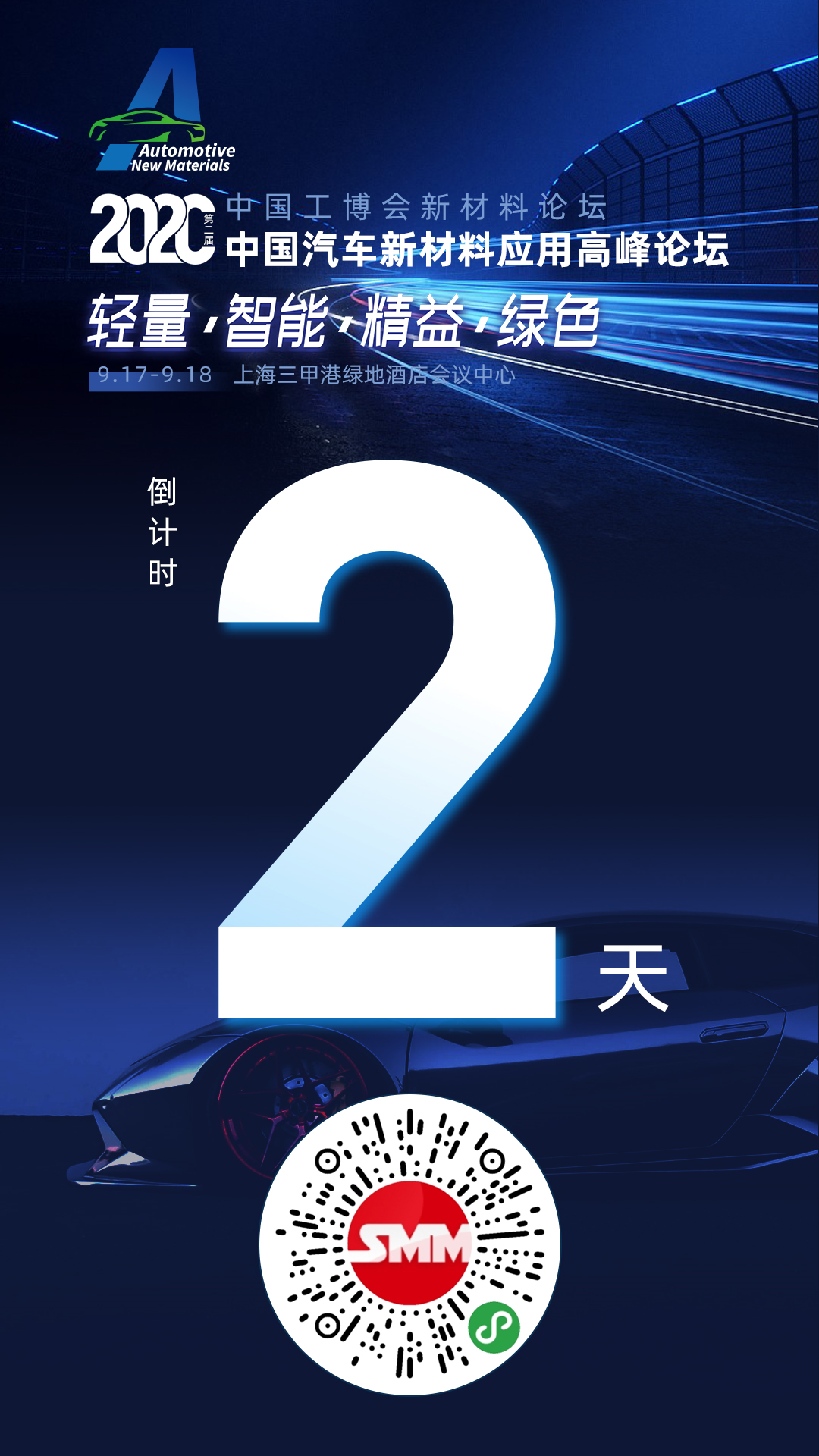
Scan the QR code above to view the business cards of the participating companies and sign up online
Scan the code and apply to join the SMM Automotive Industry Exchange Group.