The struggle between Congo and Zambia and mining companies has led to instability in the copper and cobalt supply chain!

Telah Terbit: Feb 27, 2019 16:09

SMM2, March 27: last year it was the Congo, and this year it is Zambia's turn.
 

They are all silencing opposition from some of the big mining companies by changing the mining tax system.

Global demand for their resources, particularly copper and cobalt, will give them a stable source of tax revenue.

At present, however, the huge wealth under the African copper belt is disrupting the supply chain of copper and cobalt.

One Zambian copper smelter has closed and the other has cut production, Glencore confirmed media reports last week that it would cut production at its Mutanda mine in the Congo.

The news shook the copper market and highlighted the importance of the two African countries to the global supply chain.

Cobalt has barely reacted because the "overheated" metal in recent years is still digesting the excess after the price surge in 2017.

However, the current supply turmoil will cause even greater shock to the future of cobalt and copper.
 

The miner is at a disadvantage

For some time, the Congo and Zambia have been discussing the proposed tax reform policy with mining companies.

The arguments continued earlier this month at a mining Indaba conference in Cape Town.

Yet the miners have lost.

Last June, the Congo signed a new mining law, which provides for an increase in copper royalties from 2.0 per cent to 3.5 per cent and gold from 2.5 per cent to 3.5 per cent. And introduced a new tax law, a 50% tax rate can bring it huge profits.

When Congo declared cobalt a "strategic" mineral in December, the corresponding patent rate almost tripled to 10 per cent, hitting mining companies again.

Similarly, Zambia's tax crackdown on mining companies emerged at the start of the year, with royalties rising by 1.5 percentage points to 5.5-7.5 per cent, depending on specific copper prices.

If the copper price exceeds $7500 and $9000, the concession rate will rise to 8.5 per cent and 10.0 per cent, respectively.

In addition, 15 per cent of gold and gem royalties have been introduced, while mining companies are anxiously awaiting details of a non-refundable sales tax to replace VAT with a non-refundable sales tax, which the Zambian government plans to introduce in early April.

The cost of running mining operations in both the Congo and Zambia has become increasingly high.

Marginal destruction

However, this was only a less dramatic change in Zambia's tax system, which immediately led to supply chain disruptions.

A new import duty of 5.0 per cent on copper concentrate has hindered the flow of raw materials from the Congo to Zambia.

Smelters such as Nchanga and Chambishi have traditionally relied on the supply of raw materials from the Democratic Republic of the Congo, so new import duties quickly affected them, with Nchanga production reduced and Chambishi closed because it relied entirely on concentrate supplies from the company's Boss Mining and Frontier operations in the Congo.

Future threats

Glencore faces a similar dilemma at its Mutanda mine, where its orebodies are changing from oxides to sulfides, which often require smelter processing.

This orebody change is not uncommon in copper deposits because early operations have exhausted near-surface oxide deposits, which usually cover deeper sulphide deposits.

Glencore said the new mine plan would reduce Mutanda production to 100000 tons and decide whether and how to deal with the increased sulphide reserves. "

Congo's harsher tax system makes investment decisions more difficult and is likely to be more volatile in the future.

Another key change in the new mining code last year was the reduction of operating contracts from 10 to five years, which means the government can change its targets more frequently.

And will Congo and Zambia promote the redistribution of resources and wealth by blocking investment in production?

Both Congo and Zambia are under pressure to bet their chips on copper.

At the same time, mining companies worry that the moves in both countries may be far from stopping, as both countries are burdened with heavy national debt and tight budgets.

They are also the main sources of two metals, and the rapid development of electric vehicles requires cobalt to make lithium-ion batteries and copper to build infrastructure.

Dependence on cobalt in the Congo is a well-known problem for lithium-ion battery manufacturers and their car customers.

The confidence of the Congolese government has also affected the stable supply of copper. However, they must re-understand the unpredictability of copper prices in central Africa.

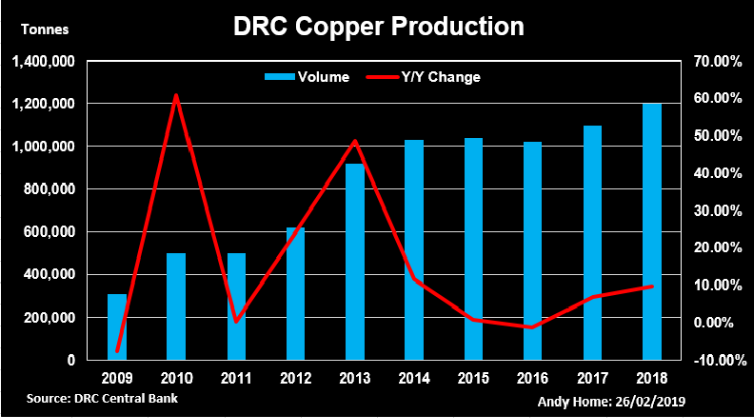
Congo's copper production collapsed in the 1990s and early 2000s, so much so that it lost its former role in the global production chain.

But now production is back. From less than 30, 000 tons in 2005 to 1.2 million tons in 2018, while Zambia produced 800000 tons, accounting for about 1/10 of global production.

Only time will tell if Congo and Zambia are on the right path, believing that mining companies will accept new mining taxes, even if they do not want to, and the cost of doing new business.

But in the short term, there will be more volatility in the supply chain.

"Click to enter the registration channel

Scan QR code, apply to join SMM metal exchange group, please indicate company + name + main business

Pernyataan Sumber Data: Kecuali informasi yang tersedia untuk publik, semua data lainnya diproses oleh SMM berdasarkan informasi publik, komunikasi pasar, dan mengandalkan model database internal SMM. Hanya untuk referensi dan tidak menjadi rekomendasi pengambilan keputusan.

Untuk pertanyaan atau informasi lebih lanjut, silakan hubungi: lemonzhao@smm.cn
Untuk informasi lebih lanjut tentang cara mengakses laporan penelitian kami, hubungi:service.en@smm.cn
Berita Terkait
Proyek Katoda Tembaga 300.000 mt Yingkou Jianfa Shenghai Tahap I Tungku Peleburan Mulai Berproduksi, Sistem Pirometalurgi Memasuki Tahap Pengeringan Tungku
21 jam yang lalu
Proyek Katoda Tembaga 300.000 mt Yingkou Jianfa Shenghai Tahap I Tungku Peleburan Mulai Berproduksi, Sistem Pirometalurgi Memasuki Tahap Pengeringan Tungku
Baca Selengkapnya
Proyek Katoda Tembaga 300.000 mt Yingkou Jianfa Shenghai Tahap I Tungku Peleburan Mulai Berproduksi, Sistem Pirometalurgi Memasuki Tahap Pengeringan Tungku
Pada 12 September pukul 9:58, tungku peleburan inti sistem pirometalurgi di proyek pemulihan multi-logam Yingkou Jianfa Shenghai Nonferrous Metals & Chemicals Co., Ltd. berhasil dinyalakan, secara resmi memasuki tahap pengeringan tungku dan menandai langkah kunci menuju commissioning dan produksi seluruh lini. Informasi publik menunjukkan bahwa proyek peningkatan teknologi pemulihan komprehensif bijih emas-perak polimetalik kompleks, relokasi, dan perluasan Yingkou Jianfa Shenghai menggunakan konsentrat tembaga sebagai bahan baku utama, dengan kapasitas terencana keseluruhan 600.000 ton/tahun katoda tembaga yang akan dibangun dalam dua fase, dengan kapasitas 300.000 ton/tahun per fase. Fase I dirancang untuk memproduksi 300.000 ton/tahun katoda tembaga dan 1,18 juta ton/tahun asam sulfat, beserta sistem pendukung untuk peleburan, konversi, pemurnian anoda, elektrolisis, benefisiasi terak, dan pemulihan logam mulia. Setelah penyalaan ini, proyek akan melaksanakan pengeringan tungku terstandarisasi dan uji coba terpadu kondisi panas di seluruh sistem untuk memverifikasi peralatan, instrumen, interlock, dan sistem kontrol otomatis. Proyek ini belum secara resmi memulai pengumpanan bahan baku dan produksi; setelah pengeringan tungku dan commissioning sistem selesai, akan dilanjutkan dengan commissioning kapasitas katoda tembaga 300.000 ton/tahun Fase I. Jika proyek berhasil mulai berproduksi, diharapkan dapat meningkatkan kapasitas peleburan tembaga di Tiongkok Utara dan semakin mendorong permintaan domestik akan bahan baku konsentrat tembaga.
21 jam yang lalu
Alchemy Resources Mulai Pengeboran Target Tembaga-Emas di Yellow Mountain
12 Sep 2026 01:13
Alchemy Resources Mulai Pengeboran Target Tembaga-Emas di Yellow Mountain
Baca Selengkapnya
Alchemy Resources Mulai Pengeboran Target Tembaga-Emas di Yellow Mountain
Alchemy Resources mengumumkan pada 11 September bahwa pengeboran sirkulasi balik telah dimulai di proyek Yellow Mountain dan Overflow di New South Wales, Australia, dengan hingga 15 lubang direncanakan selama kampanye eksplorasi terbaru. Di proyek Yellow Mountain yang 80% dimilikinya, pengeboran akan menguji perluasan mineralisasi tembaga-emas dan polimetalik yang telah diidentifikasi sebelumnya, serta dua target geofisika yang belum pernah dibor sebelumnya. Pengeboran sebelumnya di Yellow Mountain menghasilkan irisan sepanjang 113 meter dengan kadar setara tembaga 1,17%, terdiri dari 0,33% tembaga, 0,37 g/t emas, 24,3 g/t perak, 0,86% timbal, dan 1,23% seng. Kampanye pengeboran terbaru dirancang untuk menguji apakah sistem mineralisasi yang diketahui meluas ke area target yang baru diidentifikasi. Program ini juga akan mencakup pengeboran di proyek Overflow, di mana Alchemy menargetkan perluasan mineralisasi yang ada di sepanjang jurus dan di kedalaman. Overflow saat ini memiliki sumber daya mineral terindikasi sekitar 342.000 ons setara emas dan mengandung mineralisasi emas, perak, tembaga, timbal, dan seng. Dimulainya pengeboran memberikan uji jangka pendek terhadap skala dan kontinuitas mineralisasi di Yellow Mountain. Irisan tembaga-emas-polimetalik lebar yang dilaporkan sebelumnya menunjukkan potensi sistem mineralisasi yang cukup besar, sementara target geofisika yang baru ditetapkan memberikan potensi eksplorasi tambahan. Hasil pengeboran akan menjadi penting dalam menentukan apakah jejak mineralisasi dapat diperluas secara material.
12 Sep 2026 01:13
CEO Freeport Sinyalkan Kemungkinan Lanjutkan Ekspansi Tembaga Bagdad Senilai $4,5 Miliar
12 Sep 2026 01:10
CEO Freeport Sinyalkan Kemungkinan Lanjutkan Ekspansi Tembaga Bagdad Senilai $4,5 Miliar
Baca Selengkapnya
CEO Freeport Sinyalkan Kemungkinan Lanjutkan Ekspansi Tembaga Bagdad Senilai $4,5 Miliar
Chief Executive Officer Freeport-McMoRan Kathleen Quirk mengindikasikan bahwa perusahaan berharap dapat melanjutkan rencana perluasan tambang tembaga Bagdad di Arizona, menandakan komitmen yang lebih kuat terhadap proyek tersebut menjelang keputusan investasi formal. Berbicara di Jefferies Global Industrials Conference pada 10 September, Quirk mengatakan proyek tersebut masih memerlukan masukan dari dewan direksi Freeport, tetapi ia memperkirakan perusahaan akan melanjutkannya. Ia menggambarkan perluasan tersebut sebagai proyek konstruksi sekitar tiga tahun dan mencatat bahwa tidak ada hambatan perizinan besar yang diperkirakan. Estimasi proyek terbaru Freeport menempatkan belanja modal untuk perluasan Bagdad sekitar US$4,5 miliar, sekitar 30% di atas estimasi sebelumnya sebesar US$3,5 miliar, mencerminkan kenaikan biaya, perubahan lingkup, dan rekayasa tambahan. Proyek tersebut akan lebih dari dua kali lipat meningkatkan kapasitas konsentrator di Bagdad dan diperkirakan menambah sekitar 200–250 juta pon, atau sekitar 91.000–113.000 ton, produksi tembaga per tahun, bersama dengan tambahan 10–12 juta pon molibdenum. Bagdad saat ini memiliki umur cadangan lebih dari 80 tahun. Pengajuan regulasi Q2 2026 Freeport telah menggambarkan proyek tersebut sedang dipersiapkan untuk kemungkinan keputusan investasi pada paruh kedua 2026. Komentar terbaru ini dengan demikian merupakan sinyal yang lebih positif dari manajemen mengenai kemungkinan pengembangan, meskipun persetujuan dewan formal belum diumumkan. Keputusan untuk melanjutkan Bagdad akan menjadi salah satu investasi pertumbuhan tembaga jangka pendek Freeport yang paling signifikan di AS. Potensi penambahan lebih dari 90.000 ton tembaga per tahun akan meningkatkan output AS Freeport secara material, meskipun produksi pertama masih beberapa tahun lagi mengingat periode konstruksi yang diperkirakan. Perhatian kini akan beralih ke persetujuan dewan formal dan keputusan investasi akhir.
12 Sep 2026 01:10