[SMM Bilan quotidien des barres d'armature] Le rythme de déstockage ralentit légèrement, les prix des matériaux de construction pourraient continuer à se consolider à court terme

Publié: Oct 22, 2026 17:11 (GMT+8)

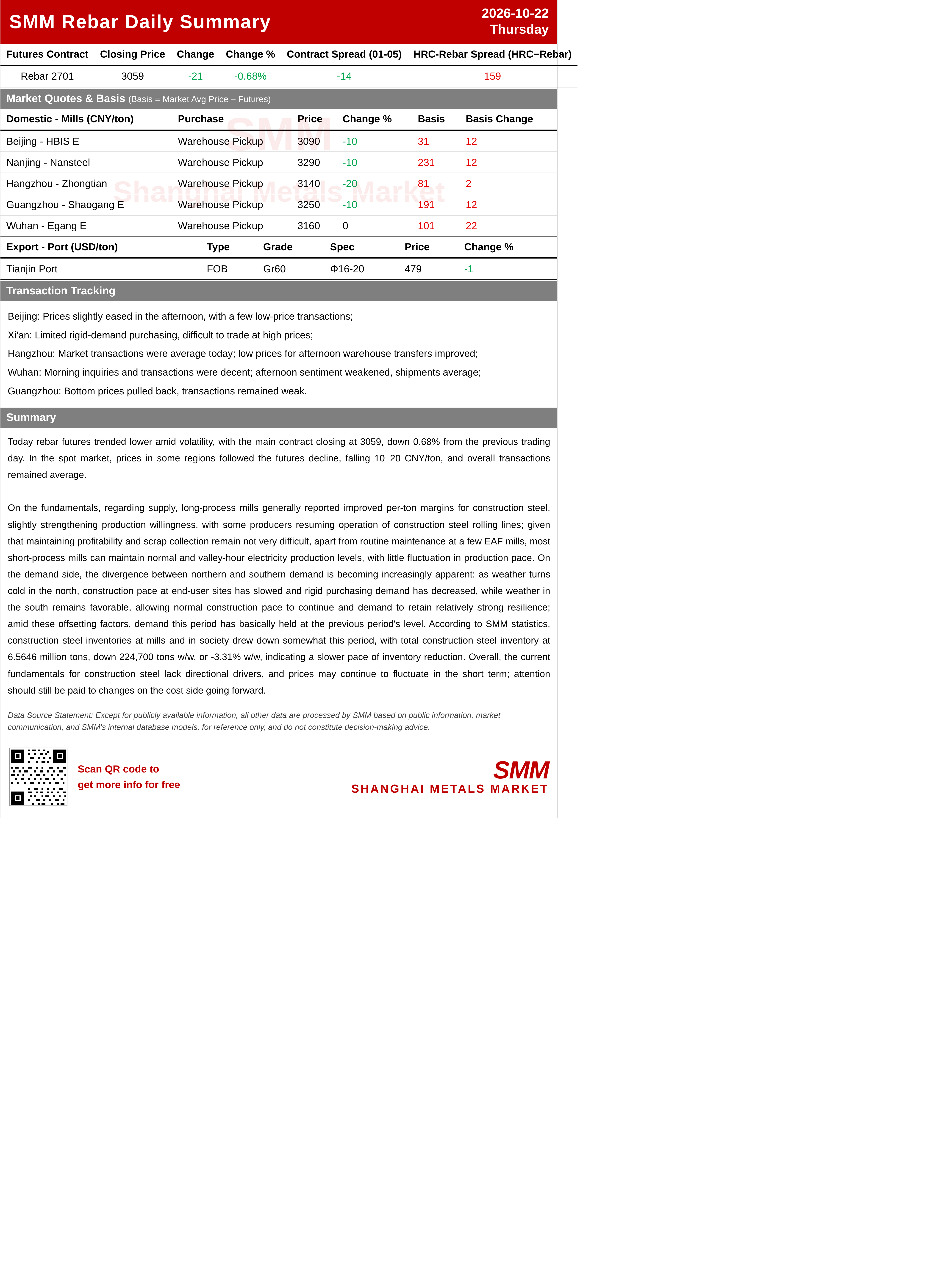
Aujourd'hui, les contrats à terme sur les barres d'armature ont légèrement baissé, le contrat le plus échangé clôturant à 3 059, en baisse de 0,68 % par rapport à la séance précédente. Sur le marché au comptant, certaines régions ont suivi la baisse des contrats à terme, avec des prix en recul de 10 à 20 yuans/tonne, et les transactions globales ont été moyennes.
Du point de vue des fondamentaux, côté offre, les aciéries au haut-fourneau ont généralement signalé que les marges bénéficiaires par tonne pour l'acier de construction se sont quelque peu redressées, ce qui a légèrement stimulé leur volonté de produire, et certaines usines ont repris la production sur les lignes de laminage d'acier de construction. Avec une rentabilité maintenue et une collecte de ferraille peu difficile, la plupart des aciéries électriques peuvent soutenir la production aux tarifs d'électricité en heures pleines et creuses, hormis l'entretien de routine dans quelques usines à four électrique, de sorte que le rythme de production a connu des fluctuations relativement faibles. Côté demande, la divergence entre le sud et le nord de la Chine devient de plus en plus évidente. Dans le nord, le temps plus froid a ralenti l'avancement des travaux sur les chantiers des utilisateurs finaux, réduisant la demande d'approvisionnement rigide. En revanche, le sud bénéficie de conditions météorologiques favorables, permettant de maintenir un rythme de construction normal, et la demande reste relativement résiliente. Ces tendances se compensant, la demande de cette période s'est largement maintenue au niveau de la période précédente. Selon les statistiques de SMM, les stocks des aciéries d'acier de construction et les stocks sociaux ont connu une certaine réduction cette période. Le stock total d'acier de construction s'élevait à 6,5646 millions de tonnes, en baisse de 224 700 tonnes en glissement mensuel, soit -3,31 % en glissement mensuel, le rythme de déstockage ralentissant quelque peu. Dans l'ensemble, les fondamentaux de l'acier de construction manquent actuellement de moteurs directionnels, et les prix devraient continuer à se consolider à court terme. Il convient de rester attentif aux évolutions du côté des coûts.

Déclaration sur la source des données : À l'exception des informations publiques, toutes les autres données sont traitées par SMM sur la base d'informations publiques, d'échanges avec le marché et en s'appuyant sur le modèle de base de données interne de SMM. Ils sont fournis à titre indicatif uniquement et ne constituent pas des recommandations décisionnelles.

Les images de cet article contiennent des légendes traduites par IA à titre indicatif uniquement.

Pour toute demande d'information ou pour en savoir plus, veuillez contacter : lemonzhao@smm.cn
Pour plus d'informations sur l'accès à nos rapports de recherche, veuillez contacter :service.en@smm.cn
Actualités Connexes
[Fortescue Q1 iron ore shipments fall 6% to 46.8 Mt]
il y a 1 minute
[Fortescue Q1 iron ore shipments fall 6% to 46.8 Mt]
Lire la suite
[Fortescue Q1 iron ore shipments fall 6% to 46.8 Mt]
[Fortescue Q1 iron ore shipments fall 6% to 46.8 Mt]
Fortescue reported iron ore shipments of 46.8 Mt for the first quarter of FY27 (quarter ended 30 September 2026), including 2.5 Mt from Iron Bridge, down 6% year on year. Iron ore sales were 42.9 Mt, below shipments, reflecting ongoing negotiations with China Mineral Resources Group (CMRG); product inventory rose during the quarter and further inventory build is expected in October. On costs and prices, hematite C1 unit cost was US$21.98/wmt, up from US$18.17/wmt a year earlier. Hematite realised price was US$79.79/dmt and Iron Bridge Concentrate revenue was US$111.09/dmt. As of 30 September 2026, the company held US$3.2 billion in cash and US$2.8 billion in net debt after the FY26 dividend and capital expenditure. Operationally, the company said it carried out its biggest-ever shutdown across port operations during the quarter, replacing the tippler cell in Train Unloader 1 and major components on its reclaimer and shiploader. It also reported a first Ore Reserve at Blacksmith of 196 Mt at an average grade of 58% iron; Dino Otranto, CEO of Fortescue Metals and Operations, said Blacksmith will play an important role in maintaining production as existing mines mature. In addition, the Green Metal Project at Christmas Creek produced first hot metal and turbine components for the Nullagine Wind Project arrived. On safety, the company reported a Leading Safety Index (LSI) of 142 and a Total Recordable Injury Frequency Rate (TRIFR) of 1.4. FY27 guidance for shipments, C1 unit cost and capital expenditure remains unchanged but is subject to the outcome of the CMRG negotiations; operations could be affected if a resolution is not reached by the end of the calendar year. [SMM Iron Ore]
il y a 1 minute
[Fortescue Q3 iron ore shipments down 6% YoY to 46.8 Mt, FY27 guidance maintained]
il y a 1 minute
[Fortescue Q3 iron ore shipments down 6% YoY to 46.8 Mt, FY27 guidance maintained]
Lire la suite
[Fortescue Q3 iron ore shipments down 6% YoY to 46.8 Mt, FY27 guidance maintained]
[Fortescue Q3 iron ore shipments down 6% YoY to 46.8 Mt, FY27 guidance maintained]
Fortescue (ASX: FMG) reported September-quarter iron ore shipments of 46.8 Mt, down 6% YoY, including 2.5 Mt from its Iron Bridge magnetite project. The company attributed part of the shortfall to its largest-ever scheduled port maintenance shutdown, which involved replacing tippler cells at Train Unloader 1 and major upgrades to reclaimers and shiploaders at its Pilbara port infrastructure. Sales recognised in the quarter totalled 42.9 Mt, below shipments, as the company declined to finalise transactions with China Mineral Resources Group (CMRG) on terms it considers unacceptable. Fortescue maintained its FY27 shipment guidance of 197-207 Mt, but said the guidance remains contingent on resolution of the CMRG pricing negotiations before the end of the calendar year. It warned that unsold stock is expected to grow by a further 4-5 Mt in October alone and that it may be forced to adjust production levels if no deal is reached by year-end. Hematite C1 cash costs rose 21% YoY to US$21.98/wmt, above the company's FY27 guidance range of US$20.50-21.75/wmt, driven by higher diesel prices (about US$1.40/t), broader supply chain inflation and lower throughput during the port shutdown. Average realised hematite prices fell 10% YoY to US$79.79/dmt, equal to 82% of the 62% benchmark index. Net debt rose to US$2.8 billion from US$0.9 billion at 30 June, while cash reserves fell to US$3.2 billion. Fortescue also reported a maiden ore reserve of 196 Mt at 58.0% Fe for its Blacksmith project. [SMM Iron Ore]
il y a 1 minute
[Linde Doubles On-site Industrial Gas Capacity at Kalinganagar to Support Tata Steel's Expansion to 8 Mtpa]
il y a 1 minute
[Linde Doubles On-site Industrial Gas Capacity at Kalinganagar to Support Tata Steel's Expansion to 8 Mtpa]
Lire la suite
[Linde Doubles On-site Industrial Gas Capacity at Kalinganagar to Support Tata Steel's Expansion to 8 Mtpa]
[Linde Doubles On-site Industrial Gas Capacity at Kalinganagar to Support Tata Steel's Expansion to 8 Mtpa]
Linde has doubled its on-site industrial gas supply capacity for Tata Steel at the Kalinganagar Industrial Complex in Odisha, India, supporting the steelmaker's production expansion there. The move is under a long-term supply agreement and is expected to support Tata Steel's plan to raise annual steel production capacity at the facility from 3 million tonnes to 8 million tonnes. The expansion follows the de-captivation of two air separation units (ASUs), which Linde has acquired and brought into operation at Kalinganagar. The units are now supplying oxygen, nitrogen and argon to Tata Steel's ironmaking and steelmaking operations. With the two additional ASUs, Linde's total oxygen production capacity in the Kalinganagar region has risen to more than 7,000 tonnes per day, which will serve Tata Steel's growing requirements as well as strengthen Linde's ability to meet rising demand across the regional merchant market. Moloy Banerjee, President ASEAN & South Asia at Linde, said the project underscored the strength of the company's long-standing relationship with Tata Steel and highlighted the critical role of industrial gases in steelmaking. He added that the project would further deepen Linde's network density in an important industrial region and position the company to capture additional growth opportunities in India. [SMM Iron Ore]
il y a 1 minute
Inscrivez-vous pour continuer la lecture
Accédez aux dernières analyses sur les métaux et les énergies nouvelles
Vous avez déjà un compte ?Connectez-vous ici