2027 could mark an important turning point for the global copper scrap trade. This does not mean countries will simultaneously ban copper scrap imports or exports. Rather, the EU’s new access rules for non-OECD destinations, US resource-retention measures, South Korea’s export declaration system and tighter import standards across Southeast Asia are expected to take effect around the same period.
Although these policies use different tools, they point in a similar direction: copper scrap is increasingly being treated as a strategic secondary resource that countries want to retain and process domestically. Global generation may not decline, but the volume of compliant material that can move freely across borders could shrink.
The EU WSR Will Be the Most Significant Policy Variable
The EU’s revised Waste Shipment Regulation (WSR) has the clearest timetable and potentially the broadest impact.
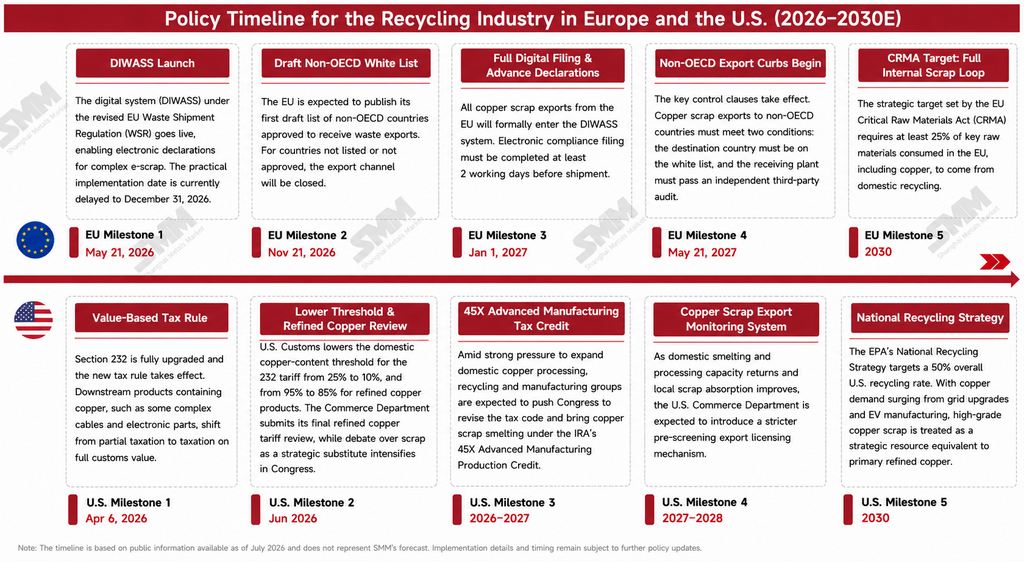
By November 21, 2026, the European Commission is expected to publish the first list of non-OECD countries approved to receive specified categories of non-hazardous EU waste. From May 21, 2027, countries not included on the list will no longer be permitted to receive relevant EU “green-listed” waste.
Approval will apply to specific waste streams rather than granting blanket access to an entire country. Even if a country is approved, it may not be authorised to import every category of scrap.
Current applications include major Asian processing and consumption markets such as India, Indonesia, Malaysia, Singapore, Thailand and Vietnam. China has not appeared on the publicly available list so far. If China is not subsequently approved for the relevant waste streams, EU copper scrap classified as green-listed waste may no longer be exported directly to mainland China through existing channels after May 21, 2027.
Exports to OECD countries will also face additional oversight. EU exporters must arrange independent audits of overseas receiving facilities to demonstrate environmentally sound treatment, while the EU may monitor or suspend exports that create environmental risks.
As a result, more European copper scrap could flow to Türkiye, Japan, South Korea and approved non-OECD destinations. Some material may also undergo further sorting or processing within Europe before being exported as higher-purity feedstock or recycled metal products.
Will the US Restrict High-Quality Copper Scrap Exports?
The US, currently the world’s largest copper scrap exporter, remains one of the most important—but still uncertain—policy variables.
US copper policy calls for at least 25% of domestically produced high-quality copper scrap to be sold within the country and recommends export licensing for such material. However, the definition of “high-quality copper scrap,” the calculation method, implementation timetable and scope of licensing have yet to be clarified.
The 25% domestic sales requirement does not amount to a ban on exporting the remaining 75%. Its impact will depend on which grades are covered and whether suppliers must complete domestic sales or merely offer material to US buyers first.
If the policy includes high-grade material such as Millberry, exports to China, Southeast Asia and Europe could decline. Nevertheless, domestic processing capacity, regional price differences and possible exemptions will determine its real effect. The policy should therefore be viewed as a potential supply risk rather than a confirmed export ban.
Japan and South Korea Strengthen Domestic Resource Circulation
Neither Japan nor South Korea has banned copper scrap exports, but both are shifting from general environmental regulation towards stronger domestic resource security.
Japan’s 2026 Circular Economy Action Plan targets recycled materials—including e-waste and copper scrap—accounting for around 30% of domestically produced refined copper by 2030. It also aims to mobilise approximately JPY1 trillion in investment in the recycling of critical minerals and metals.
Rather than relying on export restrictions, Japan is supporting investment in shredding, sorting and e-waste recycling equipment through subsidies, financing and simplified licensing procedures. At the same time, it plans to tighten customs inspections and clarify Basel Act classifications to prevent the inappropriate outflow of recyclable resources.
South Korea, meanwhile, plans to introduce export declaration requirements for ferrous and non-ferrous metal scrap that was previously exempt. Exporters may need to provide composition reports, contracts and other documentation to prevent copper scrap and e-waste from being misdeclared as ordinary ferrous scrap. The revised rules are expected to take effect on January 1, 2027.
The measure is intended to improve transparency rather than prohibit exports. Well-defined and properly declared copper scrap should continue to move, while mixed or poorly documented cargoes may face higher testing costs and longer customs clearance.
China’s Compliance Push Could Increase Import Dependence
China has not further relaxed its copper scrap import standards, but domestic tax and invoicing reforms are changing how companies assess effective supply.
The reverse-invoicing system allows qualified recycling companies to issue invoices on behalf of individual scrap sellers, helping establish a traceable tax and cost-accounting chain. In the long term, this should bring more domestic copper scrap into the formal market.
In the short term, however, companies must meet qualification requirements, maintain purchasing records and prove that transactions are genuine. Consequently, not all un-invoiced material can immediately enter compliant supply channels.
Imported recycled copper raw materials generally come with more complete customs, tax and documentation records, making them easier for compliant companies to purchase. If the EU WSR reduces direct European shipments to China while the US, Japan and South Korea strengthen domestic retention and export controls, Chinese buyers may become more dependent on compliant material from Southeast Asia, Latin America and other regions.
Southeast Asia Will Face a Double Access Barrier
Southeast Asia has absorbed substantial copper scrap sorting and processing capacity, but the region is moving towards a model that accepts clean raw materials while restricting mixed and contaminated waste.
Malaysia requires imported copper scrap, including HS 7404 material, to obtain SIRIM approval and undergo pre-shipment and arrival inspections. Imports are also subject to quotas and company qualification requirements. Malaysia introduced a comprehensive ban on e-waste imports in February 2026.
Thailand has similarly expanded restrictions on e-waste and tightened inspections of mixed metal scrap containing circuit boards. Vietnam and Indonesia continue to permit qualifying metal scrap imports for industrial use but impose conditions covering importer qualifications, impurity levels and end use.
From 2027, EU copper scrap entering Southeast Asia may therefore need to pass two separate barriers: approval under the EU WSR and compliance with the destination country’s own import standards.
The region may continue to absorb some trade diverted from China, but it is unlikely to become an unrestricted destination for low-grade or mixed scrap.
Other Markets Are Also Retaining More Resources
India introduced an extended producer responsibility system for non-ferrous metal scrap in April 2026, covering copper, aluminium, zinc and their alloys. Although this is not an import restriction, it will encourage more formal recycling and raw-material procurement. As India’s copper-processing capacity expands, competition for compliant scrap from Europe, the Middle East and the US may strengthen.
Some Middle Eastern and African countries are using export fees, licensing systems and temporary bans to retain material. The UAE currently charges AED400 per tonne on copper scrap exports, while Dubai has also imposed temporary restrictions on certain copper scrap exports. South Africa has long used export taxes and permits to raise the cost of exporting scrap metals.
These measures may not all be new in 2027, but they reflect a broader shift towards prioritising domestic smelting and manufacturing demand.
What Will Happen in 2027?
SMM expects the combined policies to produce three major changes.
First, global copper scrap generation may remain stable, but effective cross-border supply will decline. European material could be redirected towards OECD or approved non-OECD markets, while more high-quality US scrap may be retained domestically.
Second, prices for high-quality scrap are likely to remain elevated. Clean, traceable and well-documented material will face stronger competition from buyers in China, India, Japan, South Korea and Southeast Asia, supporting resilient pricing coefficients.
Third, compliance costs will increasingly be reflected in prices. In addition to copper content, recovery rates and freight, traders will need to consider facility audits, composition testing, export declarations, destination permits, traceability and return-shipment risks. Identical grades may therefore command different prices depending on their origin, route and receiving facility.
SMM believes the key question for 2027 is not whether global copper scrap trade will be broadly prohibited, but which countries, waste streams and material grades will remain within compliant trade channels.
The EU’s first approved-destination list, South Korea’s final export declaration rules and the US definition of “high-quality copper scrap” will be the three most important policy signals. Even if total trade volumes do not fall sharply, greater supply concentration, longer trade routes and rising compliance costs are likely to support high-quality copper scrap pricing and widen regional price differences.

![L'offre de minerai de cuivre et de ferraille est tendue, la production de cathodes de cuivre difficile à augmenter [Analyse SMM]](https://imgqn.smm.cn/usercenter/EOMNB20251217171709.jpg)