SMM August 7 News:
In H1 2026, the core operating logic of China's copper anode market could be summarized as follows: the commissioning of overseas projects drove a recovery in import growth, yet the tightening of domestic copper scrap policies rapidly reversed the supply-demand pattern from loose in Q1 to tight in Q2.
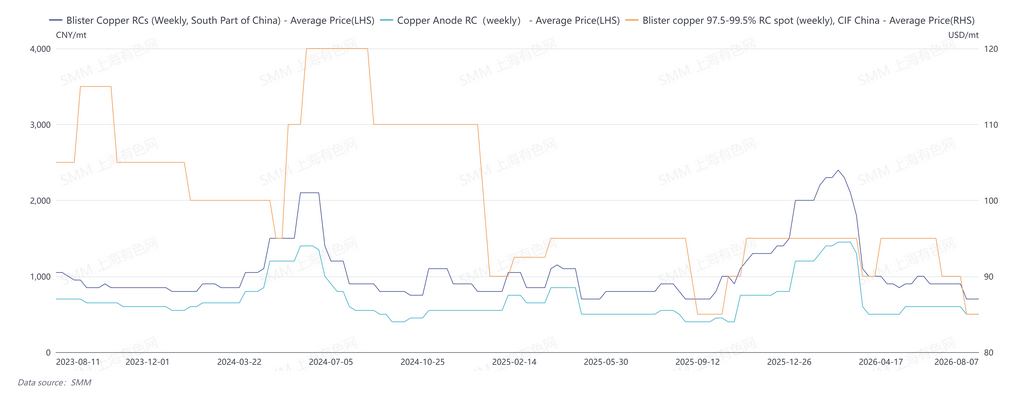
Entering July, the market logic did not undergo a fundamental shift. Although blister copper RCs remained relatively stable during the month, domestic producers of scrap-derived blister copper and copper anodes continued to face the issue of differentiation between tax-inclusive and tax-exclusive raw materials. Concurrently, some suppliers of ore-derived copper anodes conducted maintenance and commissioned their own refining capacity during the month, leading to a decline in the domestic circulation of ore-derived copper anodes and the continuous accumulation of structural imbalances on the supply side.
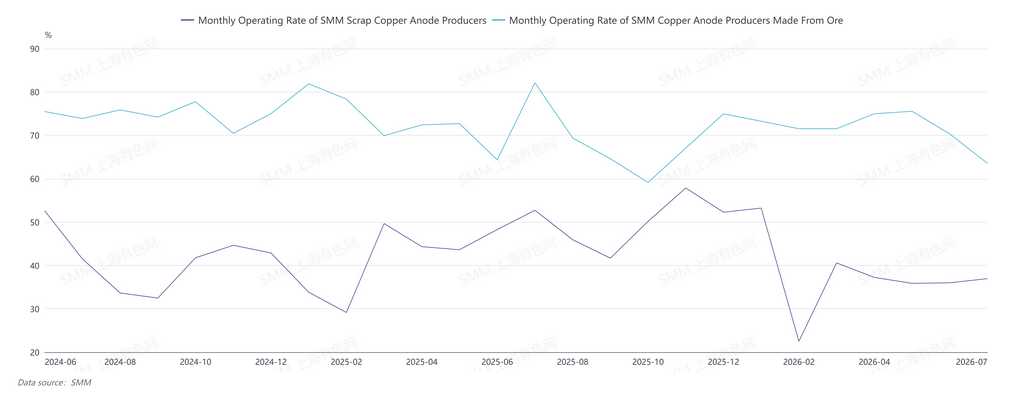
Entering August, supply-side constraints on raw materials intensified, while smelters' stockpiling demand remained rigid. The supply-demand imbalance in the market continued to worsen. As of August 7, the SMM weekly blister copper RCs cif China were quoted at $80-90/mt; weekly blister copper RCs in south China were quoted at 600-800 yuan/mt; and weekly copper anode processing fees in China were quoted at 450-550 yuan/mt, with all processing fees having fallen to their lowest points of the year.
Supply-Side Constraints Persist
The supply side of the current blister copper market is facing dual pressures from the tightening of domestic copper scrap policies and limited incremental imports from outside China.
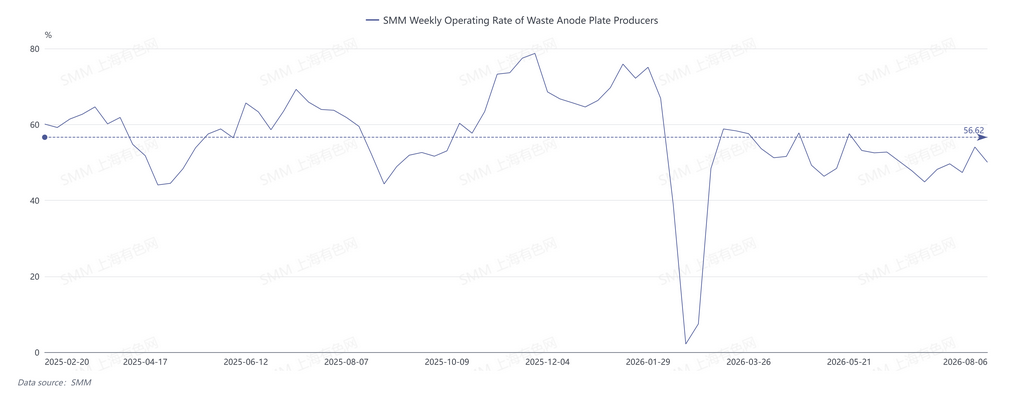
Domestically, the policy tightening in the copper scrap industry is the core variable. Following the strict enforcement of invoice regulations, the divergence between tax-inclusive and non-tax raw materials in the market has become increasingly prominent, limiting the operating rates of secondary blister copper and copper anode enterprises and continuously intensifying supply constraints. Meanwhile, delivery risks for producers have been accumulating. However, with copper prices shooting up recently, the widening price spread between primary metal and scrap has emerged as a variable, providing some relief to raw material supply pressure.
As for import, from January to June 2026, China's cumulative imports of copper anodes totaled 404,900 mt, up 6.87% YoY. The import growth primarily relied on the capacity ramp-up of the Kamoa project's smelting capacity in the DRC, with copper anode imports from the DRC surging 104.78% YoY in June. However, with Zambia's blister smelting capacity entering a concentrated maintenance period in Q3 and Q4, compounded by persistent logistics disruptions in the African region, the volume of copper anode imports is expected to be weighed down in Q3. The incremental supply of scrap-derived copper anodes imported from South Africa and Southeast Asia is worth monitoring.
Rigid Support on the Demand Side, Intensifying Scramble for Raw Materials
On the demand side, domestic copper anode inventories have been declining gradually since supply fell in Q2. Meanwhile, smelters face intensive maintenance plans in Q3 and Q4, with pre-maintenance stockpiling demand continuously rising. Against the backdrop of an unchanged ore shortage, competition for raw materials among smelters is becoming increasingly fierce, further boosting procurement demand for blister copper and copper anodes.
Against the backdrop of intensifying supply-demand imbalance, the tight pattern in the anode copper market is expected to be difficult to change in the short term.
![Japan's Copper Raw Material Procurement System Integration Delayed; PPC New Company Plan Postponed to February 2027 Operation [SMM Analysis]](https://imgqn.smm.cn/usercenter/hsjMg20251217171712.jpg)