Material Recycling Association of India
Voice of the Indian Recycling Industry
Concept Note
ONE DAY CONFERENCE ON CRITICAL MINERALS RECYCLING LANDSCAPE
1. Background & Context
India’s transition towards clean energy, electric mobility, and advanced manufacturing is driving an unprecedented demand for critical minerals such as lithium, cobalt, nickel, rare earth elements, and platinum group metals. However, India remains highly import dependent (over 80–90%) for several critical minerals (Ministry of Mines, NITI Aayog), making supply chains vulnerable to geopolitical disruptions and price volatility.
Recognizing this, the Government of India has launched the National Critical Mineral Mission (NCMM) to strengthen domestic capabilities across the value chain: from exploration and mining to processing and recycling.
While mining is inherently capital-intensive and long-gestation, recycling of critical minerals offers a near-term, scalable, and sustainable pathway with significant economic and environmental benefits:
- Import Substitution: Estimates suggest recycling could contribute a meaningful share (30-40%) of future demand, subject to collection efficiency and technology scale-up (NITI Aayog, CII)
- Carbon Emission Reduction: Recycling critical minerals can reduce emissions by 30–70% compared to primary mining, particularly for metals like aluminum, nickel, and cobalt (Global Studies)
- Energy Savings: Secondary production of metals can save up to 60–90% of energy compared to virgin extraction (IEA)
- Livelihood Generation: A formalized recycling ecosystem can generate large-scale employment, particularly by integrating India’s informal sector, which currently handles 80–90% of waste collection
- Climate & Net-Zero Goals: Recycling will play a critical role in supporting India’s commitment to net-zero emissions by 2070 and achieving 500 GW of non-fossil fuel capacity by 2030
In this context, there is a strong need for a multi-stakeholder policy dialogue to align government vision, technological capabilities, and industry realities, and to accelerate the development of a robust recycling ecosystem under NCMM.
2. Objective
This conference is designed as a high-level stakeholder consultation platform to deliberate on the role of recycling within India’s critical mineral strategy and to identify actionable interventions across policy, technology, and market development.
Key Objectives:
- Assess the role of recycling in achieving supply security under NCMM
- Evaluate the effectiveness of existing and proposed policy and incentive frameworks
- Identify gaps in regulatory frameworks and institutional coordination
- Examine challenges in technology development, commercialization, and scaling
- Capture industry perspectives on market mechanisms, feedstock availability, and financing
- Assess the current black mass landscape in India and pathways for domestic value recovery
- Develop a roadmap for building a resilient and competitive critical mineral recycling ecosystem
3. Conference Structure
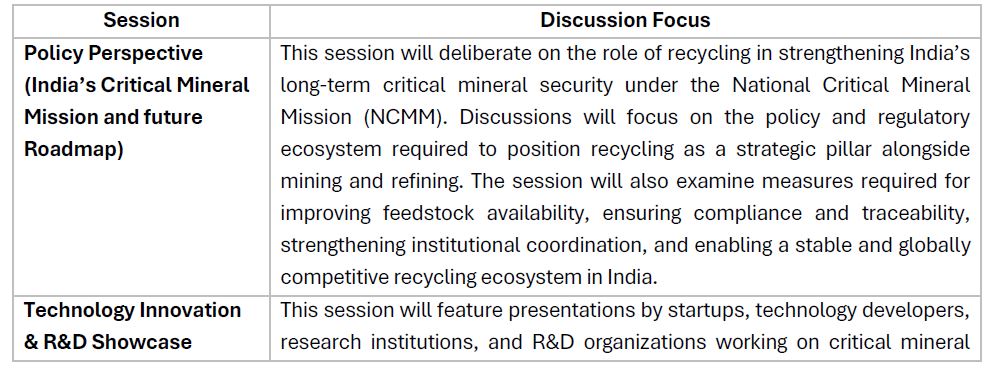
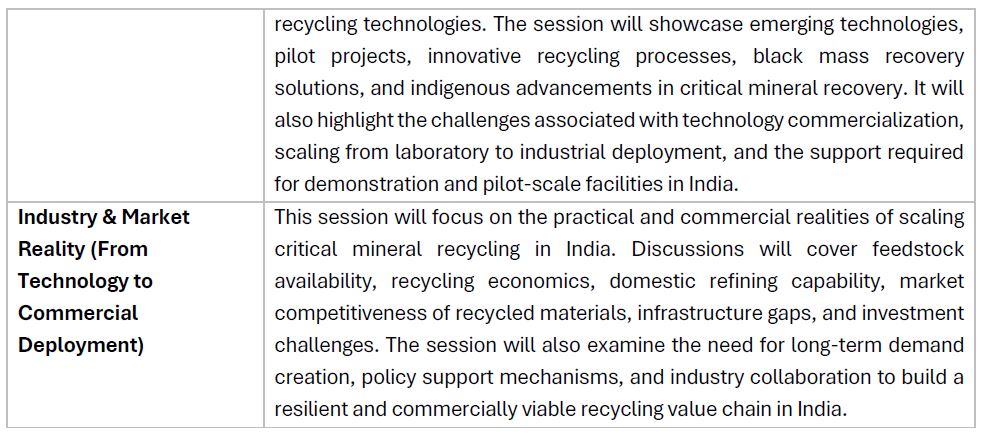
The conference is structured across three key pillars:
4. Expected Outcomes
- Development of a “Conference Recommendations Report” for submission to relevant ministries
- Identification of priority policy interventions to strengthen recycling under NCMM
- Recommendations on technology scaling, funding mechanisms, and industry support
- Actionable inputs for improving feedstock availability, market development, and regulatory alignment
5. Conclusion
As India positions itself as a global leader in clean energy and advanced manufacturing, critical mineral security will be a defining factor in sustaining this growth. Recycling presents a strategic opportunity to complement primary resource development while advancing sustainability and circular economy objectives.
This consultation aims to catalyze policy action, technological innovation, and industry alignment, enabling India to build a resilient, self-reliant, and circular critical mineral ecosystem.

![Geopolitical agreement final signing date set, the most-traded SHFE tin contract returned above 420,000 [SMM Tin Midday Review]](https://imgqn.smm.cn/usercenter/WWXJU20251217171753.jpg)