Points clés : Croissance rapide : Les matériaux cathodiques LFP (+60 %), le phosphate de fer (+67 %) et le LiPF6 (+38 %) ont connu une expansion significative de leur production, reflétant une forte demande provenant des batteries de puissance et du stockage d'énergie. Les matériaux de nouvelle génération tels que le LMFP et le phosphate de fer et de sodium composite ont progressé de plus de 90 %, entrant dans la phase de commercialisation. Retard des batteries à l'état solide : La production de P₂S₅ est restée stable à 60 000 tonnes, en hausse de seulement 11,62 %, indiquant que les batteries à l'état solide à base de sulfure sont encore au stade de la R&D et que l'industrialisation à grande échelle prendra du temps. La transformation vers les nouvelles énergies des produits chimiques phosphorés s'accélère, mais les percées en volume pour les matériaux de nouvelle génération restent à venir.
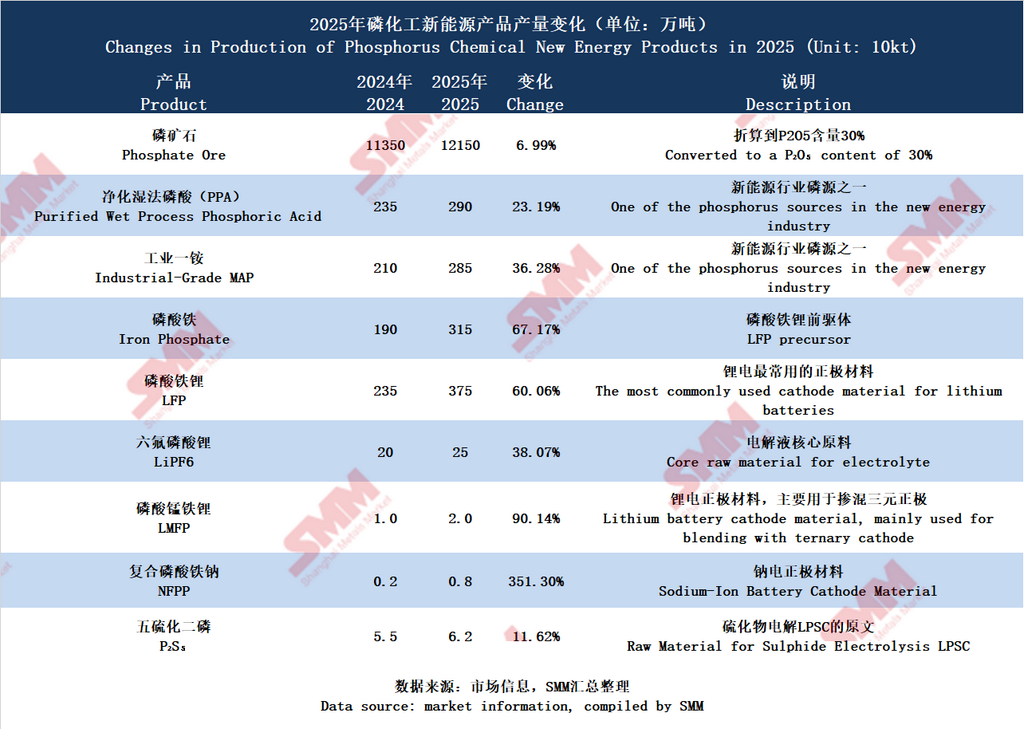
De 2024 à 2025, les produits chimiques à base de phosphore étroitement liés à l'industrie des nouvelles énergies ont généralement affiché une croissance rapide.
Parmi eux, le matériau cathodique et le précurseur phosphate de fer (+67,17 %) et le LFP (+60,06 %) ont enregistré les augmentations les plus significatives, reflétant directement la forte demande en matériaux cathodiques LFP de la part des secteurs des batteries de puissance et du stockage d'énergie. Les matières premières MAP de qualité industrielle et l'acide phosphorique purifié par voie humide ont progressé respectivement de 36,28 % et 23,19 %. En tant que sources clés de phosphore pour le LFP, leur croissance était globalement en phase avec le rythme d'expansion en aval. Le LiPF6 a progressé de 38,07 %, correspondant à l'expansion continue du marché des électrolytes. Bien que le LMFP et le phosphate de fer et de sodium composite aient eu des bases relativement faibles, leurs taux de croissance étaient extrêmement élevés (dépassant respectivement 90 % et 350 %), indiquant que les matériaux cathodiques de nouvelle génération (ternaire mélangé, batterie sodium-ion) entrent dans la phase de commercialisation. Côté batteries à l'état solide, la production de P₂S₅ est restée stable autour de 60 000 tonnes sur les deux années, n'augmentant que de 11,62 %. En tant que matière première essentielle pour les électrolytes solides à base de sulfure (par ex. LPSC), la production de P₂S₅ n'a pas connu de croissance explosive, suggérant que les batteries tout-solide à base de sulfure sont encore au stade de la R&D ou de la production pilote et n'ont pas encore généré de demande d'industrialisation à grande échelle. De plus, la croissance des applications du P₂S₅ dans les industries traditionnelles a été limitée. Dans l'ensemble, les produits chimiques phosphorés accélèrent leur transition vers le secteur des nouvelles énergies, tandis que la montée en volume à grande échelle des matériaux de batteries de nouvelle génération nécessitera encore du temps.
Remarque : Si vous avez des ajouts ou des corrections concernant les détails mentionnés dans cet article, n'hésitez pas à nous contacter à tout moment. Les coordonnées sont les suivantes :
Tél. : 021-20707860 (ou ajoutez le WeChat 13585549799) Yang Chaoxing, merci !
![[SMM News] Le Zimbabwe impose une prise de participation dans 14 minerais (Li, Ni) sous peine d'interdiction d'exploitation. Dirigeant chinois : nouveaux projets concernés ; anciens exemptés.](https://imgqn.smm.cn/usercenter/QXufg20251217171730.jpg)
![[Batterie au lithium : 13 entreprises prévoient d'augmenter le capital de Sunwoda Power]](https://imgqn.smm.cn/usercenter/jZvMC20251217171729.jpg)