Les exportations de produits en magnésium ont bien démarré en janvier-février 2026, avec une hausse cumulée de 3 400 t
En janvier 2026, les exportations chinoises de produits en magnésium ont affiché de solides performances, atteignant 40 300 t, en hausse de 6 % sur un an et de 4,2 % par rapport à décembre 2025. Deux raisons principales expliquent cette évolution : premièrement, les commandes ont été passées de manière intensive au T4 2025, alors que les prix du magnésium continuaient de baisser, et les entreprises aval hors de Chine ont successivement sécurisé leurs commandes du T1 2026 à partir d’octobre. Ajouté à des exportations globalement faibles au S1, cela a entraîné une forte hausse de la demande en fin d’année, stimulant nettement les exportations en janvier ; deuxièmement, en raison des congés du Nouvel An chinois en février, les négociants ont majoritairement choisi d’expédier massivement en janvier, lorsque les capacités de transport étaient suffisantes, ce qui a encore accru le volume des exportations. Dans l’ensemble, janvier a posé des bases solides pour le marché des exportations de magnésium sur l’ensemble de l’année.
En février 2026, le total des exportations de produits en magnésium s’est établi à 32 300 t, en hausse de 3,7 % sur un an, mais en baisse de 1,96 % sur un mois. Bien que les exportations de février aient reculé en rythme mensuel en raison des congés du Nouvel An chinois, leur niveau global est resté supérieur à celui de la même période de 2025. Les exportations cumulées sur janvier-février ont atteint 72 700 t, soit une augmentation de 3 400 t par rapport à la même période de l’an dernier, marquant un début d’année globalement positif.
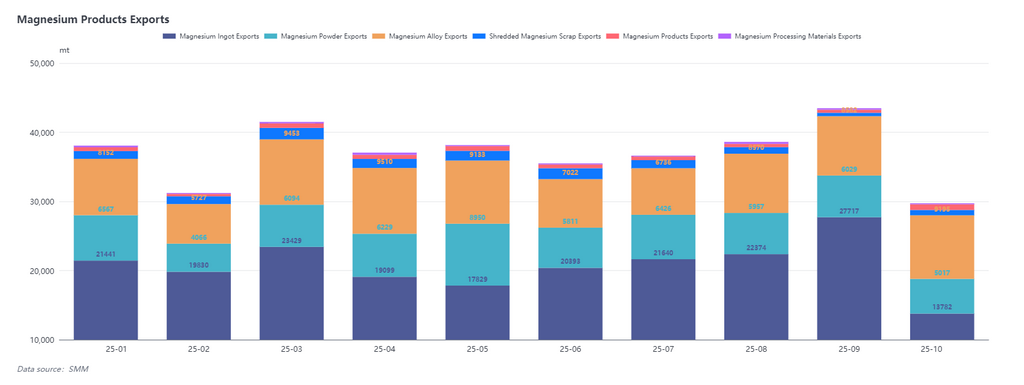
L’alliage de magnésium a porté la croissance des exportations en début d’année, tandis que les lingots de magnésium ont subi des pressions et que la poudre de magnésium est restée stable
Par produit, la hausse de la demande à l’export au début de 2026 est principalement venue des alliages de magnésium.
Lingots de magnésium : En janvier 2026, les exportations chinoises de lingots de magnésium se sont élevées à 20 500 t, en baisse de 4,79 % sur un mois ; les exportations de février ont atteint 18 000 t. Les exportations cumulées sur janvier-février ont reculé de 6,8 % sur un an.
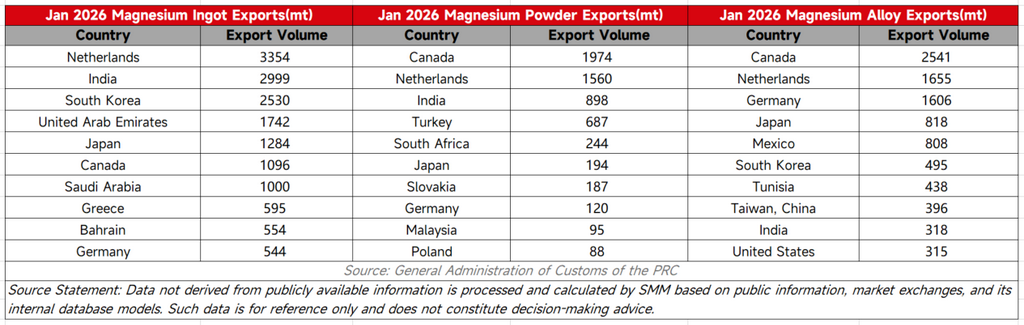
Du point de vue de la structure régionale, le recul des exportations provient principalement du marché européen. En janvier, les exportations vers les Pays-Bas n’ont été que de 3 353 t, en baisse de 33,73 % sur un mois. La principale raison tient à des facteurs saisonniers : à la mi-décembre 2025, les stocks constitués dans les ports hors de Chine étaient suffisants, tandis que la consommation a ralenti pendant les fêtes de Noël. En particulier, les négociants européens ont passé moins de commandes de lingots de magnésium, ce qui a entraîné un net repli des exportations.
Alliage de magnésium : En janvier 2026, les exportations chinoises d’alliages de magnésium ont atteint 11 000 t, en hausse de 19,72 % sur un mois, un nouveau sommet mensuel en près d’un an ; les exportations de février se sont élevées à 7 455 t. Les exportations cumulées de janvier-février ont augmenté de 33,07 % en glissement annuel.
En observant la tendance sur l’ensemble de l’année 2025, les exportations d’alliages de magnésium ont fortement fluctué, mais après l’entrée au T3, la demande hors de Chine s’est progressivement redressée et stabilisée. En 2026, cette dynamique de croissance s’est poursuivie en janvier, avec des libérations concentrées de commandes, principalement soutenues par la course des entreprises pour achever les expéditions avant le Nouvel An chinois et par des programmes de production pleins. Selon l’enquête de la SMM, les commandes à l’exportation d’alliages de magnésium sont désormais régulièrement planifiées jusqu’en avril de cette année, ce qui indique une forte résilience de la demande hors de Chine. Dans l’ensemble, les exportations d’alliages de magnésium devraient devenir un soutien important à la croissance du commerce extérieur des produits à base de magnésium en 2026, et il convient de continuer à suivre l’exécution des commandes et l’évolution de la demande hors de Chine.
Poudre de magnésium : En janvier 2026, les exportations chinoises de poudre de magnésium ont atteint 6 503 t, en hausse de 10,88 % par rapport au mois précédent ; celles de février se sont établies à 5 226 t. Les exportations cumulées de janvier-février ont progressé de 10,3 % en glissement annuel.
Dans l’ensemble, les exportations de poudre de magnésium sont restées relativement stables, les commandes de commerce extérieur reposant principalement sur des achats selon les besoins. Les exportations ont légèrement augmenté au début de l’année, et la poursuite de cette dynamique dépendra encore des performances à l’exportation en mars.
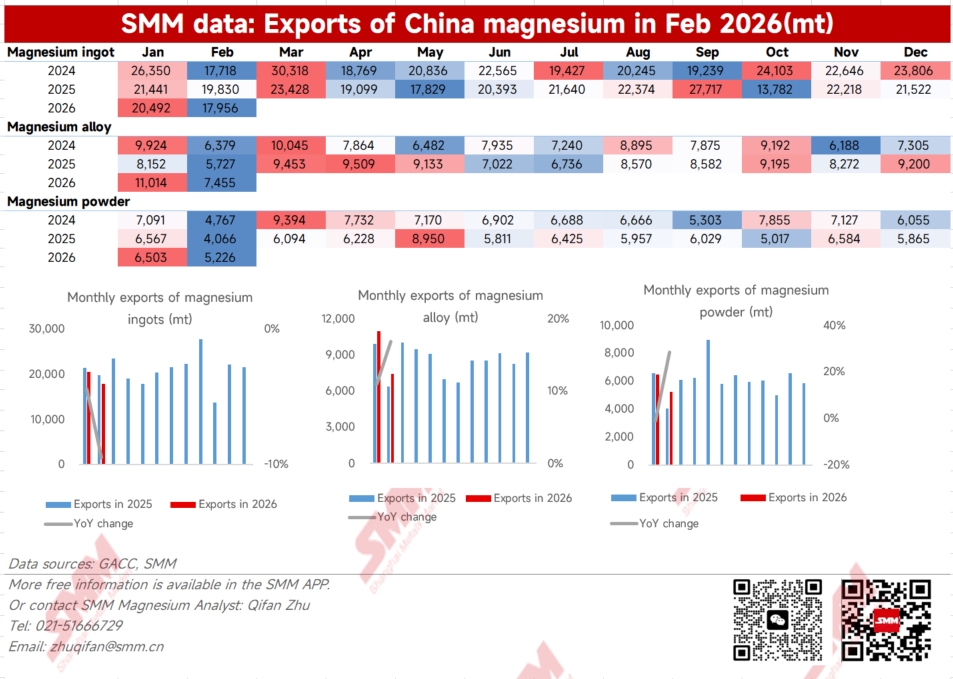
Les exportations de lingots de magnésium vers les Pays-Bas ont fortement reculé, tandis que les exportations d’alliages de magnésium vers le Canada ont enregistré une forte croissance
Par marché de destination, en termes d’exportations,
Les principaux marchés de demande pour les lingots de magnésium sont restés concentrés aux Pays-Bas, en Inde et en Corée du Sud. La baisse des exportations a principalement provenu du marché néerlandais, tandis que la demande sur le marché indien est restée stable. En outre, les exportations vers le Japon ont été de 1 284 t en janvier et de 1 938 t en février, sans baisse globale évidente. Le Canada est resté la principale destination des alliages de magnésium et de la poudre de magnésium. Parmi eux, les exportations d’alliages de magnésium vers le Canada ont atteint 2 541 t, avec une hausse relativement marquée.
Les conflits géopolitiques ont perturbé les chaînes d’approvisionnement, créant des incertitudes pour les exportations de magnésium au T2
En ce qui concerne les exportations du T2, l’impact des conflits géopolitiques sur les chaînes d’approvisionnement mondiales devient progressivement évident. Selon la SMM, l’escalade du conflit entre les États-Unis et Israël au début du mois de mars a déjà provoqué des perturbations d’approvisionnement dans deux grandes usines d’aluminium au Moyen-Orient : l’usine d’aluminium Qatalum au Qatar a été complètement mise à l’arrêt en raison d’une coupure de l’approvisionnement en gaz naturel. Sa capacité nominale annuelle d’aluminium primaire était de 636 000 t, et un arrêt ordonné devrait être achevé d’ici fin mars, tandis qu’une reprise complète de la production nécessiterait 6 à 12 mois ; Alba, à Bahreïn, a déclaré un cas de force majeure en raison des perturbations du transport maritime dans le détroit d’Ormuz et n’a pas été en mesure d’honorer ses contrats d’approvisionnement. Par conséquent, les commandes d’achat de matières premières de magnésium sur le marché du Moyen-Orient sont au point mort depuis mars, et les expéditions sont globalement perturbées.
En outre, la crise de l’approvisionnement en aluminium s’est encore propagée au marché européen, exerçant une pression sur les secteurs de la transformation des alliages d’aluminium et de l’énergie, et pesant fortement sur la demande d’exportations de magnésium. Bien que le marché des exportations de magnésium ait bien commencé au cours des deux premiers mois de 2026, les exportations après mars et au deuxième trimestre font face à une forte incertitude en raison des perturbations géopolitiques, et la tendance auparavant stable pourrait être rompue.