SMM 13 février :
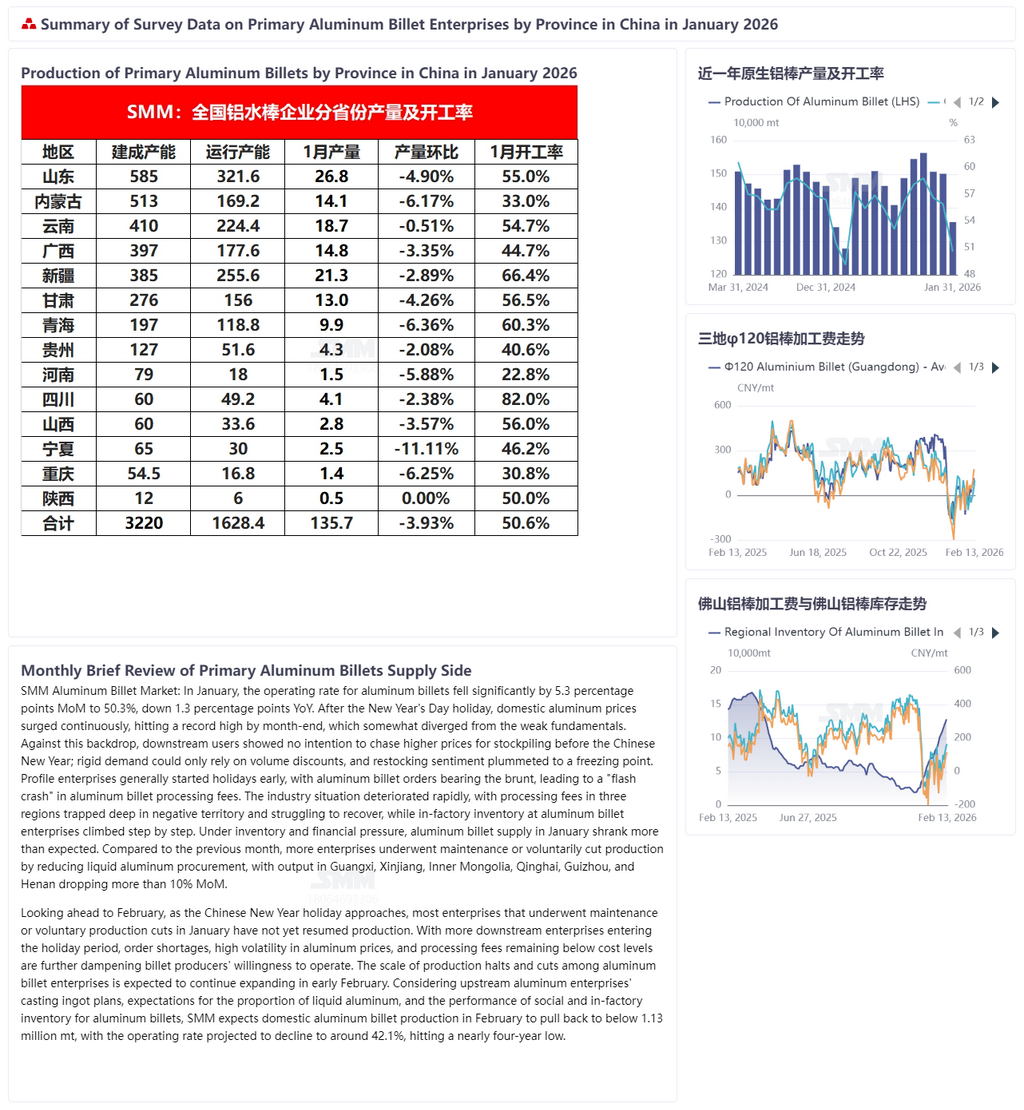
En janvier, les performances opérationnelles des billettes d'aluminium primaire domestiques se sont affaiblies plus que prévu. Selon les données du SMM, le taux d'activité des billettes d'aluminium a chuté de 5,3 points de pourcentage en glissement mensuel à 50,3 %, en baisse de 1,3 point sur un an. La production de billettes d'aluminium en janvier n'a été que de 1,357 million de tonnes, en forte baisse de 144 000 tonnes par rapport au mois précédent, soit une diminution de 3,9 % ; elle a légèrement augmenté de 12 000 tonnes sur un an, soit une hausse de 0,9 %. Après les vacances du Nouvel An, les prix intérieurs de l'aluminium ont continuellement augmenté et ont atteint un niveau record fin janvier, ce qui a divergé dans une certaine mesure des fondamentaux faibles. Dans ce contexte, les entreprises en aval n'ont montré aucune intention de suivre la hausse des prix pour constituer des stocks avant le Nouvel An chinois, la demande rigide reposant uniquement sur des remises volumétriques, et le moral de réapprovisionnement est tombé à un point de congélation. Les entreprises de profil ont généralement commencé les vacances plus tôt, et les entreprises de billettes d'aluminium ont supporté le poids des réductions de commandes, conduisant à un « ketch éclair » des frais de transformation des billettes d'aluminium. La situation de l'industrie s'est détériorée rapidement, les frais de transformation dans trois régions étant profondément ancrés en territoire négatif et peinant à se redresser, tandis que les stocks en usine des entreprises de billettes d'aluminium ont également augmenté pas à pas. Sous la pression des stocks et des capitaux, l'offre de billettes d'aluminium en janvier s'est contractée plus que prévu. Par rapport au mois précédent, davantage d'entreprises ont subi des maintenances ou ont réduit activement leur production en diminuant les achats d'aluminium liquide, avec une production en baisse de plus de 10 % en glissement mensuel dans les provinces du Guangxi, du Xinjiang, de la Mongolie intérieure, du Qinghai, du Guizhou et du Henan.
Perspectives pour février : à l'approche des vacances du Nouvel An chinois, la plupart des entreprises ayant subi des maintenances ou réduit activement leur production en janvier n'ont pas encore repris leurs activités. Avec davantage d'entreprises en aval entrant en période de vacances, le manque de commandes, les fortes fluctuations des prix de l'aluminium et les frais de transformation restant en dessous des seuils de coûts ont encore réduit la volonté de production des usines de billettes. Début février, l'ampleur des réductions et arrêts de production des entreprises de billettes d'aluminium devrait continuer à s'étendre. Les années précédentes, la plupart des entreprises de billettes d'aluminium primaire maintenaient une production normale pendant les vacances du Nouvel An chinois, mais cette année, plusieurs usines de billettes ont choisi de suspendre leurs activités pendant les vacances. Compte tenu des plans de lingots de coulée des entreprises d'aluminium en amont, des attentes concernant la proportion domestique d'aluminium liquide et des performances des stocks sociaux et en usine de billettes d'aluminium, le SMM prévoit que la production domestique de billettes d'aluminium en février tombera en dessous de 1,13 million de tonnes, avec un taux d'activité qui devrait reculer à environ 42,1 %, atteignant son plus bas niveau depuis près de quatre ans. (Les données de production de février ne sont qu'une prévision. Déclaration sur la source des données : À l'exception des informations publiquement disponibles, les autres données sont traitées par SMM sur la base d'informations publiques, de communications de marché et de la base de données interne de SMM, et sont fournies à titre indicatif uniquement, ne constituant pas un conseil à la décision.)


![Les contrats à terme sur l'aluminium continuent de baisser, les primes se réduisent [Revue de midi de l'aluminium spot SMM]](https://imgqn.smm.cn/usercenter/BrEfh20251217171652.jpg)