New Capacity of Secondary Cast Aluminum Alloy in 2024 Exceeds 1.3 Million mt, Growth Slows Under Supply Surplus Constraints [SMM Analysis]

Published: Dec 26, 2024 17:09
[SMM Analysis: New Secondary Cast Aluminum Alloy Capacity in 2024 Exceeds 1.3 Million mt, Growth Slows Under Supply Surplus Constraints] According to SMM statistics, 41 new and expanded secondary aluminum projects are planned in China in 2024, with a total capacity of 4.63 million mt, including approximately 2.05 million mt of new secondary cast aluminum alloy capacity and about 2.58 million mt of new secondary wrought aluminum alloy capacity.


SMM, December 26:

According to SMM statistics, 41 new and under-construction secondary aluminum projects are expected to be added in China in 2024, with a total capacity of 4.63 million mt. Among them, the new capacity for secondary cast aluminum alloy is approximately 2.05 million mt, while that for secondary wrought aluminum alloy is about 2.58 million mt.

The specific new capacities and project operating conditions are summarized by enterprise and product structure as follows:
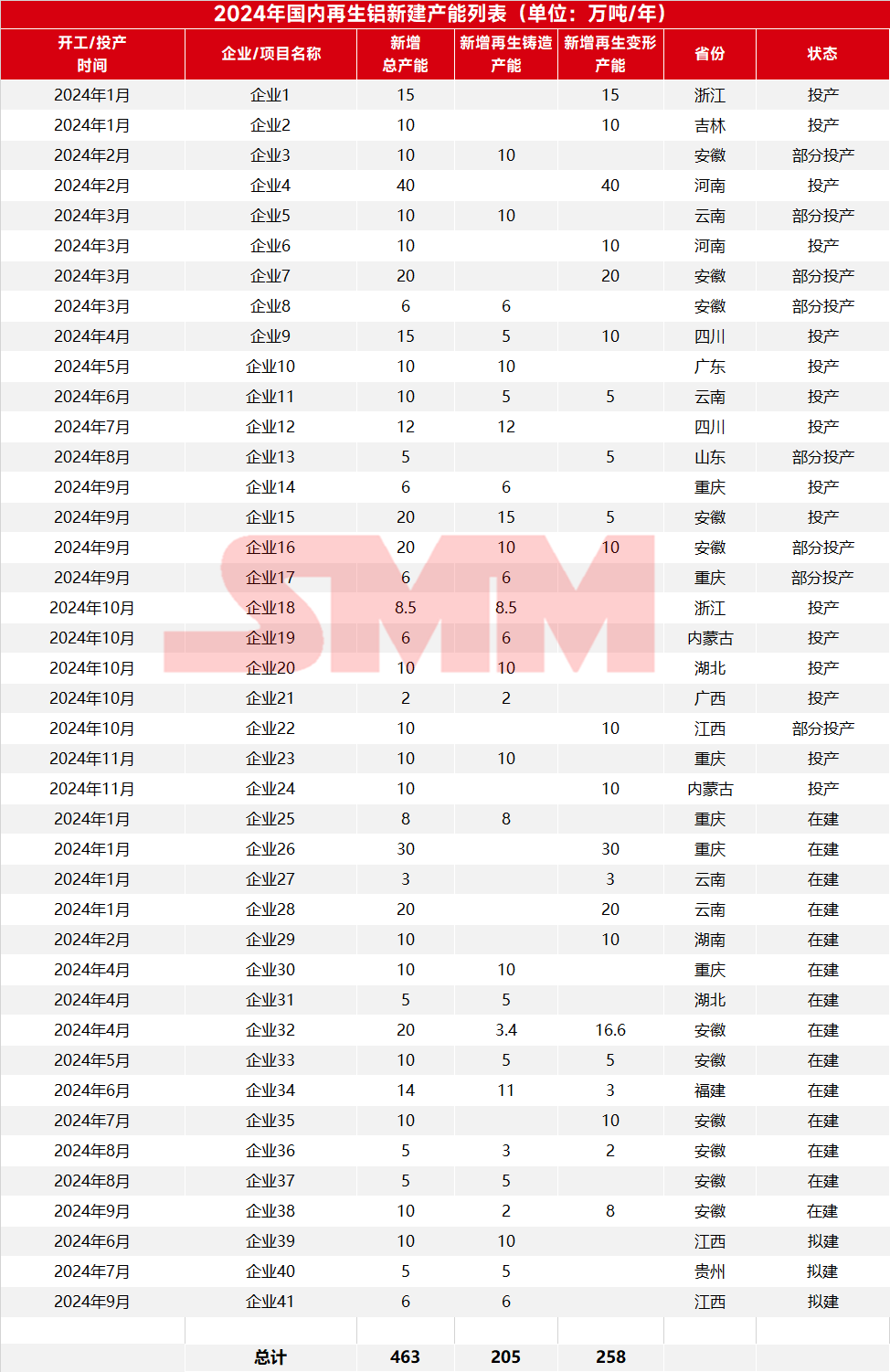
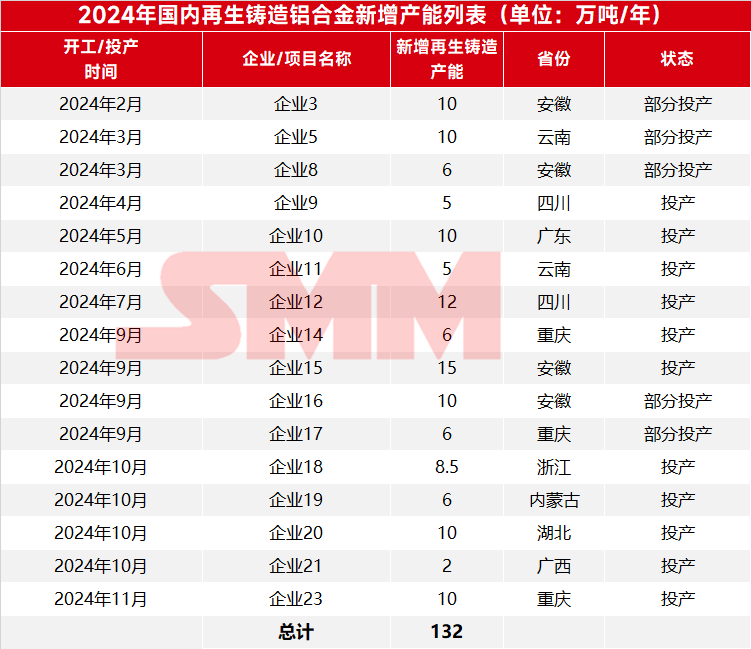
Focusing solely on secondary cast aluminum alloy, SMM statistics show that 28 new and under-construction secondary cast aluminum alloy projects are planned in China for 2024, involving a capacity of 2.05 million mt. Among these, 16 projects are expected to be operational, with an actual new capacity of 1.32 million mt this year. Compared to the 1.88 million mt capacity in 2023, the pace of capacity expansion continues to slow. Most of the new capacity this year is expected to commence operations in H2, with only 460,000 mt starting in H1, accounting for about 35% of the new capacity.

The secondary cast aluminum alloy capacities completed in 2024 are as follows:
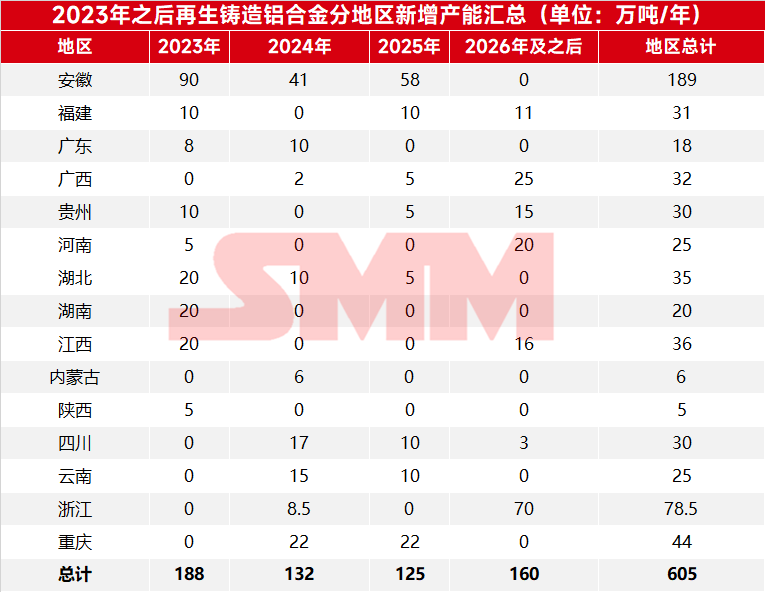
In terms of the regional distribution of new capacity, Anhui, Sichuan, and Yunnan rank as the top three, with new capacities of 410,000 mt, 170,000 mt, and 150,000 mt, respectively, in 2024. The specific regional distribution is as follows:
From the perspective of enterprises, more than half of the new capacity is contributed by leading enterprises. Their new production sites in Yunnan, Hubei, Anhui, and other regions will further expand their market coverage and optimize their product structures.

Although the expansion of secondary cast aluminum alloy projects has slightly slowed this year, the weak end-use consumption and the release of new capacity have further exacerbated the industry's oversupply, intensifying market competition. Meanwhile, the domestic aluminum scrap supply remains tight, and the overall replenishment from imported aluminum scrap is limited due to inverted domestic and international prices, failing to meet the rapidly growing downstream demand. This has led to persistently high raw material prices, reducing profits or even causing losses for secondary aluminum enterprises, thereby affecting their production enthusiasm and limiting the improvement of the industry's operating rate. By 2025, the release of new secondary aluminum alloy capacity is expected to continue at a slow pace. Additionally, due to policy adjustments and raw material constraints, some capacities may exit the market.

Data Source Statement: Except for publicly available information, all other data are processed by SMM based on publicly available information, market communication, and relying on SMM‘s internal database model. They are for reference only and do not constitute decision-making recommendations.

For any inquiries or to learn more information, please contact: lemonzhao@smm.cn
For more information on how to access our research reports, please contact:service.en@smm.cn
Related News
Middle East Crisis Sparks Global Economic Slowdown and Inflation, UN Report Shows
9 hours ago
Middle East Crisis Sparks Global Economic Slowdown and Inflation, UN Report Shows
Read More
Middle East Crisis Sparks Global Economic Slowdown and Inflation, UN Report Shows
The *World Economic Situation and Prospects as of Mid-2026* report released by the United Nations clearly pointed out that the Middle East crisis has posed a new round of shocks to the global economy, directly leading to a slowdown in global economic growth, a renewed climb in inflationary pressures, and a further intensification of global economic uncertainty. Notably, the impact of this crisis has been highly uneven, with developing countries bearing the brunt of the shocks. As things stand, global economic growth is expected to reach 2.5% in 2026, though this figure has been revised down by 0.2 percentage points from the January forecast.
9 hours ago
EU Reaches Provisional Agreement on EU-US Trade Deal with Expiry and Safeguard Clauses
9 hours ago
EU Reaches Provisional Agreement on EU-US Trade Deal with Expiry and Safeguard Clauses
Read More
EU Reaches Provisional Agreement on EU-US Trade Deal with Expiry and Safeguard Clauses
Under this provisional agreement, the tariff concessions granted by the EU on US industrial products, certain agricultural products, and seafood will expire on the originally scheduled date if both sides do not decide to extend them. In addition, the EU plans to establish a "safeguard mechanism": if US goods imports surge sharply and cause serious damage to EU industry or agriculture, the European Commission will have the authority to launch an investigation and suspend the corresponding tariff concessions. Regarding steel and aluminum products, if the US maintains tariffs exceeding 15% on EU steel and aluminum derivative products before the end of 2026, the European Commission will likewise have the authority to suspend certain tariff concessions.
9 hours ago
Fed Minutes Signal Shift to Tightening Policy Amid Inflation Concerns, Surprising Markets
10 hours ago
Fed Minutes Signal Shift to Tightening Policy Amid Inflation Concerns, Surprising Markets
Read More
Fed Minutes Signal Shift to Tightening Policy Amid Inflation Concerns, Surprising Markets
The US Fed meeting minutes revealed that many policymakers were inclined to abandon the easing bias, with most participants indicating that if inflation remained persistently above the 2% level, it would be necessary to tighten policy. Only a few officials supported future interest rate cuts, and the hawkish tone of the language far exceeded market expectations. Additionally, according to CME data, the market is now pricing in a 60% probability of the US Fed raising interest rates by 25 basis points before year-end, while expectations for interest rate cuts in 2026 have virtually disappeared.
10 hours ago
New Capacity of Secondary Cast Aluminum Alloy in 2024 Exceeds 1.3 Million mt, Growth Slows Under Supply Surplus Constraints [SMM Analysis] - Shanghai Metals Market (SMM)