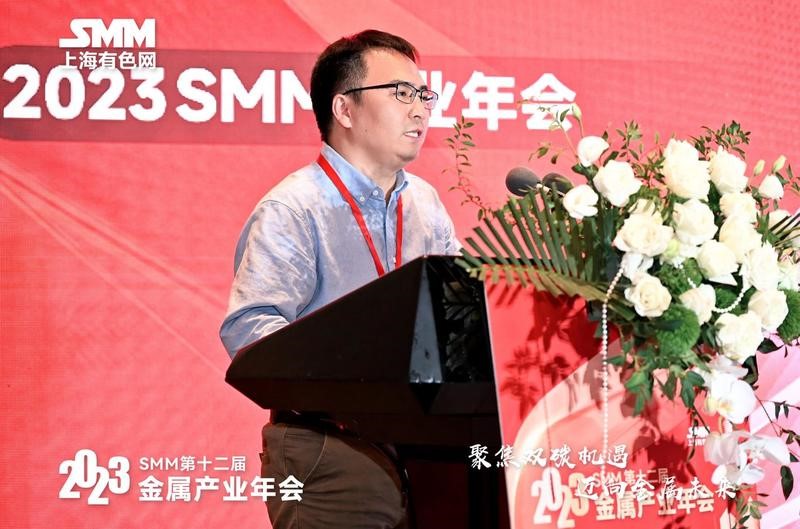
At the 2023 SMM 12th Metal Industry Annual Conference-SMM Copper Industry Forum co-sponsored by SMM, Chongqing Jiangjin District People's Government, and Shanghai Stock Exchange Institute, Peng Lijun, deputy director/Ph.D. of General Research Institute for Nonferrous Metals (GRINM), gave an analysis of the research status and development trends of elastic copper alloy materials.
Introduction to elastic copper alloys
1. Elastic copper alloys
Elastic copper alloy: a copper alloy with a small temperature coefficient of elastic modulus or frequency temperature coefficient
►Elastic modulus: the material's ability to resist elastic deformation. The greater the elastic modulus, the more difficult elastic deformation is; ►Elastic limit: the upper limit stress value at which reversible elastic deformation occurs in the material. The higher the elastic limit, the better the elastic performance.
In 2022, China's output of copper processing materials will be 20.25 million mt, accounting for approximately 65% of the world's total, ranking first in the world for nineteen consecutive years.
Elastic copper alloys account for about 60% of copper strip production, of which mid- to low-end elastic copper alloys account for about 90%.
(Relevant data comes from China Nonferrous Metal Processing Association)
With serious product homogeneity, overcapacity, and harsh competition, some high-end products (Cu-Ni-Sn, Cu-Ti) are almost entirely dependent on imports;
There is a lack of basic research and independent innovation capabilities.
Research status and development trends of elastic copper alloy materials
2.1 Elastic copper alloy-copper beryllium series
Low cost, high strength, high conductivity and high stress relaxation resistance meet the development requirements of miniaturization, high reliability and multi-function
MaterionMaterion of the United States and NGK Metal Company of Japan are two manufacturers of beryllium bronze alloys and have successfully developed a variety of high beryllium bronze alloy grades. At present, all major types of equipment parts in China are made of imported beryllium bronze alloy.
There are only a few companies in China that can produce beryllium bronze alloys on a large scale. The alloys are very poor in terms of microstructure morphology (structure size and uniformity, degree of discontinuous precipitation at grain boundaries, distribution of brittle β phase) and comprehensive properties (fatigue resistance, resistance to corrosion). There is still a certain gap compared with equivalent foreign products in terms of stress relaxation, elastic stability and elastic hysteresis, resulting in problems such as scattered insertion and extraction force of single hole of component jacks, poor dimensional stability and low service life.
When beryllium bronze is used in an environment above 150 °C , its strength and elasticity drop sharply, and the stress relaxation rate can be as high as more than 20%, resulting in a sharp reduction in elastic performance and even work failure.
The production process of beryllium bronze alloy is complex, and the structural properties are sensitive to heat treatment. Differences in process operations can easily cause uneven grain size and uneven precipitation of strengthening phases, resulting in insufficient insertion and extraction force of the alloy during service and reducing the service life of the material.
2.2 Elastic copper alloy-tin-phosphorus bronze
There are over 20 main domestic companies including Anhui Xinke, Ningbo Xingye, etc., with a total market production of about 260,000 mt, and imports of 10,000-10,000 mt in 2022 (Harada, Furukawa and other companies, fine-grained C5191, C5240, etc.).
Problems: serious product homogeneity and fierce competition; high production costs, long process flow, and long-term homogenization annealing required. Development trend: improve product quality and prepare ultra-fine grain (<5μm) materials; reduce Sn element content, adding other alloying elements, the overall performance is equivalent to traditional bronze materials; such as Xingye-XYK6XYK6, Bowei-BW33520, Jintian-JT401, etc.
2.3 Elastic copper alloy-copper nickel silicon series
Copper-nickel-silicon alloys are typical age-strengthened alloys that achieve excellent comprehensive properties through the precipitation of nanoscale precipitates.
♦Lack of independently developed alloy grades and products.
♦C70250 alloy has basically reached the foreign level. The key technology for the production of C70350 alloy has not yet been completely broken through. The performance stability is poor and the gap with foreign countries is large.
Development trend: ultra-high strength, high conductivity, balance.
Existing bottlenecks: On the basis of the main components of the C70350 alloy, intellectual property protection is required for other trace alloy elements, process systems, grain sizes, precipitate phase sizes and their contents. Breakthroughs are extremely difficult and limit China's Cu -Ni -Co - Industrial production of Si alloys.
2.4 Elastic copper alloy-copper nickel manganese series
The structure of the discontinuous precipitation structure is composed of lamellar NiMn NiMn phase and a matrix of poor solute atoms. The continuous precipitation process disperses and precipitates the NiMn NiMn phase with a face-centered tetragonal structure.
2.5 Elastic copper alloy-copper nickel tin series
Cu-Ni-Sn alloy is a new type of copper-based elastic material that can replace highly elastic beryllium bronze. It has excellent mid-temperature stress relaxation resistance, corrosion resistance in seawater or acidic, oil and gas environments, and resistance to high load conditions. The grinding performance is better than that of beryllium bronze, aluminum bronze, etc.
2.6 Elastic copper alloy-titanium bronze
Titanium bronze alloy has high strength, high elasticity, high temperature stress relaxation resistance and excellent bending and forming properties, but its electrical conductivity is slightly low.
Research ideas for improving the electrical conductivity of Cu-Ti alloys: adding alloying elements that form a second phase with the Ti element or promote the precipitation of the second phase to collaboratively improve the strength and electrical conductivity of the alloy.
The Mg element can synergistically improve the hardness and electrical conductivity of the alloy⇒The metastable precipitate phase of the two alloys is β´-Cu4Ti; after the Mg element is added, the metastable precipitate phase becomes smaller and has a higher density .
Advice and Outlook
The elastic copper alloy material system has been basically established, and domestic brass, bronze, and white copper strips have basically replaced imports; the comprehensive performance of mid-to-high-end copper-nickel-silicon and beryllium bronze alloys still lags behind foreign countries, and some rely on imports; high-end copper-nickel-tin, titanium bronze materials are basically dependent on imports;
Due to the complexity of the international situation, foreign countries have begun to limit the supply of high-end elastic copper alloy materials, or even stopped supplying them, which has seriously affected the development of domestic electronic communications, smart terminals and other markets, and there is an urgent need for domestic substitution;
The accelerated introduction of higher-performance copper alloy plates and strips into high-end elastic component application systems will receive support and cooperation from customers. This is a good time to comprehensively promote domestic substitution.
Problems and suggestions in the development and use of domestic and new products:
Since foreign countries have strict knowledge protection on the main ingredients and processes of products, it is difficult to make breakthroughs, and there are great hidden dangers in the process of localized substitution of products;
Since the development of a new product to its verification and use takes a long time, usually 2-3 years, it requires a lot of manpower and material resources. After the product is finalized, there is a hidden danger of late imitation.
Advice:
Strengthen basic research on elastic copper alloy materials, focusing on solving contradictory issues such as strength-conductivity, strength-bending forming, strength-stress relaxation, strength-fatigue performance in different application scenarios;
Guided by market demand, with high-end products as the target, we will establish a collaborative innovation mechanism of industry-university-research-application, open up the "last mile" barrier for the application of domestic elastic copper alloy materials, and promote the high-quality development and application of copper alloy processing materials.