Key Takeaway From LME Week: China’s Overseas Investment Is Key To Commodity Super Cycle, RMB Will Play A Key Role

Publié: Oct 11, 2023 11:08 (GMT+8)
Source: SMM
SHANGHAI, Oct 11 (SMM) – The ongoing 2023 SMM LME LONDON EVENT, being held at ST. Pancras Renaissance Hotel London, Euston Rd., London NW1 2AR, has brought together major industry players and commodity experts to share their valuable insights and unique perspectives on new energy and base metals outlook.

SHANGHAI, Oct 11 (SMM) – The ongoing 2023 SMM LME LONDON EVENT, being held at ST. Pancras Renaissance Hotel London, Euston Rd., London NW1 2AR, has brought together major industry players and commodity experts to share their valuable insights and unique perspectives on new energy and base metals outlook.

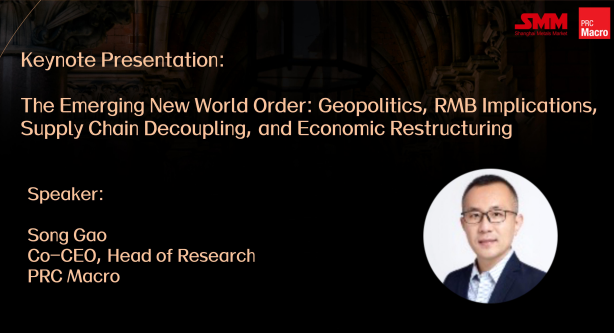
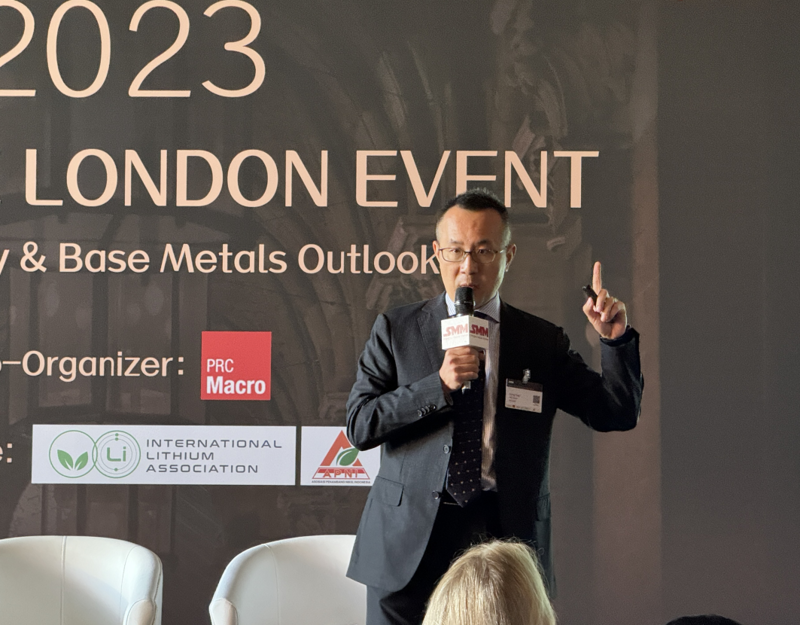
At the "SMMLMELONDONEVENT" held during LMEWEEK, Song Gao, co-CEO and research director of PRC Macro, expressed his views on "The New Order of Emerging Markets: Geopolitics, RMB Impact, Supply Chain Decoupling and Economic Restructuring."
He said that China’s overseas investment is the key to the commodity super cycle, and China’s overseas investment has just begun! Catching up with larger economies is good for metals demand.

The proportion of China's cumulative overseas direct investment (ODI) in nominal GDP is less than half of the average level of major economies. We predict that China's ODI will reach $18 trillion by 2045, increasing from approximately $180 billion currently to $1.3 trillion in 2045.

Ease the pain of deleveraging and manufacturing replenishment

Reducing the pain of deleveraging means:

1) Conventional debt conversion, interest rate cuts and debt relief; 2) Unconventional asset purchases, bank recapitalization and fiscal capital injection.

We expect manufacturing replenishment driven by housing completions, energy transition and ODI to begin in the fourth quarter.

Historically, cyclical shifts in manufacturing restocking have been consistent with rebounds in A-share prices, the yuan, and commodity and energy prices.

Energy and manufacturing upgrade

Energy transition: Energy is the new asset

The composition of China's exports reflects a shift toward high value-added, energy-intensive products.

The energy transition supports strong growth in infrastructure such as power grids and power generation.

Policy support for shantytown renovations and real estate completions supported demand for durable goods. It expects copper to have room for a 10%-15% increase.

Geopolitical de-risking and "going south"

China's official direct investment, financed by state-owned banks, rebounded sharply, partially offsetting the impact of lower exports and lower foreign direct investment risks due to the global manufacturing downturn and shrinking external demand.

China's ODI is mainly concentrated in ASEAN and BRICS countries, rather than developed markets.

Benefits of global urbanization and industrialization

Domestic and foreign factors driving China's ODI support metal demand through industrialization and urbanization in recipient countries. For example, China ODI funds the growth of steel demand in China.

Demand from the domestic energy transition and ODI offset weaker-than-expected performance of domestic real estate.

We expect China to increase its ODI efforts, focusing on manufacturing, infrastructure and mining. China's ODI will accelerate urbanization and industrialization in the global south.

The new role of RMB and the new world order

Lower RMB interest rates and de-dollarization of policies have provided support for China's ODI. Japan's experience shows that if a currency can fund carry trades, sustained ODI flows will follow. In the past, China's ODI was based on the US dollar and was greatly affected by external factors.

Currently, the RMB plays a new role in the "dual circulation".

The New World Order: The Energy-Defence-Infrastructure Axis

Southern rail and infrastructure connections

The Trans-Asian Railway network connects ASEAN.

Recipient of RMB-financed infrastructure and excess manufacturing capacity.

Capacity migration provides a new way for China to enter the DM market.

Local urbanization and industrialization drive demand for resources and increase purchasing power.

China’s manufacturing capabilities reduce the costs of the local energy transition.

Multilateral and bilateral treaties, trade areas.

Northern Energy Transport Network

Financing infrastructure and affordable, stable Russian energy supplies in RMB.

RMB finances high-value asset manufacturing projects.

High-quality and low-cost energy has subsidized China's manufacturing upgrade and energy transformation, increasing the added value and competitiveness of exports.

Higher value-added manufacturing promotes productivity growth.

This is protected by multilateral trade and investment treaties.

China drives another commodities supercycle

China ODI, RMB and Commodities Super Cycle

China will drive metals demand through urbanization and industrialization in recipient countries (ASEAN and the Belt and Road Initiative). This means that by 2040, demand for steel will reach 200 million mt, copper demand will reach 12 million mt, and aluminum demand will reach 38 million mt. Demand in the next 17 years will increase by 11%, 46%, and 55% respectively.
LME Week: Which Metal Has The Most Upside Potential For 2024? Majority (Including Citibank) Bets On Copper


Key Takeaway From LME Week: China’s Sustained And Rapid ODI Growth Will Add 11% To Demand For Steel, 46% More Demand For Copper And 55% More Demand For Aluminum


Key Takeaway From LME Week: China Fights Back By Upgrading Alumina And Primary Aluminium Trade With Russia


Déclaration sur la source des données : À l'exception des informations publiques, toutes les autres données sont traitées par SMM sur la base d'informations publiques, d'échanges avec le marché et en s'appuyant sur le modèle de base de données interne de SMM. Ils sont fournis à titre indicatif uniquement et ne constituent pas des recommandations décisionnelles.

Pour toute demande d'information ou pour en savoir plus, veuillez contacter : lemonzhao@smm.cn
Pour plus d'informations sur l'accès à nos rapports de recherche, veuillez contacter :service.en@smm.cn
Actualités Connexes
【Flash | Les expéditions de molybdène aux États-Unis en juillet dépassent la production alors que la production augmente en glissement annuel】
il y a 50 minutes
【Flash | Les expéditions de molybdène aux États-Unis en juillet dépassent la production alors que la production augmente en glissement annuel】
Lire la suite
【Flash | Les expéditions de molybdène aux États-Unis en juillet dépassent la production alors que la production augmente en glissement annuel】
L'USGS a fait état d'une production américaine de concentré de molybdène de 3 390 tonnes de molybdène contenu en juillet 2026, en baisse de 2,6 % en glissement mensuel mais en hausse de 6,3 % en glissement annuel. La production de janvier à juillet a totalisé 24 330 tonnes, en hausse d'environ 4,2 % sur la base des données mensuelles. Les expéditions de juillet ont atteint 3 730 tonnes, en hausse de 4,8 % en glissement mensuel et de 17,7 % en glissement annuel, tandis que les expéditions cumulées depuis le début de l'année ont progressé d'environ 5,7 % pour atteindre 24 600 tonnes. Les expéditions ont dépassé la production mensuelle d'environ 340 tonnes. L'USGS note que les expéditions comprennent les ventes intérieures, les exportations et les transferts vers les usines des entreprises, tandis que certaines données de producteurs sont des estimations mensuelles dérivées de publications trimestrielles ou annuelles.
il y a 50 minutes
Le panel panaméen soutient une reprise conditionnelle de Cobre Panamá pour financer une éventuelle fermeture
il y a 1 heure
Le panel panaméen soutient une reprise conditionnelle de Cobre Panamá pour financer une éventuelle fermeture
Lire la suite
Le panel panaméen soutient une reprise conditionnelle de Cobre Panamá pour financer une éventuelle fermeture
Une commission ministérielle panaméenne a recommandé l’ouverture de négociations formelles avec First Quantum Minerals en vue d’une éventuelle relance de Cobre Panamá. Selon la proposition, la mine pourrait reprendre ses activités sans étendre son emprise, les revenus d’exploitation finançant la réhabilitation, la surveillance à long terme et une fermeture ordonnée à terme, sans coût pour l’État. Tout accord exigerait l’abandon de toutes les procédures d’arbitrage international en cours et ne pourrait pas être prolongé. Le rapport ne précise ni l’ampleur ni la durée d’une relance. Cobre Panamá représentait auparavant environ 1 % de la production mondiale de cuivre. Tant qu’un accord et un calendrier ne sont pas confirmés, l’impact à court terme sur l’offre de concentré de cuivre reste limité.
il y a 1 heure
Les superviseurs d'Escondida votent à 95 % pour autoriser la grève ; les négociations entrent en médiation obligatoire
il y a 1 heure
Les superviseurs d'Escondida votent à 95 % pour autoriser la grève ; les négociations entrent en médiation obligatoire
Lire la suite
Les superviseurs d'Escondida votent à 95 % pour autoriser la grève ; les négociations entrent en médiation obligatoire
Le Syndicat n°2 des superviseurs et du personnel de la mine Escondida de BHP au Chili a rejeté l'offre salariale finale de l'entreprise, 95 % des votants se prononçant en faveur d'une grève. Le syndicat, qui compte environ 1 020 superviseurs, conteste les augmentations salariales limitées, les exigences de polyvalence et la rotation proposée de 14x14. La loi chilienne impose désormais au moins cinq jours de médiation gouvernementale, prolongeables de cinq jours supplémentaires, avant tout débrayage légal. La mine a produit 1,26 million de tonnes au cours de l'exercice 2026, en baisse de 3 % sur un an, avec une prévision de 1,0 à 1,1 million de tonnes pour l'exercice 2027. La production n'est actuellement pas affectée, mais ce vote accroît le risque d'approvisionnement après qu'un accident mortel a interrompu les opérations fin septembre.
il y a 1 heure