SMM Exclusive: China Copper Cathode Market Research

Publié: Jul 27, 2023 13:24 (GMT+8)
Source: SMM
Copper, as one of the bulk strategic materials, is an irreplaceable and important raw material in the national economy, having both commodity and financial attributes. China is the world's largest producer and consumer of copper semis. The application fields of copper semis continue to expand and the level of localisation continues to improve. The national 14th Five-Year Plan and high-quality development have put forward clear development directions and goals for copper-related industries. SMM analyses the future trend and main application fields of copper in China based on the current market supply and demand of copper in China and current policies.

Copper, as one of the bulk strategic materials, is an irreplaceable and important raw material in the national economy, having both commodity and financial attributes. China is the world's largest producer and consumer of copper semis. The application fields of copper semis continue to expand and the level of localisation continues to improve. The national 14th Five-Year Plan and high-quality development have put forward clear development directions and goals for copper-related industries. SMM analyses the future trend and main application fields of copper in China based on the current market supply and demand of copper in China and current policies.

China copper cathode supply analysis

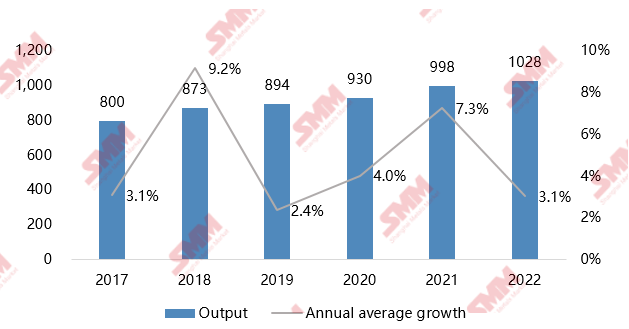
China is the main producer of copper cathode and also the largest contributor to the global output of copper cathode. China’s copper cathode output in 2022 was 10.28 million mt, accounting for 42% of the global total. With the continuous development and progress of China's scientific and technological level, the copper cathode manufacturing technology has become more and more mature, helping output of copper cathode increase. In 2018, the output of copper cathode increased significantly from 8 million mt to 8.73 million mt, due mainly to China's copper smelting projects being put into production. After 2018, the growth rate stabilised and the average annual growth rate remained at 4.2%.


China's copper cathode supply 2017-2022 (unit: 10,000 mt)

Source: SMM

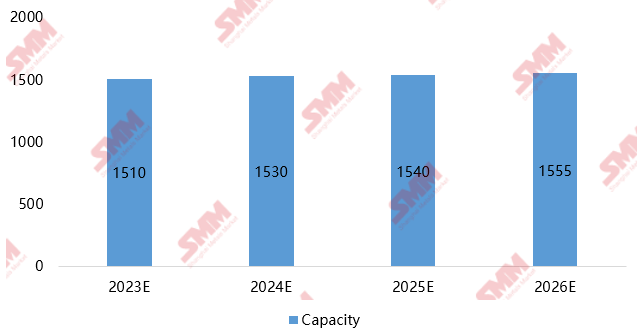
With the gradual release of new copper cathode production capacity in China, it is expected that the output of copper cathode will show a year-by-year growth trend from 2023E to 2026E, but the growth rate will gradually slow down. On the supply side, scarce reserves of domestic copper resources has limited the growth of copper cathode production. According to the future expansion plans of copper enterprises, it is estimated that by 2026, the production capacity of copper cathode in China will reach 15.55 million mt, and the output will reach 12.43 million mt. Although the growth rate of copper cathode production in China is higher than that of consumption, the supply still falls short of demand, resulting in a high degree of dependence on imported products.


China's copper cathode supply development trend 2023E-2027E (unit: 10,000 mt)

Source: SMM


China copper cathode supply analysis


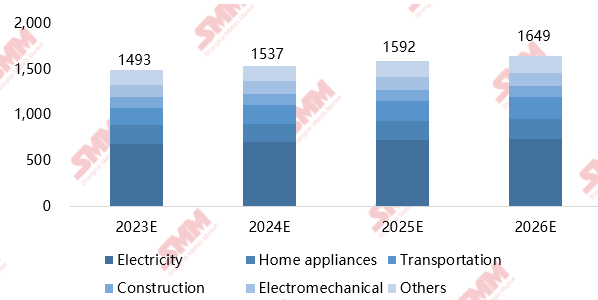
The end-user demand for copper cathode is wide. According to SMM statistics, the total end-user demand for copper cathode in China was 14.56 million mt in 2022. Copper demand in the power industry accounted for 46%, and home appliances accounted for about 14% of copper consumption. Transportation accounted for about 12%. The construction and electronics industries accounted for 8% and 9% respectively.

The demand from the power industry will be the core driving factor for the growth of copper consumption in the future. With the implementation of the dual-carbon policy goal, new infrastructure and clean energy may become new bright spots in the increase in domestic demand for copper cathode. The power structure will transit to clean and low-carbon, and the pace of power investment will continue to accelerate in the future. Wind power and photovoltaic power generation will contribute to most of the new power installations.

For the construction sector, it is estimated that China's urbanisation rate will reach 65.5% by 2025, according to China's Rural Development Report issued by the Chinese Academy of Social Sciences. And the rate will reach 70% by 2030, according to State Council National Population Development Plan (2016-2030). Considering that China's urbanisation rate has reached 63.89% in 2020 (0.49 percentage point higher compared to the planned 63.4%), and average copper consumption of 0.28 kg in per m2 construction (according to the Ministry of Land and Resources Future Demand for Copper Downstream Industries),  it is estimated that by 2026, the amount of copper used in the construction industry will reach at least 1.2 million mt, with an average annual growth rate of 1.1% in copper consumption.

In the transportation sector, according to China's New Energy Vehicle Industry Development Plan (2021-2035), the penetration rate of new energy vehicles in China will reach 20% in 2025, and the amount of copper used in new energy vehicles will increase. New energy vehicle motors, batteries and charging functions all require a large amount of copper. The automotive electronics driven by new energy vehicles will also increase the use of copper. SMM expects that the amount of copper used in the transportation sector will stand at 2.45 million mt in 2026 with supportive policies. The copper demand is promising on the back of support from new energy vehicles.

In the home appliance industry, the copper consumption of air conditioners accounts for about 80%. In the future, as the production and sales scale of the air conditioner industry is affected by the implementation of the New Energy Efficiency Policy and the full completion of the goals stipulated in the Montreal Protocol, it is expected to enter a new period of expansion. It is estimated that the output of air conditioners from 2023 to 2026 may grow at an average annual rate of about 6%, that is, the demand for copper in the air conditioner industry may reach 1.688 million mt by 2026. The overall copper consumption by household appliances may reach 2.11 million mt.

In the mechanical sector, as the COVID-19 pandemic situation continues to improve, the demand for consumer electronics products will return to normal. The demand for copper in 5G communications industry and new energy automotive electronics will maintain a healthy growth. It is estimated that by 2026, the copper consumption of domestic electronics industry will reach 1.47 million mt, a year-on-year growth rate of 2%.


China's copper cathode end-user demand trend 2023-2026E (unit: 10,000 mt)

Source: SMM

SMM is an information provider in China's professional non-ferrous consulting field. The consulting products mainly include industry supply and demand price analysis, supply chain management analysis, market research, on-site research, professional research reports, customized research reports, industrial planning books, industry white papers, etc. The reports can be updated quarterly, semi-annually, or annually according to the need of clients.

For more information, please contact:

Nonferrous Consulting Manager Deng Chenyang (17789717229)


Déclaration sur la source des données : À l'exception des informations publiques, toutes les autres données sont traitées par SMM sur la base d'informations publiques, d'échanges avec le marché et en s'appuyant sur le modèle de base de données interne de SMM. Ils sont fournis à titre indicatif uniquement et ne constituent pas des recommandations décisionnelles.

Pour toute demande d'information ou pour en savoir plus, veuillez contacter : lemonzhao@smm.cn
Pour plus d'informations sur l'accès à nos rapports de recherche, veuillez contacter :service.en@smm.cn
Actualités Connexes
KGHM et South32 lancent une expansion de 725 millions de dollars américains à Sierra Gorda, augmentant la capacité de cuivre de 26 %
02 Oct 2026 16:31 (GMT+8)
KGHM et South32 lancent une expansion de 725 millions de dollars américains à Sierra Gorda, augmentant la capacité de cuivre de 26 %
Lire la suite
KGHM et South32 lancent une expansion de 725 millions de dollars américains à Sierra Gorda, augmentant la capacité de cuivre de 26 %
KGHM et South32 ont lancé les travaux d'une quatrième ligne de broyage à la mine de cuivre-molybdène de Sierra Gorda, dans la région d'Atacama au Chili. Cette expansion de 725 millions de dollars américains s'étalera sur trois ans à partir de janvier 2027, avec une achèvement prévu fin 2029 et une pleine production au second semestre 2030. La capacité de traitement du minerai augmentera de 26 %, passant de 131 000 tonnes par jour à 165 000 tonnes par jour. La production annuelle de cuivre devrait passer de 165 000 tonnes en 2025 à 195 000 tonnes, avec comme sous-produits 6 000 tonnes de molybdène, 58 000 onces d'or et 1,7 million d'onces d'argent. Le projet créera plus de 900 emplois directs et sera financé par les flux de trésorerie d'exploitation et l'endettement. Les coûts d'exploitation unitaires devraient baisser d'environ 10 %.
02 Oct 2026 16:31 (GMT+8)
Emerita prolonge l'examen final de l'EEP de la ceinture ibérique ouest, publication attendue dans les semaines à venir
02 Oct 2026 15:31 (GMT+8)
Emerita prolonge l'examen final de l'EEP de la ceinture ibérique ouest, publication attendue dans les semaines à venir
Lire la suite
Emerita prolonge l'examen final de l'EEP de la ceinture ibérique ouest, publication attendue dans les semaines à venir
Emerita Resources a fait le point sur l’étude de faisabilité préliminaire (EFP) de son projet polymétallique Iberian Belt West en Espagne, indiquant que l’étude est bien avancée mais reste en cours de révision technique finale. La société a précisé que le processus de révision a été élargi afin d’inclure une supervision technique et une assurance qualité supplémentaires avant publication. En conséquence, Emerita prévoit désormais la publication de l’EFP dans les semaines à venir plutôt que dans le délai précédemment annoncé. Iberian Belt West recèle une minéralisation en cuivre, zinc, plomb, or et argent et constitue l’un des principaux actifs en phase de développement d’Emerita en Espagne. L’EFP devrait fournir des précisions actualisées sur le plan minier proposé, la configuration du traitement, les besoins en capitaux, les coûts d’exploitation et l’économie du projet. Emerita a indiqué que ces travaux de révision supplémentaires visent à garantir la cohérence et l’exhaustivité des différentes disciplines techniques contribuant à l’étude avant sa finalisation. La société n’a pas annoncé de nouvelle date précise de publication, et aucune nouvelle donnée de production, de capital ou économique n’a été communiquée dans cette dernière mise à jour. Cette révision prolongée retarde la prochaine étape technique majeure pour Iberian Belt West, mais la société continue d’indiquer que l’EFP est proche de son achèvement. Pour le marché du cuivre, l’importance de l’étude dépendra du profil de production et de l’économie du projet qui seront finalement publiés, en particulier la contribution du cuivre par rapport aux autres métaux payables du projet. L’attention restera donc portée sur le calendrier de publication de l’EFP et sur la question de savoir si l’étude finale modifie sensiblement les perspectives de développement du projet.
02 Oct 2026 15:31 (GMT+8)
Cascadia recoupe 75,55 m à 1,19 % Cu au projet cuivre-or Carmacks
02 Oct 2026 15:27 (GMT+8)
Cascadia recoupe 75,55 m à 1,19 % Cu au projet cuivre-or Carmacks
Lire la suite
Cascadia recoupe 75,55 m à 1,19 % Cu au projet cuivre-or Carmacks
Cascadia Minerals a publié des résultats de forage supplémentaires issus de son programme d’exploration 2026 au projet de cuivre-or Carmacks, dans le Yukon, au Canada, de nouveaux forages d’extension élargissant la minéralisation de la zone 2000S au-delà des limites de la ressource minérale existante. Le sondage CD-26-058 a retourné 75,55 mètres titrant 1,19 % de cuivre, 0,97 g/t d’or, 10,4 g/t d’argent et 335 ppm de molybdène, soit l’équivalent de 2,18 % d’équivalent cuivre. L’intervalle comprenait 48,66 mètres titrant 1,61 % de cuivre, 1,39 g/t d’or, 15,1 g/t d’argent et 475 ppm de molybdène, soit l’équivalent de 3,03 % CuEq. Dans le même sondage, un intervalle à plus haute teneur de 14,50 mètres a retourné 2,30 % de cuivre, 2,68 g/t d’or, 29,5 g/t d’argent et 1 015 ppm de molybdène, soit l’équivalent de 5,08 % CuEq. Un second sondage, CD-26-059, a recoupé 93,99 mètres titrant 0,96 % de cuivre, 0,70 g/t d’or, 4,6 g/t d’argent et 919 ppm de molybdène, soit l’équivalent de 1,94 % CuEq. Cela comprenait 63,97 mètres à 1,26 % de cuivre, 0,96 g/t d’or, 6,3 g/t d’argent et 1 049 ppm de molybdène, soit l’équivalent de 2,52 % CuEq. Cascadia a indiqué que les derniers résultats continuent d’étendre la minéralisation de la zone 2000S au-delà des limites de la ressource minérale actuelle et mettent en évidence la nature à plus haute teneur de l’extension. Les intervalles de forage rapportés représentent des épaisseurs forées, les largeurs réelles étant estimées à environ 60–70 %. Les derniers résultats d’extension indiquent que la minéralisation de cuivre-or de la zone 2000S s’étend au-delà des limites de la ressource minérale actuelle de Carmacks. Les larges intervalles et les zones internes à plus haute teneur pourraient soutenir une future expansion de la ressource si des forages supplémentaires confirment la continuité. Cependant, les nouvelles intersections n’ont pas encore été intégrées dans une estimation actualisée des ressources minérales, ce qui signifie que leur impact final sur l’échelle du projet et la planification minière reste à déterminer.
02 Oct 2026 15:27 (GMT+8)