SHANGHAI, Feb 10 (SMM) -
Macro front
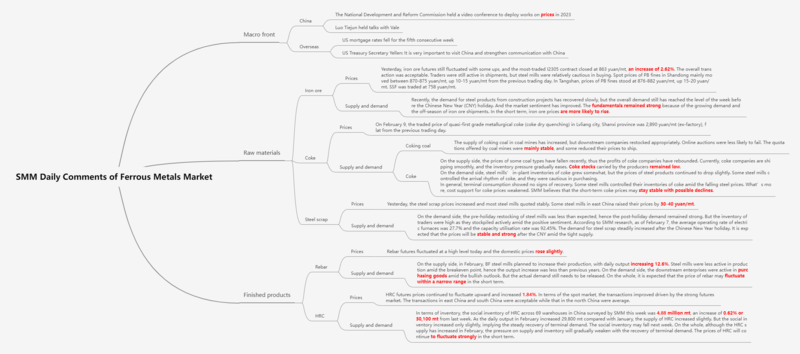
China: The National Development and Reform Commission held a video conference to deploy works on prices in 2023
Luo Tiejun held talks with Vale
Overseas: US mortgage rates fell for the fifth consecutive week
US Treasury Secretary Yellen: It is very important to visit China and strengthen communication with China
Raw materials:
Iron ore
Yesterday, iron ore futures still fluctuated with some ups, and the most-traded I2305 contract closed at 863 yuan/mt, an increase of 2.62%. The overall transaction was acceptable. Traders were still active in shipments, but steel mills were relatively cautious in buying. Spot prices of PB fines in Shandong mainly moved between 870-875 yuan/mt, up 10-15 yuan/mt from the previous trading day. In Tangshan, prices of PB fines stood at 876-882 yuan/mt, up 15-20 yuan/mt. SSF was traded at 758 yuan/mt.
Recently, the demand for steel products from construction projects has recovered slowly, but the overall demand still has reached the level of the week before the Chinese New Year (CNY) holiday. And the market sentiment has improved. The fundamentals remained strong because of the growing demand and the off-season of iron ore shipments. In the short term, iron ore prices are more likely to rise.
Coke
On February 9, the traded price of quasi-first grade metallurgical coke (coke dry quenching) in Lvliang city, Shanxi province was 2,890 yuan/mt (ex-factory), flat from the previous trading day.
Coking coal: The supply of coking coal in coal mines has increased, but downstream companies restocked appropriately. Online auctions were less likely to fail. The quotations offered by coal mines were mainly stable, and some reduced their prices to ship.
Coke: On the supply side, the prices of some coal types have fallen recently, thus the profits of coke companies have rebounded. Currently, coke companies are shipping smoothly, and the inventory pressure gradually eases. Coke stocks carried by the producers remained low.
On the demand side, steel mills' in-plant inventories of coke grew somewhat, but the prices of steel products continued to drop slightly. Some steel mills controlled the arrival rhythm of coke, and they were cautious in purchasing.
In general, terminal consumption showed no signs of recovery. Some steel mills controlled their inventories of coke amid the falling steel prices. What’s more, cost support for coke prices weakened. SMM believes that the short-term coke prices may stay stable with possible declines.
Steel scrap: Yesterday, the steel scrap prices increased and most steel mills quoted stably. Some steel mills in east China raised their prices by 30-40 yuan/mt.
On the demand side, the pre-holiday restocking of steel mills was less than expected, hence the post-holiday demand remained strong. But the inventory of traders were high as they stockpiled actively amid the positive sentiment. According to SMM research, as of February 7, the average operating rate of electric furnaces was 27.7% and the capacity utilisation rate was 92.45%. The demand for steel scrap steadily increased after the Chinese New Year holiday. It is expected that the prices will be stable and strong after the CNY amid the tight supply.
Finished products
Rebar: Rebar futures fluctuated at a high level today and the domestic prices rose slightly.
On the supply side, in February, BF steel mills planned to increase their production, with daily output increasing 12.6%. Steel mills were less active in production amid the breakeven point, hence the output increase was less than previous years. On the demand side, the downstream enterprises were active in purchasing goods amid the bullish outlook. But the actual demand still needs to be released. On the whole, it is expected that the price of rebar may fluctuate within a narrow range in the short term.
HRC: HRC futures prices continued to fluctuate upward and increased 1.84%. In terms of the spot market, the transactions improved driven by the strong futures market. The transactions in east China and south China were acceptable while that in the north China were average.
In terms of inventory, the social inventory of HRC across 69 warehouses in China surveyed by SMM this week was 4.8791 million mt, an increase of 0.62% or 30,100 mt from last week. As the daily output in February increased 29,800 mt compared with January, the supply of HRC increased slightly. But the social inventory increased only slightly, implying the steady recovery of terminal demand. The social inventory may fall next week. On the whole, although the HRC supply has increased in February, the pressure on supply and inventory will gradually weaken with the recovery of terminal demand. The prices of HRC will continue to fluctuate strongly in the short term.
![[L'Afrique du Sud propose des droits antidumping provisoires allant jusqu'à 28,11 % sur les aciers prélaqués chinois]](https://imgqn.smm.cn/usercenter/FFFrV20251217171719.jpg)
![[La Syrie conclut un accord avec l'Arabie saoudite pour relancer l'aciérie de Hama]](https://imgqn.smm.cn/usercenter/ntiFA20251217171719.jpg)
![[Analyse SMM] Les règles européennes de fusion-coulée arrivent : la chaîne d'approvisionnement en acier au carbone face à une refonte générationnelle](https://imgqn.smm.cn/usercenter/LSkpO20251217171720.jpg)