SMM Analysis of the Impact of Power Shortages in Yunnan on Chinese Aluminum Supply

Publié: Sep 2, 2022 10:41
Source: SMM
SHANGHAI, Sep 2 (SMM) - Not long after the stringent power rationing policy in Sichuan, Yunnan, another aluminium production hub, has also suffered from hydropower shortages recently, triggering concerns over supply in the province.

SHANGHAI, Sep 2 (SMM) - Not long after the stringent power rationing policy in Sichuan, Yunnan, another aluminium production hub, has also suffered from hydropower shortages recently, triggering concerns over potential output reduction in the province. SMM’s latest survey showed that most of the aluminium smelters in Yunnan are currently in normal operations, but they have expressed concerns over the future power supply. Many aluminium smelters in Yunnan have recently undertaken orderly electricity consumption and practice of power load interruptions. As a major aluminium producing province that relies heavily on hydropower, the operations of aluminium smelters in Yunnan will have a significant impact on the entire aluminium industry.  

Aluminium capacity distribution in Yunnan 
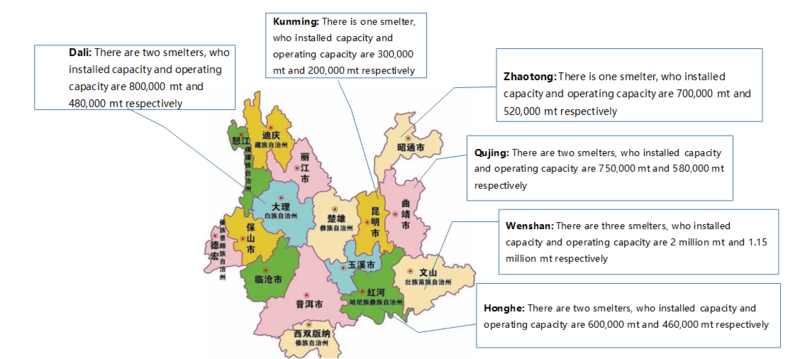
 

Driven by multiple favourable policies and low-carbon initiative, a tremendous amount of aluminium capacity has been relocated to Yunnan in recent years. In 2021, Yunnan cancelled the preferential power tariff policy to the aluminium industry that it had previously promised, under the requirement of the National Development and Reform Commission (NDRC) in its Notice on Tiered Power Tariffs in Aluminium Industry. Nevertheless, under the push to achieve carbon peak and carbon neutrality goals, Yunnan attracted smelters from other regions to transfer their aluminium capacity to the province by virtue of its abundance of cheaper green hydropower. 

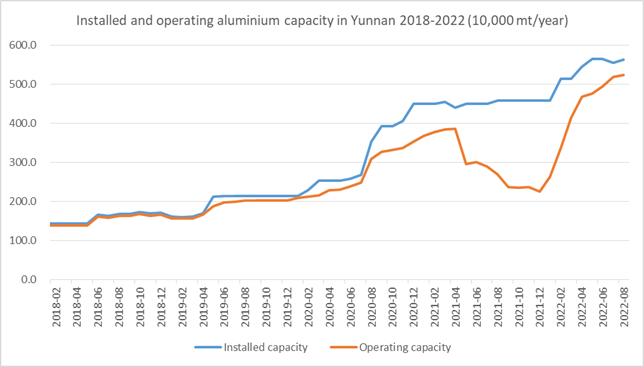
According to the latest statistics of SMM, the installed aluminium capacity in Yunnan currently stands at approximately 5.63 million mt, up 23% year on year and accounting for 12.7% of China's total installed aluminium capacity. As of the end of August, the operating aluminium capacity in Yunnan stood at 5.25 million mt, up 94.4% year on year. As more smelters, such as Weiqiao Group, will transfer their capacity to Yunnan, the installed aluminium capacity in the province looks set to exceed 9 million mt in the future, ranking first in the country. 

According to data from the Energy administration of Yunnan, with the 12 big hydropower stations, such as Wudongde, Baihetan, Xiluodu, Nuozhadu, Huangdeng, Guanyinyan and Ludila, being put into operation successively, Yunnan's installed hydropower capacity has surged from 34.99 million kW to 78.2 million kW, ranking second in China. 7 out of the top ten hydropower stations in China are located in Yunnan, which also has 3 power stations of 10 million kW and 14 power stations of 1 million kW. Yunnan's installed power capacity has jumped to 100 million kW, with green energy power generating capacity accounting for about 90%, 60 percentage points higher than the national average. From January to July, Yunnan's industrial power generation above designated size reached 213.11 billion KWH, up 16.1% year on year. Specifically, its hydropower generation stood at 171.03 billion KWH, up 26.8%, and thermal power generation at 25.47 billion KWH, down 17.1%. Clean electricity accounted for 88.1%, 4.2 percentage points higher than the same period last year. 

According to the feedback from aluminium smelters in Yunnan, the electricity supply in the province was normal from January to August, and hydropower was abundant in the first half of this year, encouraging local smelters to resume their production or put their new capacity into operation at a faster pace. The operating aluminium capacity in the province constantly refreshed new highs, intensifying the local supply pressure. 

Nevertheless, local hydropower companies said that nearly half of the main power stations reported insufficient water supply in August, and the water storage of main reservoirs decreased when compared with last year, which could threaten the power supply in Yunnan this winter and next spring. Based on the current water level and rainfalls, the market is increasingly concerned about the operations of aluminium smelters in Yunnan. Smelters may be subject to power rationing and production curtailment after the dry season arrives.

According to SMM's preliminary estimates, the domestic installed aluminium capacity totalled 44.47 million mt at the end of August, while the operating capacity decreased 800,000 mt from the end of July to 40.6 million mt. If 20-30% of aluminium capacity in Yunnan is reduced due to the power rationing, the domestic operating capacity may fall below 40 million mt, and domestic aluminium supply pressure will be significantly alleviated in 2022. The uncertainty over future power supply will have an impact on the transfer of aluminium capacity from other regions to Yunnan, and SMM will keep a close eye on the operations of local smelters.

Déclaration sur la source des données : À l'exception des informations publiques, toutes les autres données sont traitées par SMM sur la base d'informations publiques, d'échanges avec le marché et en s'appuyant sur le modèle de base de données interne de SMM. Ils sont fournis à titre indicatif uniquement et ne constituent pas des recommandations décisionnelles.

Pour toute demande d'information ou pour en savoir plus, veuillez contacter : lemonzhao@smm.cn
Pour plus d'informations sur l'accès à nos rapports de recherche, veuillez contacter :service.en@smm.cn
Actualités Connexes
Le PMI manufacturier américain baisse à 53,8 en juillet, le PMI des services atteint un plus haut de huit mois.
il y a 11 heures
Le PMI manufacturier américain baisse à 53,8 en juillet, le PMI des services atteint un plus haut de huit mois.
Lire la suite
Le PMI manufacturier américain baisse à 53,8 en juillet, le PMI des services atteint un plus haut de huit mois.
L'indice PMI flash manufacturier américain S&P Global a reculé de manière inattendue à 53,8 en juillet, son plus bas niveau depuis mars, alors que les attentes du marché tablaient sur une hausse à 54,3. En revanche, l'indice PMI flash des services s'est établi à 53,6, un plus haut de huit mois, portant l'indice PMI composite flash à 53,6, également un plus haut de huit mois, les deux chiffres dépassant largement les attentes du marché.
il y a 11 heures
Trump discute de la stratégie de sortie de la guerre d’Iran : escalade militaire ou négociations sur fond de pourparlers en cours
il y a 12 heures
Trump discute de la stratégie de sortie de la guerre d’Iran : escalade militaire ou négociations sur fond de pourparlers en cours
Lire la suite
Trump discute de la stratégie de sortie de la guerre d’Iran : escalade militaire ou négociations sur fond de pourparlers en cours
Le président américain Trump, lors d'une discussion à la Maison-Blanche sur la « stratégie de sortie » de la guerre avec l'Iran, a souligné que les États-Unis font face à deux options : premièrement, maintenir les opérations militaires actuelles, voire intensifier les frappes pour démanteler progressivement les capacités militaires iraniennes ; deuxièmement, parvenir à un accord par la négociation. Trump a indiqué que, bien que l'Iran soit intéressé par un accord, il n'est actuellement « pas encore prêt ». Il a déclaré que les États-Unis peuvent soit conserver le rythme actuel des opérations, soit choisir d'intensifier les frappes plus rapidement. Par ailleurs, les États-Unis négocient toujours avec l'Iran.
il y a 12 heures
Midea Air Conditioning abandonne son traditionnel lancement de la saison froide au profit d'une stratégie axée sur le commerce de détail en 2027
il y a 12 heures
Midea Air Conditioning abandonne son traditionnel lancement de la saison froide au profit d'une stratégie axée sur le commerce de détail en 2027
Lire la suite
Midea Air Conditioning abandonne son traditionnel lancement de la saison froide au profit d'une stratégie axée sur le commerce de détail en 2027
Selon Yingketong, Midea Air Conditioning a officiellement annoncé en juillet 2026 qu’elle ne lancera plus l’ouverture traditionnelle de la saison froide pour la nouvelle année de refroidissement 2027, s’engageant plutôt pleinement dans une nouvelle stratégie de « bataille pour la vente au détail et concurrence pour les utilisateurs finaux ». Cette décision marque un arrêt temporaire du modèle, vieux de près de trois décennies, consistant à « collecter des paiements hors saison et à courir après les volumes en haute saison » dans l’industrie de la climatisation. L’« ouverture de la saison froide » est un rythme commercial unique dans le secteur de la climatisation. En général, à partir du second semestre (de juillet/août à octobre/novembre), les producteurs organisent des ouvertures par lots, par le biais de mesures incitatives, pour attirer les distributeurs à effectuer des paiements anticipés et à stocker des marchandises. Puis, au premier semestre de l’année suivante, ils concentrent les expéditions lors de diverses promotions de vente à grande échelle, créant un cycle de « pousser les stocks hors saison et courir après les volumes en haute saison ». Les mesures spécifiques concernant l’annulation par Midea Air Conditioning de la nouvelle ouverture de la saison froide incluent : ne plus organiser de réunions d’ouverture impliquant des paiements centralisés des canaux, le verrouillage des politiques et le stockage à grande échelle ; abolir la pratique des « paiements anticipés obligatoires pour verrouiller les politiques annuelles » ; et passer à un réapprovisionnement en fonction de la demande réelle, avec des politiques normalisées sur l’ensemble du cycle.
il y a 12 heures
SMM Analysis of the Impact of Power Shortages in Yunnan on Chinese Aluminum Supply - Shanghai Metals Market (SMM)