Metals generally rebounded, Shanghai tin closed up 2%, Shanghai nickel decline narrowed to 5.57% [overnight market]

Publié: Mar 29, 2022 07:48 (GMT+8)
Source: SMM
[overnight quotation: metals generally rebounded Shanghai tin closed up 2% Shanghai nickel decline narrowed to 5.57%] in night trading, metal in Shanghai rebounded, Shanghai copper rose 0.81%, Shanghai lead and zinc both rose more than 0.7%, Shanghai tin closed up 2%, Shanghai aluminum fell 0.13%, Shanghai nickel fell 5.57%. In black, the decline of stainless steel narrowed to 1.03%, that of hot rolling decreased by 0.08%, that of iron ore rose by more than 1%, and that of thread slightly increased by 0.48%. For coal series, only thermal coal closed down 1.19%, while coking coal and coke closed up to 1.96% and 1.6% respectively.

Crude oil: international two-barrel oil futures closed sharply above 9% on Monday, with bulls closing short-term profits without further positive impetus. Fears of a drag on energy demand from the epidemic, hopes of peace talks between Russia and Ukraine and news of Iran's support for a truce in Yemen have eased some tensions, but market participants say Russian crude oil sanctions are the biggest supply risk compared to Russian-Ukrainian negotiations. The United States has previously said it is considering releasing more crude oil reserves, but inventories are already low and the scale of the release may be limited. OPEC + will hold a meeting on Thursday, and sources said that despite high oil prices, OPEC + is expected to maintain its plan to increase production slightly in May. In the long run, the risk of the oil market has not been fundamentally resolved.

On the dollar side: boosted by Wall Street's higher expectations of a Fed interest rate hike, the dollar index closed up 0.35% on Monday, reaching an intraday high of 99.37. But the decline in the Dallas Fed's index of manufacturing activity, output and orders released last night held back the dollar's rise. The yield on 10-year u.s. Treasuries rose above 2.5% to a three-year high on Monday.

Today's focus is on data such as Japan's February unemployment rate, Germany's April Gfk consumer confidence index, the Bank of England's mortgage permit in February, the last day's gold and silver daily warehouse receipt changes, and the US Conference Board consumer confidence index in March.

Metal futures:

By the end of the day, basic metals fell in the inner market. Among them, Shanghai nickel fell by 14.74%, Shanghai copper and tin fell by more than 0.8%, and Shanghai aluminum fell slightly by 0.11%. Black series, only stainless steel floating green, fell 6.6%; iron ore rose nearly 4.5%, hot rolling, thread up more than 1%. Coal series, coking coal and coke rose by 1.21% and 0.87% respectively, while thermal coal fell by 2.62%.

During the night session, metal rebounded in the inner market. Shanghai copper rose 0.81%, Shanghai lead and zinc both rose more than 0.7%, Shanghai tin closed up 2%, Shanghai aluminum fell 0.13%, and Shanghai nickel fell 5.57%.

In black, the decline of stainless steel narrowed to 1.03%, that of hot rolling decreased by 0.08%, that of iron ore rose by more than 1%, and that of thread slightly increased by 0.48%.

For coal series, only thermal coal closed down 1.19%, while coking coal and coke closed up to 1.96% and 1.6% respectively.

LME metal, only lun nickel floating green, fell more than 9%; lun lead rose 1.5%, Lun copper and zinc rose slightly to 0.91% and 0.77%, respectively, and lun aluminum closed flat.

Precious metal, COMEX gold futures fell on Monday, weighed down by higher US bond yields and a stronger dollar, while palladium tumbled nearly 8 per cent as supply concerns eased ahead of peace talks between Russia and Ukraine.

13:30 New York time (01:30 Beijing time on March 29th) the April gold futures contract, which was most actively traded by), COMEX, fell 0.7 per cent, or $14.40, to settle at $1939.80 an ounce.

As of 07:20 on March 29th, it closed at night on March 28th:
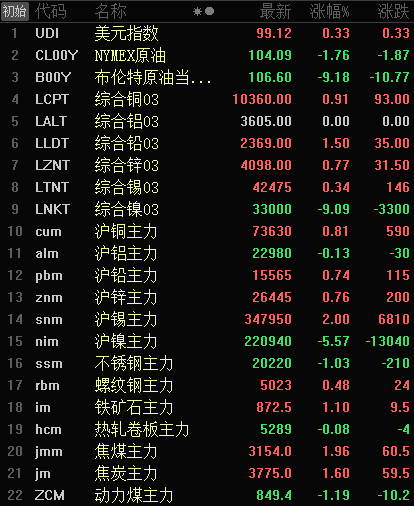
"Futures prices fluctuate greatly. For enterprise settlement, please refer to SMM spot quotation!


Déclaration sur la source des données : À l'exception des informations publiques, toutes les autres données sont traitées par SMM sur la base d'informations publiques, d'échanges avec le marché et en s'appuyant sur le modèle de base de données interne de SMM. Ils sont fournis à titre indicatif uniquement et ne constituent pas des recommandations décisionnelles.

Pour toute demande d'information ou pour en savoir plus, veuillez contacter : lemonzhao@smm.cn
Pour plus d'informations sur l'accès à nos rapports de recherche, veuillez contacter :service.en@smm.cn
Actualités Connexes
La production de Blanket recule alors que Caledonia réduit ses prévisions pour 2026
il y a 5 heures
La production de Blanket recule alors que Caledonia réduit ses prévisions pour 2026
Lire la suite
La production de Blanket recule alors que Caledonia réduit ses prévisions pour 2026
[SMM Flash Or] Caledonia Mining a annoncé que la mine Blanket au Zimbabwe a produit 17 030 oz au T3 2026, en baisse de 10,9 % par rapport aux 19 106 oz de l'année précédente, tandis que la production sur neuf mois est tombée à 49 158 oz contre 58 846 oz. La société a attribué le déficit du trimestre à une capacité d'air comprimé insuffisante dans les zones profondes à haute teneur et à des problèmes de mise en service qui ont laissé environ 1 100 oz d'or libre temporairement retenues dans l'usine. Elle a réduit ses prévisions de production 2026 à 69 000–72 500 oz, contre 72 000–76 500 oz. Cette perturbation accroît la pression sur les coûts unitaires à court terme : Caledonia a relevé ses prévisions de coût sur mine à 1 700–1 900 $ US/oz et ses prévisions d'AISC à 2 650–2 850 $ US/oz. Deux des quatre nouveaux compresseurs avaient été déployés au 9 octobre, et la direction prévoit de récupérer l'or retenu à partir de la mi-octobre après la mise en service d'une capacité d'élution supplémentaire. Ces améliorations du T4 restent des prévisions ; le fait vérifié est la baisse de la production au T3 et la révision des prévisions, et non une reprise complète de la production.
il y a 5 heures
L'Éthiopie inaugure sa première raffinerie nationale de métaux précieux
il y a 7 heures
L'Éthiopie inaugure sa première raffinerie nationale de métaux précieux
Lire la suite
L'Éthiopie inaugure sa première raffinerie nationale de métaux précieux
[SMM Gold Flash] L’Éthiopie a inauguré sa première raffinerie nationale de métaux précieux dans la zone économique spéciale de Bole Lemi le 10 octobre. L’installation est un partenariat entre la société publique Ethiopian Investment Holdings et Sam Precious Metals ; Reuters a estimé l’investissement initial à 50 millions de dollars américains. Le bureau du Premier ministre a indiqué que la raffinerie est conçue pour analyser, affiner et couler l’or, et fabriquer des lingots d’or et d’argent, avec une capacité annoncée de traitement à pleine capacité de plus de 600 tonnes de métaux précieux par an. Ce lancement offre à l’Éthiopie une filière nationale pour raffiner l’or en lingots prêts à l’exportation et potentiellement servir les producteurs voisins, favorisant la traçabilité et conservant davantage de valeur de transformation en Afrique. Toutefois, le chiffre de 600 tonnes correspond à la capacité nominale pour les métaux précieux — et non à une production d’or confirmée — et ni le gouvernement ni l’opérateur n’ont communiqué le débit actuel, le taux d’utilisation ou les engagements d’approvisionnement. L’inauguration établit donc une capacité de raffinage ; elle ne démontre pas que l’usine fonctionne déjà à sa capacité nominale.
il y a 7 heures
Sixième déficit argentifère consécutif : le manque d’offre atteint 46 millions d’onces !
il y a 8 heures
Sixième déficit argentifère consécutif : le manque d’offre atteint 46 millions d’onces !
Lire la suite
Sixième déficit argentifère consécutif : le manque d’offre atteint 46 millions d’onces !
il y a 8 heures