2021 has become a record-breaking year for lithium carbonate prices. According to SMM prices, the price of battery-grade lithium carbonate in China rose from 53000 yuan / ton to 254000 yuan / ton as of December 24, an increase of about 379% from the beginning of the year, a record high. As the price center of lithium products, with the rising price of lithium carbonate, the prices of all lithium products such as lithium ore, lithium hydroxide, lithium hexafluorophosphate and lithium metal are higher. At the same time, in the lithium industry chain, the price of raw material lithium carbonate continues to hit a record high, resulting in a series of price increases from cathode materials (ternary materials, lithium cobalt, lithium ferric phosphate, lithium manganate) to batteries. In addition, the recycling coefficient of waste batteries has also been quoted for more than 100% in the case of high lithium prices. So what happened to China's lithium carbonate market in 2021?
Previous Life Review of "254000 yuan / ton" Lithium Carbonate:
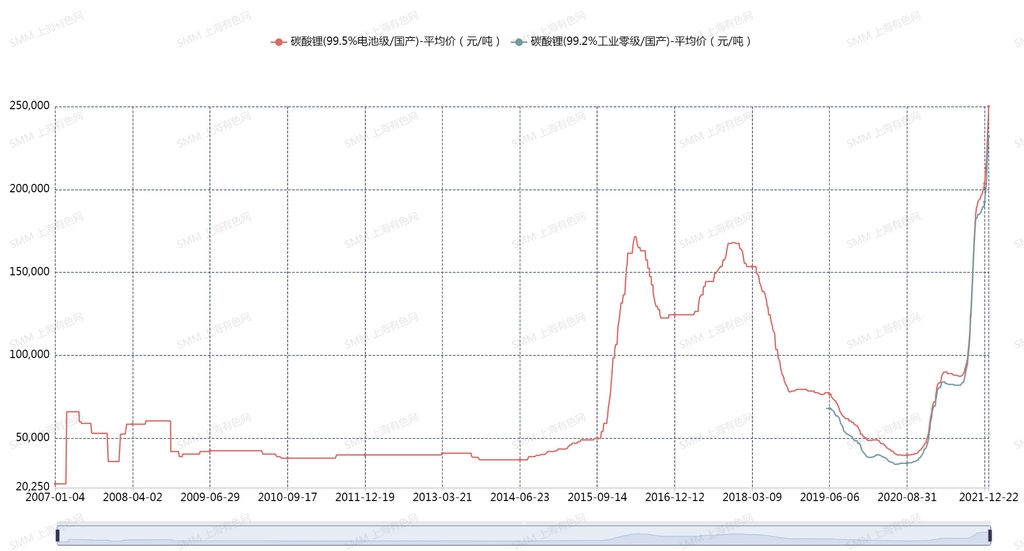
Before 2015, the price of lithium carbonate, which was used as the raw material of the traditional industry, changed little, but with the outbreak of the new energy vehicle market, the demand for upstream raw materials in the lithium power industry increased significantly after the introduction of the subsidy policy. the highest price of battery-grade lithium carbonate in history is only 171500 yuan / ton. With the rise in demand, the industry is in short supply, resulting in the release of more resources, enterprises to expand production, lithium carbonate production began to show a significant increase in 2017, but before the full outbreak of demand, the output increased greatly. as a result, prices began to enter a period of price decline for a period of about three years. With the passage of time to October 2020, with the global sales of new energy vehicles rising, driven by popular models, lithium iron phosphate batteries and materials are very hot, and the demand for battery-grade and industrial-grade lithium carbonate has increased by more than 120% compared with the same period last year. so the price of lithium carbonate has bottomed out.
In the first quarter of 2021, in the early days of the Spring Festival, due to the low import volume caused by the centralized maintenance of lithium salt plants, downstream Spring Festival stock and the continuous spread of the overseas epidemic, there was a supply gap of about 20% in China's lithium carbonate market. At the end of March 2021, the price of battery-grade lithium carbonate in China rose from 53000 yuan / ton to 88500 yuan / ton.
In the second quarter of 2021, due to the continuous intensification of the epidemic in India and the off-season demand for domestic consumer electronics, the demand for lithium carbonate in lithium cobalt oxide obviously weakened, and the power market also showed weak and stable operation. However, the maintenance of the supply-side smelter has been completed, and the supply has surged by more than 20%. At the same time, the clearance of overseas ports in South America has led to a significant increase in imports, a significant reversal in supply and demand in China's lithium carbonate market, and increasing inventory pressure. Prices have gradually declined slightly. From April to June 2021, the price of lithium carbonate in China dropped from 90, 000 yuan / ton to 87500 yuan / ton.
In the third quarter of 2021, the price of lithium carbonate entered a high-speed exponential upward state. In August, the new production capacity of the domestic lithium iron phosphate market was released rapidly, the superposition market was more optimistic about the future, the market obviously cherished the sale and the price jumped, and the transaction price rose all the way up to the end of September. Domestic battery-grade lithium carbonate rose from 87500 yuan / ton to 171500 yuan / ton.
In the fourth quarter of 2021, in early October, with the obvious replenishment of overseas imports, the market shortage sentiment eased slightly, and the price upward slowed down, but as November-December approached, the overseas shipping schedule was delayed, and the expansion rate of superimposed lithium iron phosphate accelerated. Lithium carbonate market entered the supply "winter" season, prices soared all the way and broke through historical highs, and there was also obvious panic at the end of the year downstream. The purchase volume of industrial carbon and quasi-electric carbon has increased significantly, and the lithium iron phosphate industry even has the behavior of "inner volume" high price grabbing, and the trading volume of industrial carbon has increased significantly, so that the price difference between industrial carbon and electric carbon has further narrowed. As of December 22nd, domestic battery-grade lithium carbonate rose from 171500 yuan / ton to 254000 yuan / ton.
The demand for Lithium Iron Phosphate broke out and the "tornado" of the industry affected the price of lithium.
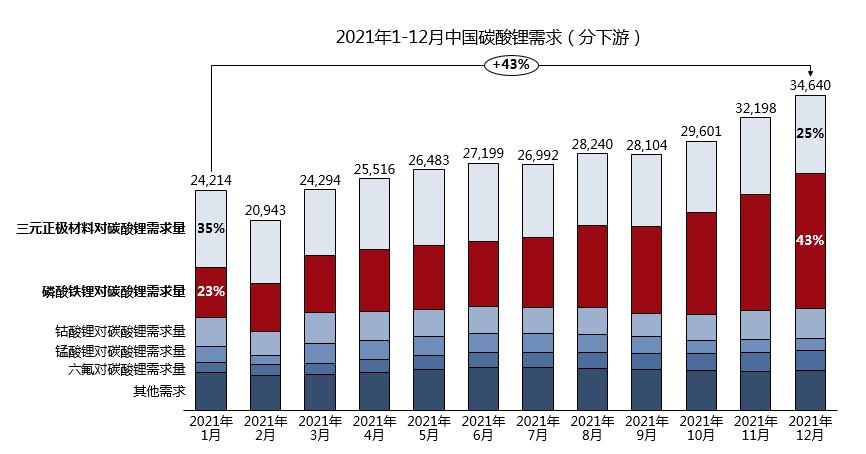
According to SMM statistics, the output of lithium iron phosphate materials in China is expected to be 60, 000 tons in December 2021, an increase of 205% over the same period last year. The total production capacity of lithium iron phosphate in 2021 is about 531000 tons, an increase of 66% over the same period last year. The total output of lithium iron phosphate in 2021 is expected to be 413000 tons, an increase of 183% over the same period last year. In the power market, more and more models are equipped with lithium iron phosphate batteries this year, such as BYD's new electric cars, Great Wall Eula cat series, Wuling Hongguang MINI, Xiaopeng G3 and P7, zero running T03, Roewe eRX5 and Roewe ei6 MAX and Chery eQ1 and other A00 models. BYD's overall electric car sales have been outstanding this year, with production and sales rising by 10,000 units a month in recent months. Most of its models are lithium iron phosphate batteries, and demand for lithium iron batteries has increased significantly. Tesla's domestic standard continued version of Model Y this year also switched to lithium iron phosphate battery. In addition, it was announced on October 21 that the standard extended version of the model will use lithium iron phosphate (LFP) battery to replace the previous ternary lithium battery, while the long-lasting version will continue to use ternary lithium battery. At present, Tesla only produces lithium iron phosphate version Model 3 and Model Y in the Chinese market. With the change of the standard continued version of the model, it is expected that more iron-lithium version models will be produced by factories in the United States and Europe in the future. From the battery market news, the domestic Ningde era (Tesla iron lithium battery supplier) iron lithium orders will increase significantly next year, it is expected that next year CATL iron lithium batteries may account for 70% or more. Domestic battery enterprises distribute more iron-lithium production lines, such as Ningde era, BYD, Guoxuan Hi-Tech, Yiwei Lithium Energy, Ruipu Energy, etc., traditional ternary battery enterprises Honeycomb Energy, Funeng Technology, Xin Wanda and other battery companies have also begun to build or have produced iron-lithium batteries. In addition, overseas battery companies such as LG Chemical and SKI also began to layout lithium iron phosphate batteries this year. In addition, enterprises in different fields, such as ternary material enterprises, ternary precursor enterprises, phosphorus chemical enterprises, titanium dioxide enterprises and so on, have entered the lithium iron phosphate market one after another, and lithium iron phosphate has become a hot market in the new energy industry this year. With the gradual expansion of China's lithium iron phosphate project, SMM expects the total production capacity of lithium iron phosphate to be about 1.24 million tons in 2022, an increase of 135 percent over the same period last year; total production of lithium iron phosphate will reach 700000 tons, an increase of about 70 percent over the same period last year.
In the form of such a frenzied outbreak of demand, it has also brought about a price jump caused by the shortage of raw materials in the upstream. According to SMM, China's demand for lithium carbonate in 2021 totaled 330000 tons, an increase of 61 per cent over the same period last year. Sub-downstream demand, lithium iron phosphate materials for lithium carbonate demand increased significantly, in contrast, iron lithium demand for ternary demand formed a significant squeeze, low-end ternary products will gradually be replaced by lithium iron phosphate. It is worth noting that with the gradual landing of the production expansion project, the procurement demand for lithium carbonate in the market capacity of lithium iron phosphate may be higher than its actual production demand, so the gap may be further enlarged next year when resources cannot be greatly expanded.
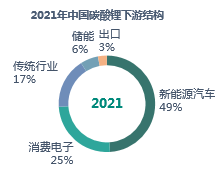
The market pattern of lithium carbonate tends to be dispersed, and the surrogate processing business helps to increase the supply under the condition of shortage.
China's lithium carbonate supply is about 229000 tons in 2021, an increase of 35 per cent over the same period last year. The domestic production capacity of lithium carbonate is about 415500 tons / year, an increase of 19% over the same period last year. According to the classification of raw materials, 49% of China's lithium carbonate output is produced from spodumene, 25% from lithium mica and 26% from salt lake brine. The supply increment this year mainly comes from lithium salt enterprises such as Shengxin Lithium Energy, Yichun Silver Lithium, Lanke Lithium Industry, Hebei Jicheng, Jiangxi Jiuling, Wudi Golden Bay and so on. With the gradual climbing of some of the new domestic production capacity next year, the existing production capacity is expected to reach 280000 tons of lithium carbonate in 2022 in the case of alternative processing and raw material increment. An increase of 22% over the same period last year.
In the first quarter of this year, during the Spring Festival, smelters stopped production and overhauled, and gas restrictions and production cuts occurred frequently in winter. Large lithium salt factories in Sichuan and some areas of Jiangxi stop production and maintenance, mainly for rotary kilns and other production equipment for annual maintenance and waste cleaning; the impact of power cuts in Jiangxi region led to some lithium salt factories to reduce production, the impact continues after the Spring Festival; the production reduction in Qinghai is a conventional production reduction, which is the normal low temperature in Qinghai area from October to December and January to March every year, and the output rate is greatly reduced due to the influence of low temperature climate. At the same time, due to the excessive consumption of natural gas resources caused by extreme weather, the government gives priority to ensuring people's livelihood, and then increases natural gas costs or relatively limits gas consumption for some manufacturers in Qinghai, resulting in a relatively obvious reduction in production. Shandong restricts production and emissions to some industrial parks, resulting in a slight reduction in output. In the second quarter, after the Spring Festival, the major enterprises returned to work and production smoothly, and some of the new production capacity in Jiangxi was obviously released. With the rise in temperature, the output in Qinghai increased significantly. Qinghai Lanke lithium industry also significantly released its new production capacity in the first half of the year, and in June, it successfully achieved the target of producing 100 tons of lithium carbonate per day. Part of the production capacity in Sichuan is affected by the shortage of spodumene resources, and its own start-up is not good, but the OEM increment is obvious, which increases the market supply increment. In the third quarter, about 10% of production has been reduced due to the effects of mid-year overhaul by mainstream head manufacturers, delays in the arrival of mineral resources in Hong Kong, and power cuts. The production capacity of some smelters in Qinghai has been sufficient; in Jiangxi, the production capacity of some manufacturers has reached saturation, the production capacity of new production lines has climbed slightly, and the recovery and extraction of lithium in the superimposed part has increased compared with last year, and the supply is relatively considerable; in Sichuan, as maintenance enterprises resume production, but under the influence of power cuts, output has dropped slightly. In the fourth quarter, Qinghai returned to low production, Sichuan and Jiangxi head manufacturers entered the state of maintenance at the end of the year, the output has decreased.
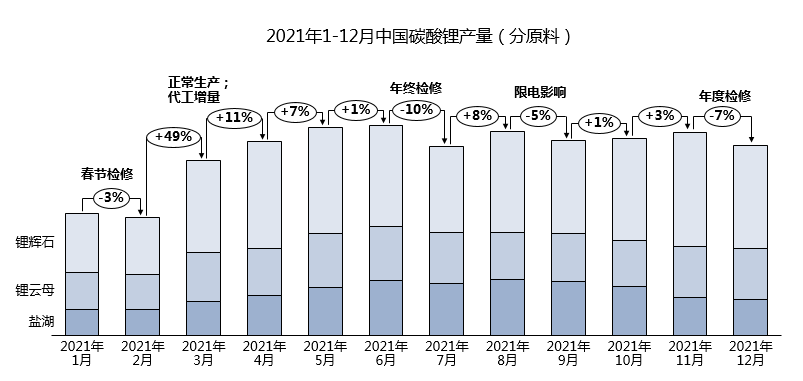
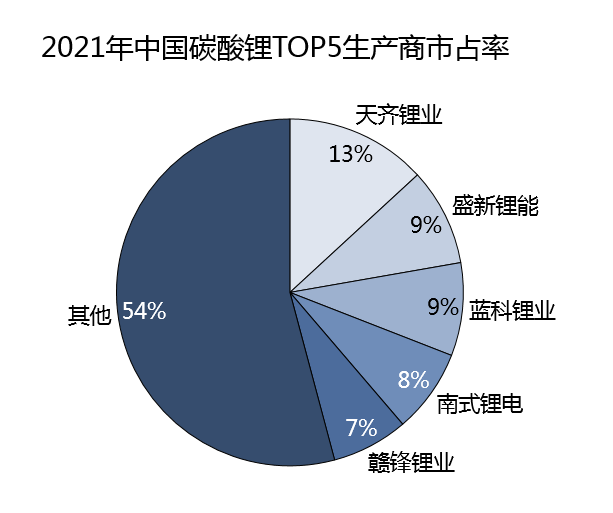
According to SMM statistics, the market share of Chinese lithium carbonate Top 5 production enterprises is about 46%, which is significantly lower than that of 51% in 2020. The enterprise structure of China's lithium carbonate market tends to be scattered, which will form a more fierce competition pattern for raw materials, ores and brine. In 2021, Tianqi Lithium Industry still ranks first in lithium carbonate output, while Shengxin Lithium Energy, Lanke Lithium Industry, Nanshi Lithium Industry and Ganfeng Lithium Industry enter the top five due to maintaining a high operating rate throughout the year.
The import volume will increase significantly in 2021, and the new overseas production capacity can be expected next year.
In 2021, China's lithium carbonate imports are expected to be about 80,000 tons, an increase of 59% over the same period last year, mainly from Chile. According to SMM's understanding, at present, the mainstream overseas smelters in production are SQM, Yabo Chemical, Livent and other international enterprises, with Chile accounting for more production. Due to the transportation distance, some Argentine imports are transferred from Chile to China. In 2021, due to large fluctuations in import volume due to overseas outbreaks and annual maritime logistics / container restrictions, some downstream temporarily accelerated domestic procurement and replenishment due to disruptions in the supply of overseas raw materials. Next year, with the expansion of overseas salt lake projects, such as SQM, Abel Chemical, livent, Mount Everest in Tibet, Ganfeng Lithium Industry and other projects in Chile and Argentina, total imports of lithium carbonate are expected to reach 125000 tons next year, an increase of 56 per cent over the same period last year. At present, with the strengthening of cooperation between global lithium salt and downstream materials and battery enterprises, the volume of direct supply products has increased significantly, and the proportion of intermediate trade may decline.
The waste recovery coefficient is disturbed by lithium price, but the cost is worrying, but the order increases.
At a time when resources are limited, the recovery of lithium from waste has gradually become the focus of the market. At present, recycling enterprises take the waste from battery factories and the black powder sold by traders as the main raw materials for extracting cobalt, nickel and lithium. Before 2021, because the lithium price is low and the recovery value is low, the output is low, and the raw material procurement is mainly based on cobalt, nickel and other metals. However, with the lithium price gradually breaking through 200000, the recovery value has increased significantly, driven by profits from lithium extraction, the supply side of recycled raw materials has greatly increased the valuation coefficient of cobalt and nickel, rising to 104% from 77% at the beginning of the year, and the cost of lithium recovery enterprises has increased significantly. However, in the case of shortage of lithium resources, downstream inquiry orders continue to increase. At present, the mainstream domestic recycling enterprises with lithium extraction capacity include Greenmei, Bangpu cycle, Ganfeng cycle, Huayou cycle, Hunan Sinorama, Tianqi Jintai Pavilion, Chizhou Xian, Jiangxi Ruida and other enterprises. The products gradually changed from lithium sulfate solution and crude lithium carbonate to the production of high quality industrial carbon, quasi-electric carbon and even battery-grade lithium carbonate. The annual production of lithium extraction from the recycling plate is expected to be about 22000 tons of lithium carbonate equivalent in 2021, an increase of about 46 per cent over the same period last year. Recycling companies will expand significantly in lithium extraction next year, and China's production of recycled lithium is expected to increase to 33000 tons in 2022, an increase of 50 per cent over the same period last year.
The significant market behavior of domestic lithium carbonate leads the price to rise at a high speed.
According to SMM estimates, the gap between supply and demand of lithium carbonate in 2021 is about 36000 tons of lithium carbonate equivalent, which is equivalent to 11% of the gap. Due to structural shortages, some market actions have contributed to the rise in lithium carbonate prices. 1) when the demand is surging and the supply is tight and the price is expected to rise, some enterprises adopt the sales restriction mode, which leads to an exponential rapid upward trend in the market zero unit price in the third quarter. 2) downstream enterprises accelerate production expansion and greatly increase demand for raw materials. there is a "competitive" procurement of raw materials among peers, and the situation of locking goods at high prices is out. 3) part of the upstream signing mode has been changed, from the monthly formula price settlement signed by the long order to the order mode at the end of the month, so as to maximize the profit space. In 2022, under the expectation of the rapid expansion of the global lithium power industry, the global and Chinese lithium carbonate gap may be further enlarged.
SMM New Energy Research team
Yi Yanting 021-51666860
Mei Wangqin 021-51666759
Liu Xiaoyi 021-51666716
Yuan Ye 021-51595792
Ren Pengfei 021-51595913
Ma Rui 021-51595780
![[SMM Revue hebdomadaire du marché des cellules de batteries de stockage d'énergie 9.3] L'offre restreinte de feuilles de cuivre limite les calendriers de production de septembre, les prix des cellules de batteries de stockage d'énergie restent fermes](https://imgqn.smm.cn/usercenter/tKgKv20251217171725.png)
![Revue hebdomadaire du marché du carbonate de lithium : du 31/08 au 03/09, les prix au comptant du carbonate de lithium ont d'abord augmenté puis baissé, tendance globale à la baisse [Revue hebdomadaire SMM]](https://imgqn.smm.cn/usercenter/PPLUj20251217171727.jpg)