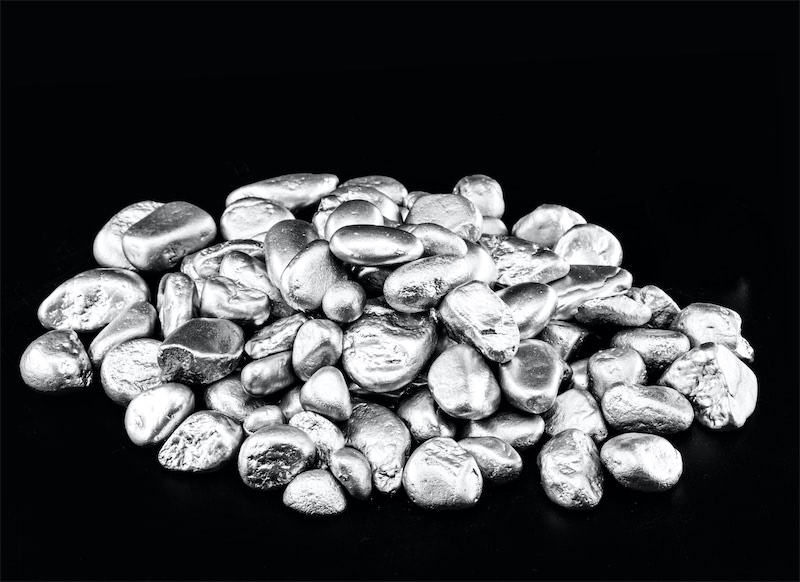
According to foreign media reports, the Tamarak mine in Aitkin County mainly produces nickel and will soon begin the Minnesota licensing process. It may face the struggle of environmental problems.
Brian Goldner, vice president of exploration at Talon Metals, inspected nickel-rich drill cores in Tamarak, Minnesota.
, Talon Metals Brian Goldner of, Talon Metals picks up a "drill core" and points to nickel-rich concentrations in an ornate shack used as a rock sample bank in Tamarak, Minnesota.
"it's ridiculous; it's world-class," said Goldner, vice president of exploration at Talon. "I've never seen anything like this in my career."
In fact, analysts who have reviewed the company's drilling results and securities filings say Talon and its mining giant partner Rio Tinto (Rio Tinto) are sitting on potential nickel-rich deposits, which is rare in the United States.
"it's a barn burner-it's very impressive," said David Hammond, a mining economist in Colorado.
Talon's promotion for the mine includes a "direct air" carbon capture system that absorbs carbon dioxide from the air and permanently stores it in the mine's rock waste. It sounds like alchemy, but a project based on similar ideas was launched in Iceland earlier this year.
Nonetheless, even if a high-grade nickel is found, Talon must prove to investors that the mine is economical. And it has not yet gone through national environmental and mine licensing procedures, which are expected to begin next year.
Other proposed sulphide mines in northern Minnesota-the PolyMet and Antofagasta Twin Metals projects-are facing strong opposition from environmental groups and the band Ojibwe, which are linked to acid waste polluting lakes, rivers and wetlands.
The Tamarak mine is unlikely to escape its own battle.
"fundamentally, sulphide mining has failed to protect water quality in water-rich environments for a long time," said Paula Maccabi (Paula Maccabee), director of advocacy for the environmental group WaterLegacy.
Nickel will be the king of Tamarak.
The Tamarack mine, which will cost about $400m and employ about 450 people, will be located in the same Great Lakes geological belt, the Mid-Continental Rift, as the mines in PolyMet and Antofagasta, Talon said.
But the two projects in northeastern Minnesota are first copper mines, with low-grade nickel and other metals as by-products. High-grade nickel is the king of Tamarak, copper is a secondary metal, cobalt and other low-grade metals.
There is only one high-grade nickel mine in the United States, the Iger mine on the Upper Peninsula of Michigan, which is expected to run out by 2025 after nine years of operation.
"the United States is almost always dependent on imported nickel," said Adrian Gardner, a nickel market analyst at consulting firm Wood Mackenzie.
Only 7 per cent of global refined nickel production is used to produce (EV) batteries for electric vehicles; he says 65 to 75 per cent is used to make stainless steel. But electric vehicle batteries are expected to account for about 22% of the market by 2030.
"what excites everyone is the growth rate," Gardner said. "now is a good time for a mine like Tamarak. Demand for nickel in both stainless steel and electric vehicles is strong. "
But for all the discussion of the electric car market, the nickel processing of batteries is usually done in China. There are not even nickel refineries in the United States to produce almost pure nickel products.
There is no structure for making nickel-based batteries in North America, says Mr Gardner.
Talon is betting that the US nickel supply chain will emerge in the coming years, pointing to the efforts of President Joe Biden's administration.
Earlier this month, the USGS designated nickel as a "key mineral" and, more importantly, the Biden administration suggested that the federal government help finance new nickel refineries.
The federal infrastructure measures signed into law this month include $6 billion in loans and grants for the processing of battery materials. A large number of projects will compete for the money.
Todd Malan, Talon's chief external affairs officer, said Talon would work with other companies-nickel refiners, battery technology companies and carmakers-to promote nickel processing projects to the federal government, especially an oil refinery in Minnesota.
"We have to build a team to do that," Malan said. Rio Tinto is considering participation.
The muscles behind the Rio Tinto project
Rio Tinto's Kennicott subsidiary began looking for copper and nickel in Aitkin County as early as 1991, but did not start drilling until 11 years later. After 42 drills, Rio Tinto finally achieved encouraging results in 2008.
Anglo-Australian Rio Tinto is the world's second-largest mining company, operating mines, smelters and metal refineries in 35 countries, dealing with minerals from iron ore to copper to diamonds.
In 2018, Rio Tinto signed a contract with Talon to become a joint venture partner of the Tamarack project. Mining economist Hammond said Rio Tinto "does not engage in the business of developing small mines." "so they will transfer [development] to Talon."
Talon is headquartered in the British Virgin Islands and operates in Canada. Its shares trade on the Toronto Stock Exchange at about 70 cents.
This is a "junior" miner, a company dedicated to mining and exploration, usually targeting only one project. PolyMet's mine, which is closest to Minnesota's reality, is also a junior miner backed by global mining giant Glencore.
But there is a key difference between the two.
Glencore owns more than 70 per cent of PolyMet and has been increasing its shares over time. Talon has been buying projects originally as Rio and now owns 51 per cent of the Tamarack joint venture and could hold up to 60 per cent. (Rio in turn owns 6 per cent of Talon. )
This year, Talon's drilling program, which will last six to nine months, produces core samples with higher nickel and copper grades than the mine plan it currently submits to the securities regulator.
"of course the rank is good. But the second question is quantity: how big is it? " Said Nitin Laddha, an equity analyst at Couloir Capital. In other words, are the nickel-copper deposits near Tamarak rich enough to eventually accommodate several relatively small deposits?
Talon's mineral lease covers about 31000 acres, mainly with Minnesota. The project does not involve federal land. Even a small mine can still be hugely profitable for Talon owners because of its high-grade minerals.
The details of the environment have not yet been made public.
Talon says the mine's environmental footprint is relatively small. Waste rock (called tailings) is not stored in the dam, reducing the risk of sulfuric acid leaking into the surrounding water system.
Instead, a large part of the tailings will be mixed with cement and pumped back underground. The rest will be dried, stacked and covered with soil. Nevertheless, the environmental details of the Tamarak mine have not been made public.
When they show up, Ojibwe's Mille Lacs band will keep a close eye on them. Part of the band's reservation is less than 10 miles from Tamarak (Tamarack). The same is true of the main waters of wild rice, which is a mecca for the Ogibwe people.
Kelly Applegate, Mille Lac's natural resources commissioner, says the band does not yet have a place in the mine. But it has a lot of concerns, especially about the possible toxic leaching of buried tailings.
"We are worried that the groundwater may come into contact with the disturbed rock," Applegate said.
Talon and Rio Tinto announced last month a carbon dioxide reduction project linked to the mine. They are working with California-based Carbon Capture Inc. Work together to develop a technology that can remove carbon dioxide directly from the air.
Rio Tinto has invested $4 million in the company and has raised more than $40 million so far. The carbon dioxide removed from the air by Carbon Capture's machine is mixed with a mixture of tailings and cement and then stored underground.
Magnesium-rich rocks that are usually accompanied by high-grade nickel deposits react naturally with carbon dioxide to turn them into rocks. This has happened for thousands of years. The trick of direct carbon capture is to greatly accelerate the mineralization process.
Direct carbon capture technology is still in its infancy and may never prove to be cost-effective on any significant scale.
Still, the world's first commercial direct carbon capture project opened with great fanfare in Iceland two months ago. It injects carbon into the depths of basalt strata-which can also convert carbon dioxide into rock.
Icelandic companies sell carbon credits, including to big companies such as Microsoft and Audi. The Tamarack program also depends on the company's purchase of carbon credits-and the federal tax credit used to capture carbon.
![[SMM Analysis] Indonesian Ore Prices Under Downward Pressure, Persistently Low Grade Restricts Supply Quality](https://imgqn.smm.cn/usercenter/WYeHX20251217171733.jpg)
![[SMM Nickel Market Flash] Indonesia RKEF Utilisation Drops to 76% on Ore Quota Cut; Govt Eyes $18-20K Nickel Range](https://imgqn.smm.cn/usercenter/yaAtG20251217171733.jpg)
![[SMM Nickel Market Flash] Chinese Nickel Majors Eye Africa and Pacific as Indonesia Policy Pressure Mounts](https://imgqn.smm.cn/usercenter/GmHLU20251217171733.jpg)