Recently, the National Development and Reform Commission and the State-owned assets Supervision and Administration Commission have commissioned relevant industry associations and research institutes to carry out research on the development path of key industries such as carbon peak, carbon-neutral constraints, power, building materials, non-ferrous materials, and so on. Aluminum industry is not only the basic industry to develop the national economy and improve people's living standards, but also the largest source of carbon dioxide emission in the non-ferrous industry. All aspects of its life cycle, including bauxite mining, alumina smelting, primary aluminum electrolysis, aluminum, final product production and recycling of recycled aluminum, as well as upstream energy production process, will emit CO2. Therefore, exploring the path of carbon emission reduction in aluminum industry is very important to achieve the goal of carbon peak and carbon neutralization in China.
Carbon peak and carbon neutralization in aluminum industry
Definition of carbon peak and carbon neutralization
According to the definition of (Intergovernmental Panel on Climate Change, IPCC) of the United Nations Intergovernmental Panel on Climate change, carbon peak means that the annual CO2 emissions of a region or industry reach the highest value in history, and then enter the process of continuous decline, which is the historical inflection point of CO2 emissions from increase to decline. The carbon peak includes the year of the peak and the peak. Carbon neutralization refers to CO2 emissions generated by human activities, which is balanced with the absorption achieved by the application of CO2 removal technologies such as afforestation.
Carbon peak and carbon neutralization target in aluminum industry
In October 2019, the 96th meeting of the Council of the International Aluminum Association decided to set up a working group on ways to reduce greenhouse gas emissions in the international aluminum industry, which is responsible for the reduction of greenhouse gas carbon emissions in the international aluminum industry. the coverage of greenhouse gas emissions in the aluminum industry and zero net greenhouse gas emission targets and approaches in 2050 were preliminarily drawn up.
In March 2021, the International Aluminum Association issued the "2050 greenhouse Gas Emission path of Aluminum Industry" and put forward the greenhouse gas emission reduction target of the global aluminum industry: by 2050, under the condition of global aluminum output of 170 million tons (including 90 million tons of primary aluminum), the total emission of the global aluminum industry covering the whole industry chain (bauxite, alumina and electrolytic aluminum production, aluminum processing and manufacturing, as well as waste recovery and recycling) is 250 million tons CO2 equivalent, and the total emission of aluminum industry covers the whole industry chain (bauxite, alumina and electrolytic aluminum production, aluminum processing and manufacturing, as well as waste recovery and recycling). Among them, the emissions generated by power consumption in all processes related to primary aluminum production (especially in the smelting process) are close to zero, and the direct emissions are 200 million tons CO2 equivalent, and the emissions of fuel combustion and electricity consumption in the recovery and manufacturing process are 50 million tons CO2 equivalent.
With reference to the greenhouse gas emission reduction targets of the international aluminum industry, combined with the current CO2 emission situation of China's aluminum industry, and the China Nonferrous Metals Industry Association put forward by the China Nonferrous Metals Industry Association, the non-ferrous industry strives to achieve a carbon peak by 2025 and a 40% emission reduction target by 2040. China's aluminum industry is expected to achieve a carbon peak of about 560 million t CO2 equivalent in 2025.
Emission status of aluminum industry
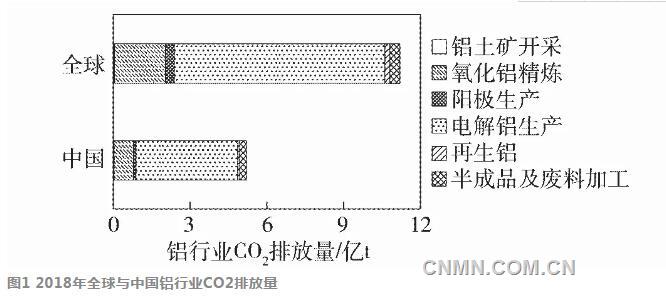
In 2018, the global output of aluminum is 95 million tons, of which the output of primary aluminum is 64 million tons and that of recycled aluminum is 31 million tons. CO2 emissions from the global aluminum industry are 1.13 billion t equivalent. In the same period, the output of aluminum in China is 42.75 million t, of which the output of primary aluminum is 35.8 million t, the output of recycled aluminum is 6.95 million t, and the CO2 emission of aluminum industry in China is 520 million t equivalent.
The aluminum industry includes primary aluminum production (aluminum mining, alumina production, anode production, electrolytic aluminum production), recycled aluminum and aluminum processing and product manufacturing, among which primary aluminum production accounts for 94.85% of CO2 emissions in the aluminum industry, as shown in figure 2.
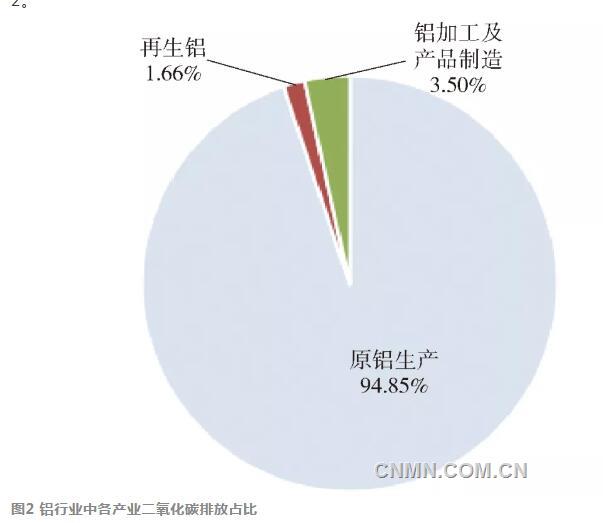
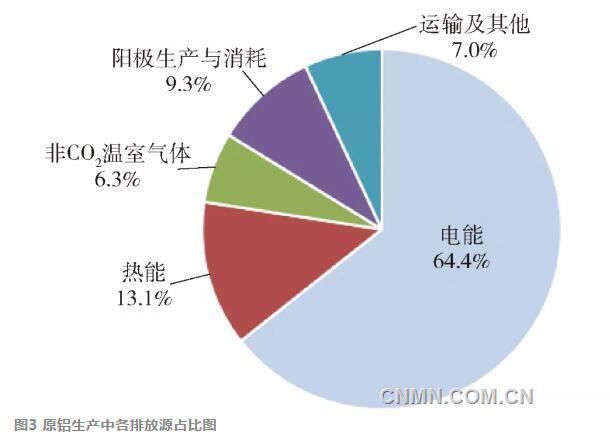
In the primary aluminum production, the CO2 of energy consumption and emission accounts for a relatively large proportion, reaching 77.5% (of which, the CO2 of electric energy consumption and emission accounts for about 64.3%, and the CO2 of thermal energy consumption accounts for 13.1%).
Characteristics of carbon Emission from Aluminum Industry in China
Coal and electricity account for a large proportion in the production of electrolytic aluminum in China.
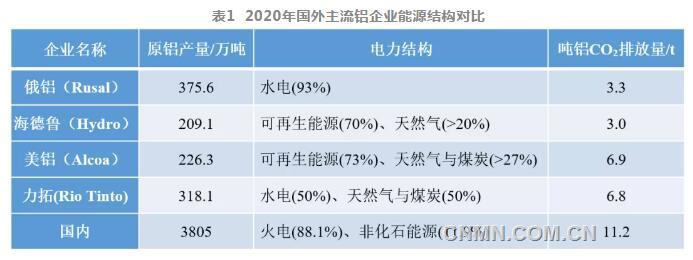
Compared with the electrolytic aluminum enterprises in Europe and the United States, the carbon emission of the electrolytic aluminum industry in China is higher, mainly because the domestic primary aluminum power depends heavily on thermal power. According to statistics, by the end of 2020, China's electrolytic aluminum production capacity accounted for 65.2% of self-provided electricity consumption and 34.8% of grid electricity consumption. Among them, the self-provided electricity is all thermal power, and the network power is divided according to the power generation structure of Electroweb in each region. It is estimated that in the energy structure of electrolytic aluminum, thermal power accounts for 88.1%, and non-fossil energy accounts for 11.9%.
There is limited space for the energy consumption index of electrolytic aluminum and alumina to decrease significantly.
At present, the most typical production process of primary aluminum is cryolite-alumina molten salt electrolysis (Hall-Elut molten salt electrolysis). After more than 100 years of continuous process optimization, the potential excavation of production process indexes of alumina and electrolytic aluminum is close to the limit. Under the condition that there is no subversive production process change, the decline space of various indexes of aluminum smelting is limited.
There are still bottlenecks in key carbon reduction technologies.
In aluminum smelting production, there are insufficient reserves of zero-carbon and negative-carbon core technologies, such as low-temperature waste heat recovery, waste-free metallurgy, inert anode, high-efficiency and ultra-low energy consumption aluminum electrolysis, carbon dioxide capture and utilization, etc.
The proportion of recycled aluminum is relatively low.
Estimates show that the carbon dioxide emissions of recycled aluminum are only about 4% of those of primary aluminum. In 2020, the global aluminum output was 99.1 million tons, of which the recycled aluminum output was 33.8 million tons, accounting for 34.1% of the global aluminum output. In the same year, the output of aluminum in China was 44.48 million tons, of which the output of recycled aluminum was 7.4 million tons, accounting for 16.6 percent of the domestic aluminum output. There is a big gap between the output of recycled aluminum in China and the international average level.
Realization of carbon peak carbon neutralization path in aluminum industry
Combined with the characteristics of carbon emissions in China's aluminum industry, the ways to achieve carbon peak and carbon neutralization mainly include the improvement of energy efficiency, industrial structure adjustment, energy structure adjustment, zero-carbon (negative carbon) technology development and so on.
Saving energy and improving efficiency to reduce carbon emission intensity
In 2005, the proposal of the CPC Central Committee on the formulation of the Eleventh five-year Plan for National Economic and Social Development raised resource conservation to China's "basic national policy" for the first time. In the three "five-year plans" since 2006, the energy saving index to reduce the energy consumption per unit GDP has always been listed as one of the important binding indicators of the "five-year Plan". From 2006 to 2019, China's energy consumption per unit GDP decreased by 42.5%, carbon dioxide emissions per unit GDP decreased by 47.9%, and AC power consumption of electrolytic aluminum decreased by about 7.0% from 14575 kWh/t to 13555 kWh/t,.
Multiple estimates show that energy conservation and improved energy efficiency contribute more than 70% to China's carbon emissions peak target by 2030, while renewable energy and nuclear power contribute nearly 30%. Carbon dioxide capture and storage technology is difficult to make a substantial contribution to our country's goal of reaching the carbon peak before 2030.
Therefore, in order to achieve carbon peak and carbon neutralization, we should increase the popularization and application of energy-saving technology and equipment, innovate third-party energy-saving service models such as contract energy management, and promote energy-saving technology, energy-saving equipment, energy cascade utilization and waste heat utilization. to land projects that improve energy efficiency; Strengthen the standard management of the whole process, the whole chain and all elements, diagnose the energy saving, find the gap, carry out lean management, take continuous improvement as the carrier, tap the potential of energy saving and consumption reduction, and optimize the technical and economic indicators.
Optimize the structure of aluminum industry and increase the output of recycled aluminum
Consolidate and eliminate the excess capacity of electrolytic aluminum, strictly control the ceiling production capacity of 45 million tons of electrolytic aluminum, strengthen the development of "urban mines", vigorously develop short-flow smelting process, greatly increase the production capacity of recycled aluminum and increase the proportion of recycled aluminum. Select coastal and hydropower-rich green energy areas to carry out the layout of aluminum industry, promote the development of industrial agglomeration, build aluminum cluster industrial base, and reduce carbon emissions in the process of logistics, transportation and metal remelting.
Optimize Energy structure and realize Green Development of Aluminum Industry
Optimizing the energy structure, shrinking the capacity of electrolytic aluminum thermal power and increasing the proportion of clean energy use are the most direct and effective ways to achieve carbon peak and carbon neutralization in the aluminum industry. The main measures include:
1) to eliminate coal-fired self-provided power plants, or to replace thermal power with clean energy through the replacement of generation rights of self-provided units;
2) clean the self-provided power plant and replace coal with low-carbon or zero-carbon energy;
3) making use of the enterprise factory building and its surrounding environment to build wind and photovoltaic power stations, combined with energy storage technology, to realize the direct supply of clean energy;
4) relying on hydropower and nuclear power resources, replacing the production capacity of electrolytic aluminum to realize the direct utilization of clean energy;
5) promote low-carbon transport and gradually introduce electric and hydrogen transport vehicles.
Promote technological innovation and achieve a breakthrough in subversive carbon reduction technology
Integrate domestic scientific research institutes, set up a low-carbon green development and innovation platform for China's non-ferrous metals industry, lay out forward-looking, strategic and subversive projects in the fields of energy conservation and carbon reduction, clean production and clean energy, and implement key green technology actions. strive to achieve breakthroughs in non-waste metallurgy, efficient and ultra-low energy consumption aluminum reduction cells, inert anodes and carbon dioxide capture, utilization and storage technologies in the aluminum industry. Provide technical support for green development.
Conclusion: on July 30, 2021, the political Bureau of the CPC Central Committee held a meeting and proposed to do a good job in carbon peak and carbon neutralization work in an overall and orderly manner, issue an action plan for carbon peak before 2030 as soon as possible, adhere to a national game of chess, correct sports-style "carbon reduction", establish first and then break, and resolutely curb the blind development of the "two high" projects. As a major carbon emitter, the aluminum industry should take the carbon peak and carbon neutralization target as an opportunity to promote industrial upgrading by constantly improving energy efficiency, vigorously adjusting the industrial structure, increasing the use of clean energy, promoting scientific and technological innovation, and promoting product application. To seize the commanding heights of international low-carbon development.