"Click to view details
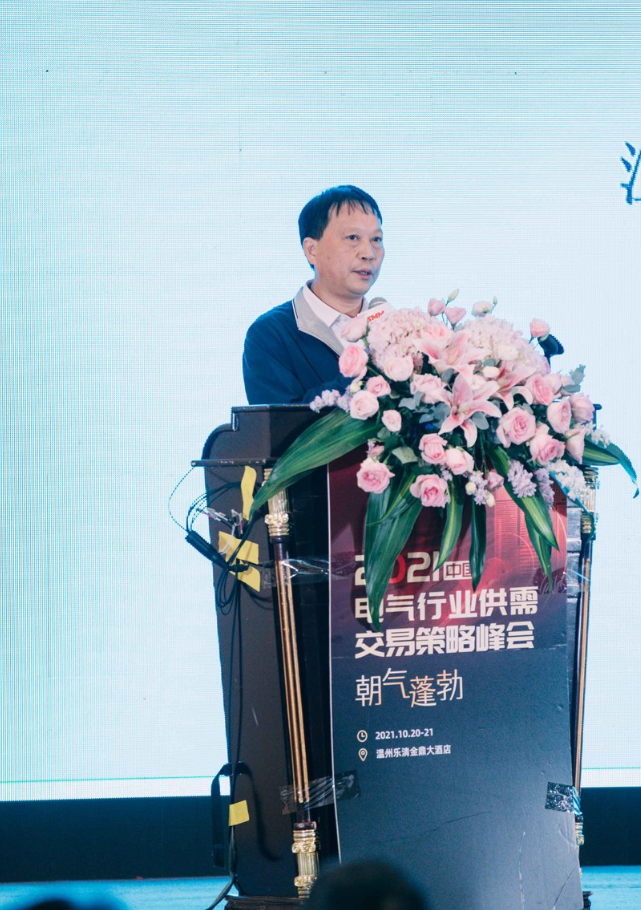
At the 2021 China Electric Industry supply and demand Trading Strategy Summit hosted by (SMM) of SMM Information & Technology Co., Ltd., Hong Dianhua, sales Director of Jiangxi Baotai Nonferrous Metals Group Co., Ltd., introduced the development situation analysis and market trend analysis of copper bars. Hong Tianhua said that in terms of China's copper imports, China's copper imports reached 4.98 million tons in 2019, a cumulative decline of 6%; in 2019, China's copper imports reached 32.471 billion US dollars, a cumulative decline of 13.3%. In 2020, China's copper imports reached 6.68 million tons, an accumulative increase of 34.1 percent. Imports reached US $43.171 billion, an increase of 32.9 percent over the same period last year. Copper imports are expected to reach 7 million tons in 2021, with a cumulative increase of 3440 percent, and imports will reach 45 billion US dollars.
Development status of copper products
Copper is made of pure copper or copper alloy in various shapes including bars, wires, plates, strips, tubes, foils and so on. Copper is processed by rolling, extrusion and drawing, in which plates and strips are hot-rolled and cold-rolled, while strips and foils are cold-rolled; pipes and bars are divided into extruded and drawn products; wires are drawn. Copper can be divided into many types: copper plate, copper bar, copper tube, copper strip, copper wire, copper bar, copper material.
Development status of copper products:
I. Copper bars
Electrical copper bar is a kind of high current conductive product, which is made of copper material, also known as copper bus bar, grounded copper bar or conductive copper bar. It is a long conductor with rectangular cross section or rounded rectangle, which is used in the circuit to transmit current and connect electrical equipment. Copper bar has been widely used in electrical equipment, especially in complete sets of power distribution equipment, and plays a role in connecting electrical equipment in electrical engineering, such as high and low voltage electrical appliances, switch contacts, power distribution equipment, bus slots and so on. it is also used to transport current in ultra-high current electrolytic smelting projects such as metal smelting, electroplating, chemical caustic soda and so on.
II. Copper plate and strip
Copper strip is a kind of copper, copper strip is the general name of copper plate and copper strip, copper plate refers to copper rolled plate, rolling includes hot rolling and cold rolling, and copper strip refers to copper rolled products with thickness between 0.06~1.5mm. According to different grades, copper strip can be roughly divided into brass strip, copper strip, bronze strip and white copper strip. Copper strip is widely used in conductive, thermal and corrosion resistant equipment because of its special metal properties, high conductivity and strong corrosion resistance. Such as wire, cable, conductive screw, detonator for blasting, evaporator for chemical industry, storage and all kinds of pipes, etc. Copper strip can also do a variety of deep drawing and bending parts, such as pins, rivets, washers, nuts, ducts, barometers, screen, radiator parts and so on.
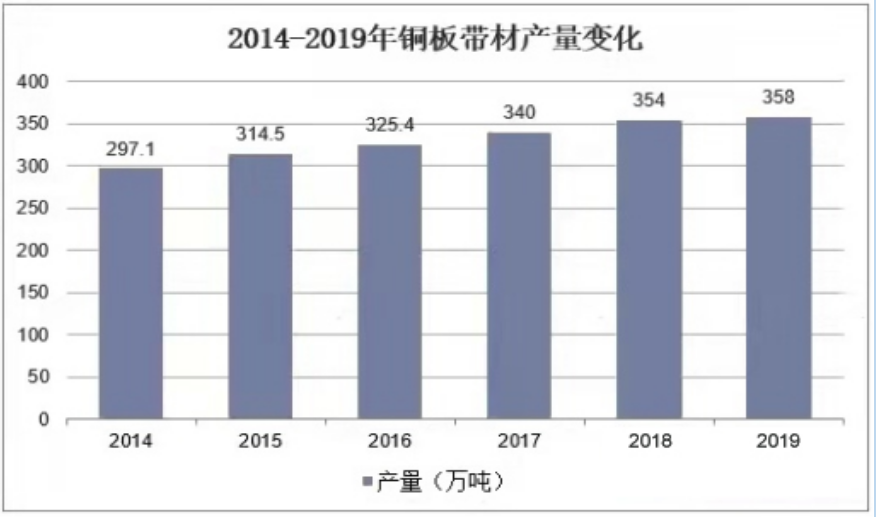
In recent years, the output of copper plate and strip materials in China has shown a steady upward trend. according to the market data, the domestic output of copper plate and strip has increased from 2.971 million tons to 3.58 million tons from 2014 to 2019. The production and consumption of copper plate and strip in China ranks first in the world, accounting for about 2/5 of the world's total output and consumption. It is expected that the output of copper plate and strip will increase linearly in 2021, and the output will reach about 5 million tons.
According to data from the China Business Industrial Research Institute, China's copper production is relatively volatile. In 2020, China's copper production increased to 20.455 million tons, an increase of 283000 tons over the previous year, an increase of 1.4 percent over the same period last year. China's copper production from January to March in 2021 was 4.516 million tons. From the perspective of distribution area, from January to March 2021, China's copper production was mainly concentrated in East China, accounting for 70.36% of the total copper output, followed by Central China, accounting for 12.73%, and then South China, accounting for 7.52%.
From the perspective of copper output of provinces and cities in China, the top five copper output in 2020 are Jiangxi Province, Jiangsu Province, Zhejiang Province, Guangdong Province and Anhui Province, with copper output of 3.8477 million tons, 3.6983 million tons, 2.7421 million tons, 2.6206 million tons and 2.3633 million tons respectively, all exceeding 2 million tons. It is estimated that the national output of copper will reach 3 million tons in 2021.
From the perspective of China's copper imports, China's copper imports reached 4.98 million tons in 2019, a cumulative decrease of 6%; in 2019, China's copper imports reached 32.471 billion US dollars, a cumulative decline of 13.3%. In 2020, China's copper imports reached 6.68 million tons, an accumulative increase of 34.1 percent. Imports reached US $43.171 billion, an increase of 32.9 percent over the same period last year. Copper imports are expected to reach 7 million tons in 2021, with a cumulative increase of 3440 percent, and imports will reach 45 billion US dollars.
In 2020, the output of copper processing materials in China showed a trend of low before and high after. Affected by the epidemic in the first quarter, there was almost no growth. With the effective control of the epidemic in China and the outbreak abroad, the demand of the global commodity market also recovered and increased rapidly. Since the second quarter, the output of copper processing materials in China has increased compared with the same period last year, and the production situation of many enterprises has reached the best level in history. According to the China Nonferrous Metal processing Industry Association, the output of the copper processing industry increased and profits decreased in the first half of the year. The main reason: affected by the epidemic, copper processing enterprises as a whole returned to work and production relatively late, because they were worried about the poor demand in the downstream market and fierce competition in the industry, enterprises reduced prices and increased orders in order to preserve health. However, the economy recovers quickly, the downstream orders are full, it is difficult to recover after the reduction of processing fees, and profits decline, which does not increase profits for many enterprises. In the third and fourth quarters, China's economy returned to its pre-epidemic level, foreign demand also picked up, downstream demand began to increase, and the output and profits of large enterprises further improved.
Third, phosphorus copper ball
With the rapid development of electronic technology, the production demand of all kinds of circuit boards increases greatly. As an important raw material of electroplating anode, the demand for copper is greatly increased, in which PCB precision circuit board needs phosphorus copper ball as anode. The production line of phosphorus copper ball adopts advanced technology and equipment such as up-drawing continuous casting, continuous extrusion, automatic upsetting ball, grinding and polishing, automatic cleaning, automatic weighing, automatic packaging, robot palletizing, AGV unmanned forklift, etc., which not only greatly improves the degree of automation, saves human resources, but also significantly improves production capacity and efficiency. The automatic production line is based on the production of high-grade microcrystalline phosphorus copper ball and anode phosphorus copper ball. It has a strong advantage of technological innovation in the same industry, and plays a leading role in promoting and promoting the development of phosphorus-copper ball-related industries.
The future development prospect of copper products:
1. Integrate enterprise resources. Through technology research and development, product upgrading, scale expansion and the extension of the industrial chain, we can enhance the resource integration ability of enterprises, increase the anti-risk ability of enterprises, and improve the comprehensive competitiveness of enterprises.
two。 Pay attention to the development of brand image. It is built from both internal and external aspects. Internally: improve product quality, practice the internal skills of the enterprise; create a corporate culture, so as to better maintain the corporate brand image. External: enterprises carry out promotion through advertising and various media channels.
3. A variety of products go hand in hand with market segments
The copper processing industry will further increase investment in science and technology, vigorously carry out technological innovation, product quality and grade will continue to improve steadily, strive to develop in the direction of multi-variety and high precision, and the product standard level will continue to be in the international advanced ranks. Copper products are used in electric power, household appliances, automobiles, construction, electronic instruments, national defense, transportation, marine engineering and other markets and industries, occupy the high-end copper market, meet the requirements of national economic modernization and high-tech development, and enhance its competitiveness in domestic and foreign markets.
4. The future development trend of copper processing industry. In the development of the global copper industry, China has become a big country in the production, processing and consumption of refined copper in the world. The development trend of the international copper processing industry in the next few years is as follows:
(1) the growth of the number of enterprises is limited, because the market and technology are already very mature, new enterprises enter, there is little room for development.
(2) the scale of the existing enterprises will become larger and larger, and the excellent enterprises will eliminate some of the backward enterprises.
(3) with the continuous progress and development of society, the demand for copper will continue to increase, so the production capacity and output will also continue to increase.
(4) the variety of products will continue to increase, and the quality of products will be better.
(5) the new materials are developing in the direction of high precision, precision, sharpness, functionalization and intelligence, and the products are developing in the direction of high precision, high surface and high consistency of performance.
(6) the new process will develop in the direction of energy saving, environmental protection, low-carbon continuity and short process, more energy saving and consumption reduction, low carbon emission reduction, green environmental protection, advanced and efficient, which will promote the better and healthier development of the copper industry.