SHANGHAI, Oct 20 (SMM) - The General Office of the Ministry of Ecology and Environment under the Ministry of Industry and Information Technology issued a notice on September 30, requiring staggered production of the steel industry in the heating season of 2021-2022 in Beijing-Tianjin-Hebei and surrounding areas (the “Notice”).
SMM did some calculations based on the Notice:
Date of Implementation
From Nov. 15, 2021 to Mar. 15, 2022
The local crude steel output shall meet the pre-set target from Nov. 15, 2021 to Dec. 31, 2021 (the first phase).
The local staggered production shall be no less than 30% of the crude steel output in the same period last year in principle with a goal of reducing the additional waste emissions from heating in winter from Jan. 1, 2022 to Mar. 15, 2022 (the second phase).
Areas covered by the Notice
Beijing; Tianjin; Shijiazhuang, Tangshan, Handan, Xingtai, Baoding, Cangzhou, Langfang, Hengshui and Xiongan New District in Hebei Province; Taiyuan, Yangquan, Changzhi, Jincheng, Shandong Province , Zibo, Jining, Dezhou, Liaocheng, Binzhou, Heze in Shanxi Province; Zhengzhou, Kaifeng, Anyang, Hebi, Xinxiang, Jiaozuo, Puyang (including Dingzhou, Xinji, Hebei, Jiyuan, Henan) in Henan Province (hereafter referred to as the 2+26 cities). Chengde, Zhangjiakou, Qinhuangdao, Linfen, Rizhao, Linyi, Weifang, Taian will implement staggered production by reference to the Notice.
The first phase: to ensure that the crude steel output does not exceed that in the previous year. SMM expects that from October to December, the domestic unfilled output reduction task is about 20-23 million mt.
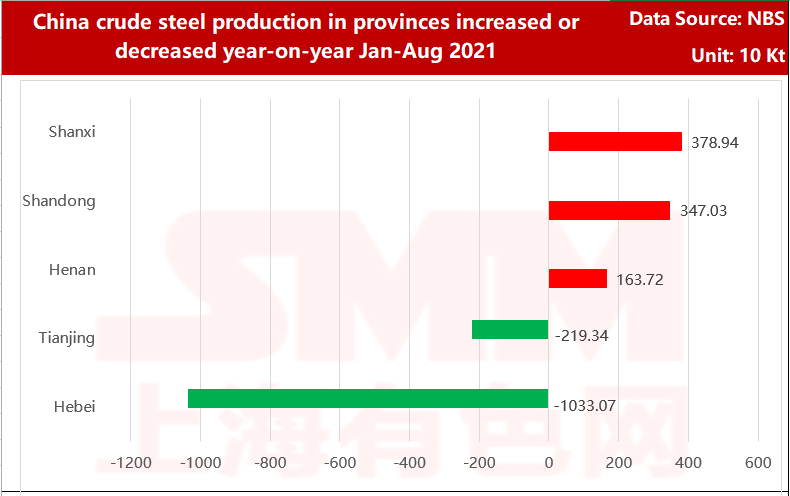
According to the latest data from the Bureau of Statistics, from January to August, only the crude steel output in Shanxi, Shandong, and Henan exceeded the output in 2020 by around 8.9 million mt in total. SMM estimates that the average daily crude steel output from September to December in Shanxi, Shandong, and Henan should decrease by 73,000 mt from the average daily output of 424,400 mt in August to 351,000 mt per day, a decrease of 17%. Since mid-to-late September, a large number of domestic steel mills have reduced their production or carried out overhauls under the influence of the dual control of energy consumption. If the relevant steel mills maintain the current production level, it should be able to complete the production cut target.
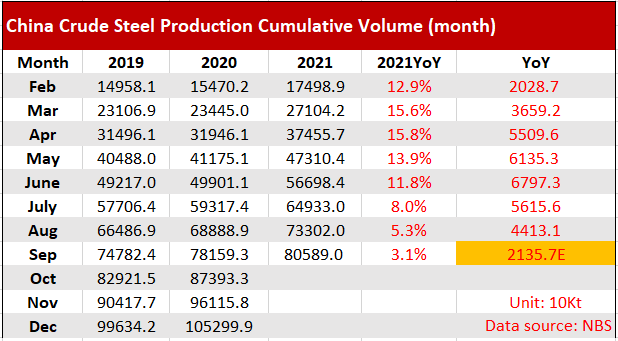
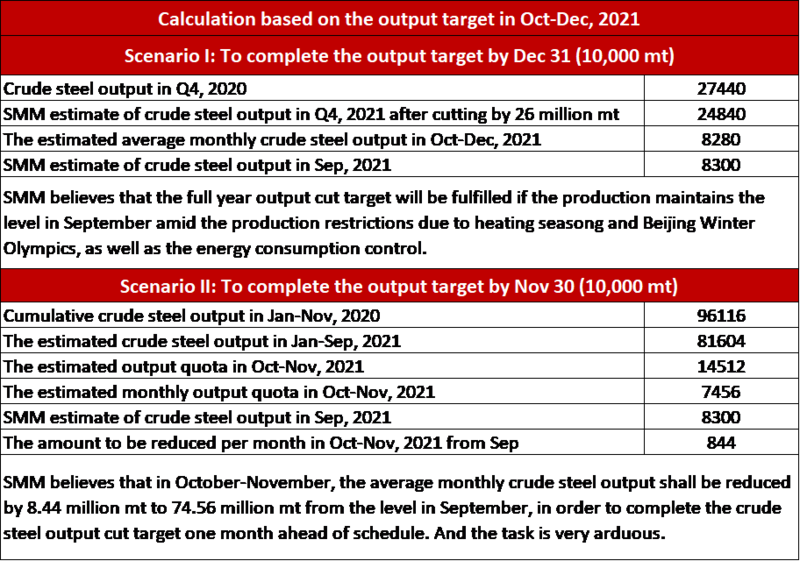
Domestically speaking, as the National Bureau of Statistics revised China's crude steel output in the "Statistical Bulletin" published on February 28, China's crude steel output in 2020 was revised from 1,053 million mt to 1,064.77 million mt. According to SMM calculation, the actual increase in crude steel output from January to September in China in 2021 was about 21.36 million mt from last year. In the fourth quarter of 2020, China's crude steel output was 274.4 million mt. If 21.36 million mt of crude steel were to be reduced year-on-year, the allowed crude steel output in the fourth quarter of this year would be 253.04 million mt, with an average monthly output of 84.35 million mt. The domestic output of crude steel stood at 73.75 million mt in September. Thanks to the production control required by the heating season, the Beijing Winter Olympics and energy consumption control, it will easy for China to meet the full-year crude steel output cut target in 2021, and the monthly output in the last three months could even rise by 10 million mt from the level in September.
However, according to SMM research, some large domestic steel mills have been urged to complete the production cut target one month in advance. According to SMM calculations, from October to November, the monthly output is allowed to increase by 4.86 million mt to 73.75 million mt on average compared with September in order to complete the full-year target one month in advance. On the whole, as the domestic production restrictions continued to intensify from July to September, the target of crude steel output cut could be easily achieved, or even overfulfilled.
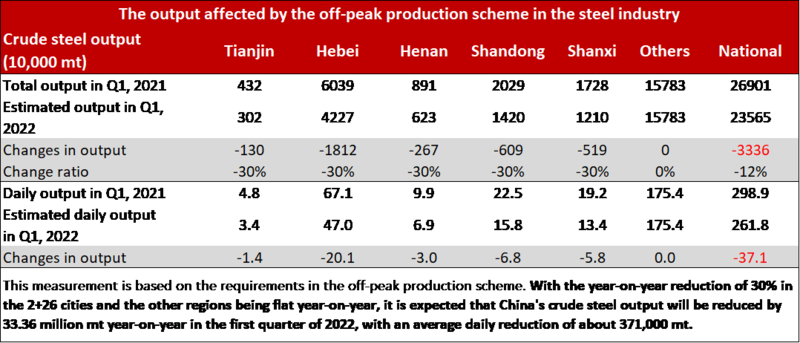
The second stage: In the first quarter of 2022, China's crude steel output shall be reduced by 33.35 million mt year-on-year, with an average daily reduction of about 371,000 mt.
According to the requirement, the local staggered production shall be no less than 30% of the crude steel output in the same period last year in principle with a goal of reducing the additional waste emissions from heating in winter from Jan. 1, 2022 to Mar. 15, 2022.
According to statistics from the Bureau of Statistics, in the first quarter of 2020, China's crude steel output was 269.01 million mt, and the total crude steel output in the 2+26 cities was 111.18 million mt. Based on the assumption that the production in the 2+26 cities shall drop by 30% year-on-year and the production in other regions stays unchanged, SMM predicts that China's crude steel output in the first quarter of 2022 will decrease year-on-year by approximately 33.36 million mt, with an average daily reduction of about 371,000 mt.
Since the Notice has urged the receivers to strictly follow the production reduction requirement, SMM believes that the impact on the total production will be much significant than power rationing.
Considering that China has attached great importance to the Beijing Winter Olympics which will be held during Feb 4 to 20, 2022, this Notice is expected to be implemented smoothly. Meanwhile, it is mentioned in the Notice that "the staggered production shall be carried out by shutting down the blast furnaces, and other alternative plans like reducing the operating rates will not be allowed. It shall be implemented by specifying the names of enterprises, the production lines, the production facilities and the production time periods. While the proportion of staggered production of the coke ovens, sintering, pellets, lime kilns and other supporting equipment shall not be lower than the staggered production ratio of blast furnace.” The staggered production will basically focus on the shutdown of blast furnaces, reducing the real output of molten iron. Compared with the current power rationing policy, under which only the production of rolling lines is suspended while the blast furnaces remain normal operation, the Notice will play a greater role in reducing the real output of crude steel.
On the whole, the Notice of staggered production has urged the steel mills to strictly follow the requirements with higher intensity. And the pressures faced by the domestic steel supply will be greatly eased. However, the steel demand has been sluggish amid the disrupted downstream production and transport caused by the upcoming Winter Olympics. The traders have mostly refused to accept the high prices for restocking in winter amid the sluggish demand. SMM believes that the steel prices will not rise significantly on the issuance of the Notice as the demand and supply have been both weak.