This morning, the Ningde era was up nearly 8% in intraday trading. By midday, the share price was up 5.41% at 561.10 yuan per share.
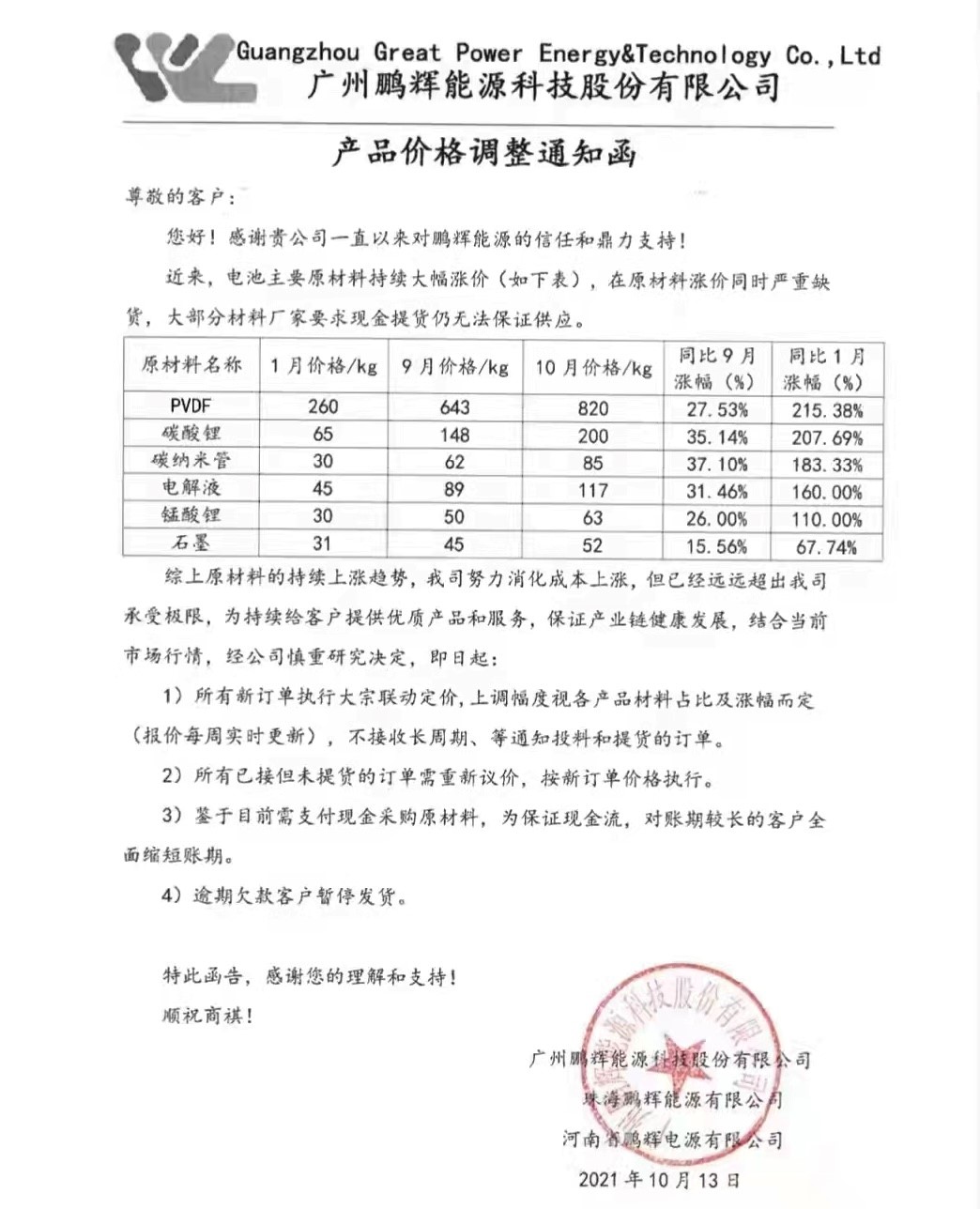
Just yesterday, a price increase letter from Penghui Energy came out of the market. In the letter, the company listed the items of raw materials and recent price changes, and said that the rising prices of raw materials were seriously out of stock at the same time, and most of the materials merchants still could not guarantee the supply when they asked for cash delivery.
With the rise in raw materials continuing, Penghui Energy said the cost pressure "has far exceeded the limit." Therefore, in addition to two measures such as comprehensively shortening the account period for longer-term customers and suspending deliveries for overdue customers in order to ensure cash flow, the company also plays the card of "price increase".
The price increase measures are mainly divided into two parts: first, new orders implement bulk linkage pricing and do not accept orders with long periods and waiting for notice to feed and pick up goods; second, all orders that have been received but have not been picked up need to be renegotiated.
A reporter from Science and Technology Innovation Board Daily called Penghui Energy about the matter, but there was no answer.
For battery companies, how much pressure is there to increase the price of raw materials?
The upsurge in the prosperity of new energy vehicles has long been an indisputable fact, so since the beginning of this year, the supply of raw materials for power batteries has fallen short of demand, prices have gone up centrally, and some auxiliary materials have risen several times more than at the beginning of the year.
The power battery can be divided into two parts: battery and Pack (battery system). The cost of each part is composed of material cost and manufacturing cost respectively.
In theory, according to the preliminary calculation of GGII, the theoretical cost of cell and battery system has increased by more than 30% due to the increase in the price of raw materials, and the pressure on battery enterprises has increased sharply. Tianfeng Securities reported on October 7 that if combined with the impact of bargaining power and purchase volume on the actual procurement cost, overlaying the hedge between performance and technological progress and cost increases, then on the whole, the increase in the price of raw materials transmitted to the end of the power battery will increase by about 20% and 25%.
The rise in raw material prices in the first half of the year was mainly carried by battery factories, and the cost pressure was not transmitted downstream. Although the head manufacturers have strong bargaining power and have the opportunity to lower the actual purchase price, their performance has also been affected to a certain extent.
At present, the major battery companies have not yet released three quarterly reports, but from the medium report, Guoxuan Hi-Tech, Funeng Technology and other companies reported a year-on-year decline in gross profit margin, which mentioned in the report that the rising price of raw materials put pressure on operating cost / gross profit margin.
According to industry estimates, this wave of out-of-stock prices of raw materials will continue into the first half of 2022. For example, Ganfeng Lithium Industry has recently raised the price of all metal lithium products, the unit price soared 100000 yuan / ton, and the price adjustment letter is only valid for one month, it is expected that the follow-up price may continue to explore. Under such circumstances, it is not a long-term solution for the battery factory to "knock out its teeth and swallow" alone.
So, how will the cost pressure be transmitted?
The above report of Tianfeng Securities gives the view that under the current price increase conditions, the increased cost of the battery will be transmitted downstream, but not all of it will be transferred to the downstream vehicle factory. It is expected that the purchase price of the battery eventually transmitted to the vehicle factory may actually increase by about 10%, 20%, and the vehicle material cost will increase by 3.5%. 7%.
However, since the second half of last year, the production and sales of new energy vehicles have shown a significant upward trend. Considering factors such as economies of scale, Tianfeng Securities pointed out that the vehicle cost of new energy vehicles may have declined, which can reduce or even offset the impact of rising battery costs to a certain extent.
It is suggested that we should pay attention to the car companies such as Great Wall Automobile and GAC GROUP, which can guarantee the control ability of the battery supply chain to a certain extent; Geely Automobile, Xiaopeng Automobile, Ulay, ideal Automobile, etc., which are relatively less affected by the fluctuation of battery purchase price; battery enterprises Ningde era, Yiwei LiNeng and so on.
![[Batterie à l'état solide : production d'électrolyte au sulfure 70 t, janvier-août]](https://imgqn.smm.cn/usercenter/Bwmed20251217171726.jpg)
![[SMM Analyse] L'Europe cherche à rendre sa chaîne d'approvisionnement en lithium indépendante, mais ses projets attirent les investisseurs asiatiques](https://imgqn.smm.cn/usercenter/nVnLo20251217171728.jpg)