SMM August 19: on August 19, at the online live conference hosted by SMM, Yan Yuyi, senior consulting manager of SMM New Energy, delivered a keynote speech on "Review of Cobalt and Lithium Market in July 2021". In terms of cobalt, imports of cobalt raw materials increased slightly in June, while imports from South Africa are expected to decrease in August, while lithium carbonate prices rebounded in July and lithium hydroxide prices continued to rise, he said. Specifically, for lithium carbonate, the impact of maintenance and power cuts in July led to a reduction in production, weak demand, superimposed power cuts, and a reduction in lithium hydroxide. as for lithium hydroxide, supply-side maintenance superimposed an increase in export orders, and the domestic market showed obvious destocking, and prices continued to rise.
A brief Review of the New Energy vehicle Market in January and July
Battery output in July totaled 17.4 GWH, an increase of 185.3% over the same period last year and 14.2% higher than the previous month.
According to statistics, domestic power battery production reached 17.4 GWH in July 2021, a sharp increase of 185.3% over the same period last year and 14.2% month-on-month growth. Among them, the output of ternary batteries was 8GWH, accounting for 46% of the total output, up 144% from the same period last year and 8.6% from the previous year; the output of lithium iron phosphate batteries was 9.3GWH, and the proportion of output further rose to 53.8%, up 236.2% from the same period last year and 20% from the previous year.
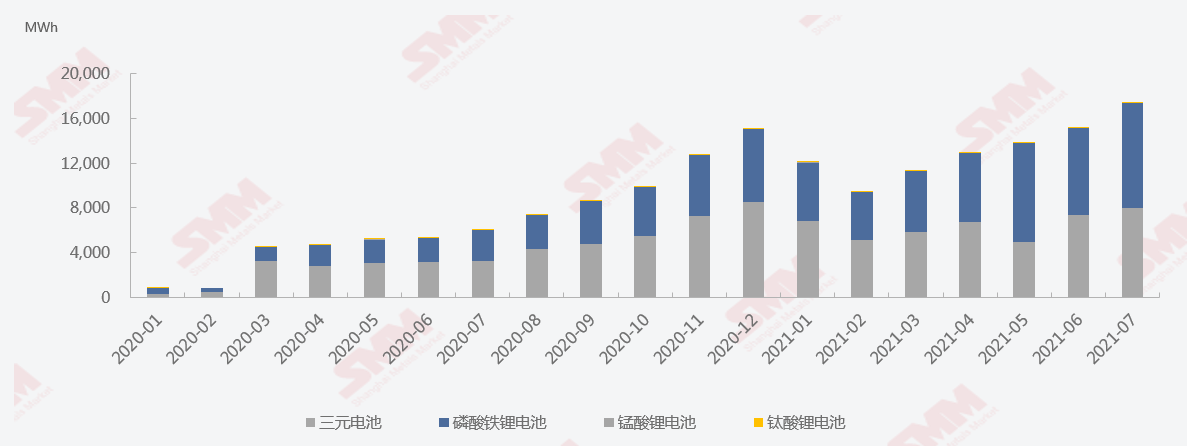
In terms of ternary batteries, high nickel ternary batteries are still the mainstream development direction. From the market share of the two, it is not difficult to see that the proportion of lithium iron phosphate production has exceeded that of ternary batteries. According to SMM research, the increase in production capacity is mainly provided by three aspects: first, professional lithium iron phosphate material enterprises, such as German Nano, Hunan Yuneng, etc.; second, Hedong science and technology, divine materials and other large-scale expansion of iron phosphate; third, the cross-border layout of traditional chemical enterprises, such as nuclear titanium dioxide, dragon python, Anada and so on.
At present, more and more car companies in the market are starting to use lithium iron phosphate batteries. Among the new forces of car building, Xiaopeng cars have been launched. Some industry experts predict that it will be a high probability event for Ulai and the ideal future to launch lithium iron phosphate models.
New energy vehicles continue to be a bright spot in July, and the cumulative production and sales have exceeded the number of domestic products for the whole year.
In July, China's production and sales of new energy vehicles reached record highs of 284000 and 271000 respectively, up 14.3 per cent and 5.8 per cent from the previous month. From January to July, the production and sales of new energy vehicles reached 1.504 million and 1.478 million respectively. The cumulative production and sales have exceeded the number of domestic previous years, and the penetration rate of new energy vehicles has also increased to 10%.
Analysis and Forecast of supply and demand structure and Price of Cobalt Salt in China in February and July
Price Review and Future Prospect of Cobalt Industry
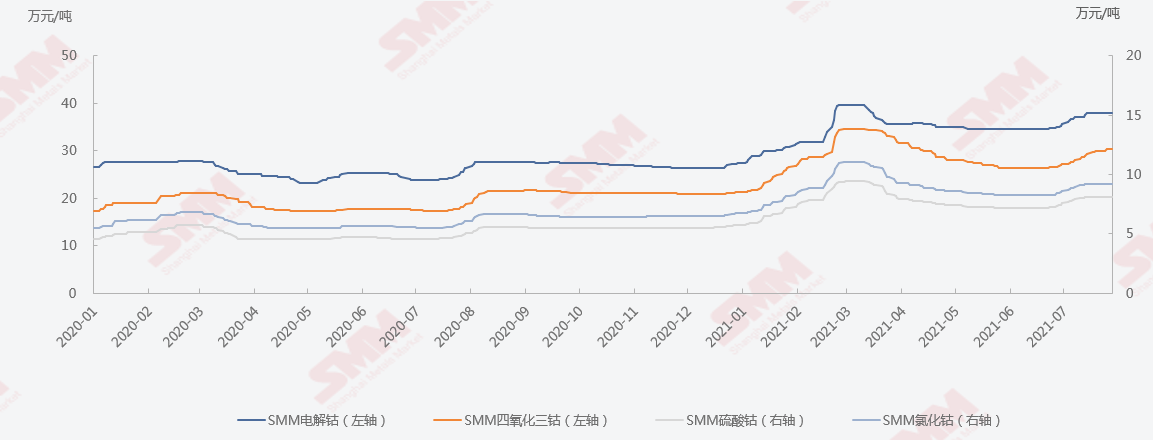
In terms of electrolytic cobalt: the average monthly price of electrolytic cobalt in July 2021 was 373000 yuan / ton, up 7% from the previous month. According to SMM analysis, the price rise at the beginning of the month is mainly due to the increased demand for alloys in overseas aviation and military industries, and the willingness of electrolytic cobalt traders to hoard goods. The recent increase in orders from alloy factories in the middle and lower reaches of the month, and the increase in procurement led to a rise in prices. The price remained stable at the end of the month, the summer break in overseas markets was light, and the willingness of domestic electrolytic cobalt suppliers to ship goods gradually increased.
Cobalt sulfate: the average monthly price of cobalt sulfate in July 2021 was 80,000 yuan / ton, up 11% from the previous month. At the beginning of this month, downstream ternary precursors and materials enterprises have been put into production, the inventory of cobalt sulfate in the plant is low, and the quotation for active market trading has been greatly raised. In the middle of the month, cobalt sulfate manufacturers hesitated to sell and quoted enterprises decreased because of concerns about the supply of raw materials. By the end of the month, the price of cobalt sulfate was flat and the market was light.
Cobalt tetroxide: the average monthly price of cobalt tetroxide in July 2021 was 289000 yuan / ton, up 10% from the previous month. At the beginning of the month, suppliers held back sales and expected peak procurement demand, and prices rose. In the middle of the month, orders for some high-rate models increased, trading volume will gradually increase, and prices will rise. At the end of the month, the transaction prices of some suppliers' rate-type orders increased, the downstream lithium cobalt oxide purchase orders for doped high-voltage models decreased, and the overall demand was weak.
Cobalt sulfate: the trend of ternary cobalt reduction is superimposed by the increase of cobalt sulfate production, and the shortage of cobalt sulfate inventory is alleviated.
On the overall supply and demand side, China's cobalt sulfate stock accumulated in July, and cobalt sulfate is expected to go to the warehouse in August.
Specifically, on the supply side, there is a metal premium for cobalt sulfate over cobalt chloride in July, and most enterprises focus on the production of cobalt sulfate; on the demand side, the demand for cobalt sulfate in series 5 and 6 of the ternary precursors in the lower reaches of July increases, while the demand for cobalt sulfate in NCA decreases; in August, the production of ternary precursors in series 8 is expected to increase significantly, and the proportion increases.
Cobalt tetroxide: the demand of digital 3C is sluggish in peak season, and the inventory pressure of cobalt tetroxide increases.
On the overall supply and demand side, the accumulated stock of cobalt tetroxide in China increased in July, and the inventory increased by 1252 physical tons in the same month.
According to SMM's previous research, on the supply side, the downstream digital 3C demand was sluggish in the third quarter, with mainstream battery companies reporting a 30% reduction in orders, mainstream cobalt tetroxide enterprise orders down by more than 10%, and most enterprises' production schedules slightly reduced from July to August, which was less than the reduction in orders, so prepare for inventory. On the demand side, the downstream digital 3C demand orders are lower than expected, the orders of lithium cobalt oxide enterprises are reduced, and the demand for cobalt tetroxide is reduced, and the mainstream lithium cobalt oxide enterprises consider a slight reduction in reserve inventory, so the reduction in demand for cobalt tetroxide is less than that of orders.
Cobalt raw materials: imports of cobalt raw materials increased slightly in June, and imports are expected to decrease in August under the influence of riots in South Africa.
In June 2021, China imported 7700 tons of cobalt raw materials, an increase of 6 percent from the previous month and 76 percent over the same period last year. From January to June 2021, the average monthly import of cobalt raw materials was 7800 metal tons, of which cobalt intermediate products imported an average of 6900 metal tons per month.
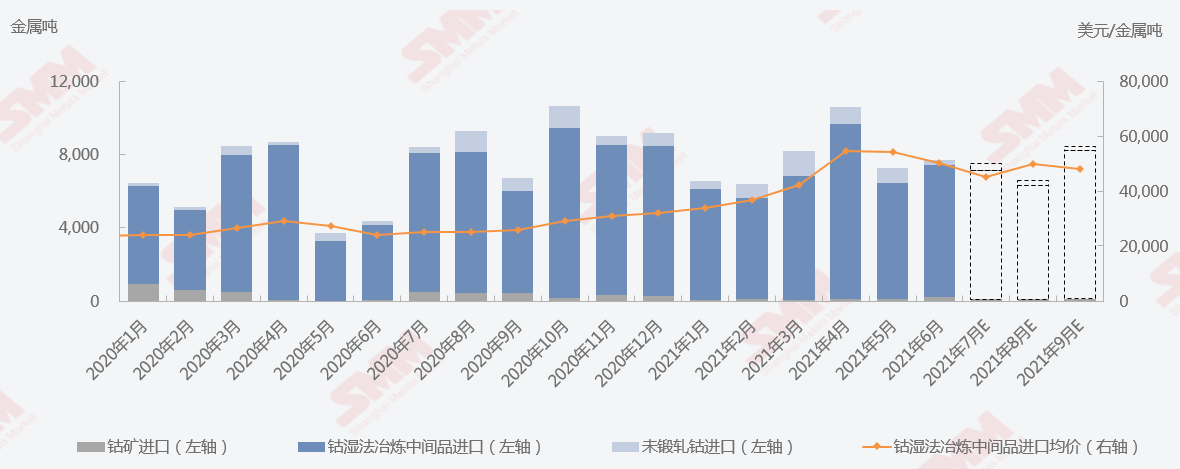
However, according to SMM research and statistics, domestic cobalt intermediate products import vehicles need to reach 7500-8500 metal tons in order to basically meet the smelter demand for cobalt raw materials, so the domestic cobalt raw material inventory gap is large. However, taking into account the port and railway outages caused by the riots in South Africa from July 9 to 17, as well as the notification of lucky delays in cobalt raw materials received by domestic enterprises, it is expected that the ship delay of 1-2 weeks will eventually affect August imports, so SMM expects imports of cobalt raw materials from July to September to be 7500, 6600 and 8400 metal tons, respectively.
As for cobalt intermediate products, the price of cobalt intermediate products is relatively high, and the cost pressure of smelting enterprises is still high, with an average import price of US $50129 per metal ton, down 7 per cent from the previous month and up 108 per cent from the same period last year.
Analysis and Forecast of supply and demand structure and Price of Lithium Salt in China in March and July
Lithium industry price: lithium carbonate price rebounded, lithium hydroxide price continues to rise
Battery-grade lithium carbonate: overhauled by manufacturers, traders hoarding goods, or price increase at the end of the month
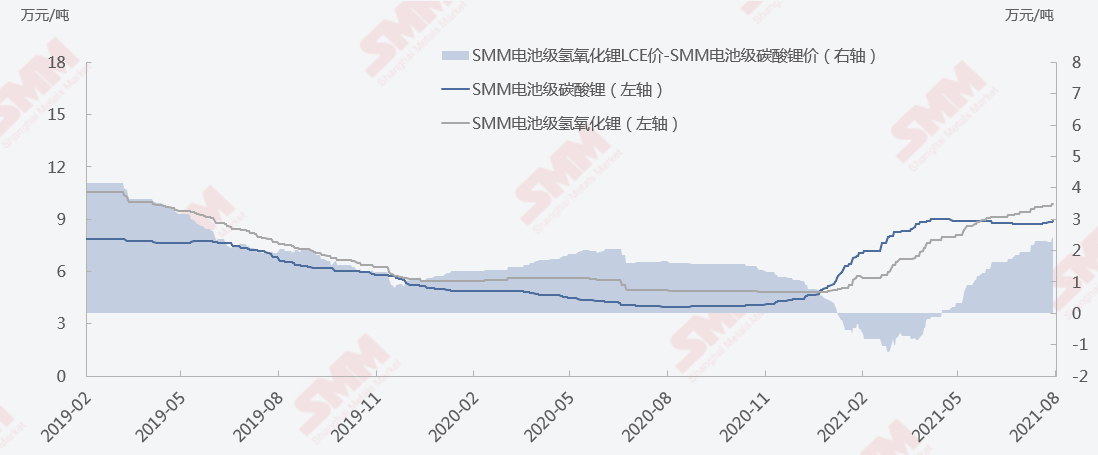
Looking back in July, the average monthly price of battery-grade lithium carbonate was 87841 yuan / ton, which was basically the same as the previous month. At the beginning of the month, the inventory of smelters in Qinghai and Jiangxi was obviously released, mainly for traders to concentrate on hoarding goods, the upstream and downstream are in a strong game state, and the price is temporarily stable. In the middle of the month, industrial and quasi-electric carbon quotations in Qinghai and Jiangxi continued to remain high, but transactions were sporadic. At the end of the month, affected by bullish sentiment, the price of lithium carbonate rose, and the transaction price rose. Industrial carbon downstream materials factory procurement difficulties, transaction prices slightly upward. Some large-scale domestic smelting production of electric carbon went into overhaul in July, and the price rose slightly.
Battery-grade lithium hydroxide: the spot of factory maintenance is tight, and the price continues to rise.
The average monthly price of battery-grade lithium hydroxide was 96432 yuan per ton in July, up 4.6 per cent from the previous month. At the beginning of the month, major manufacturers entered the annual shutdown and overhaul phase and continued until late July, with reduced supply leading to higher prices. In the middle of the month, the output of the caustic plant increased, but could not meet the urgent needs, and the quotation continued to rise. At the end of the month, the market appears the situation of high price lock volume, the transaction price is relatively extreme, the coarse particles in the quotation are more than 100000 yuan / ton, and the price will continue to rise.
Lithium carbonate: production is reduced due to the effects of maintenance and power cuts, demand is weak, and power cuts are also reduced.
On the supply side, China produced about 18975 tons of lithium carbonate in July 2021, down 10% from the previous month and an increase of 28% over the same period last year. In July, the annual overhaul of some smelters in Qinghai was limited in raw materials, which decreased by 5% compared with the previous month; in Jiangxi, production also dropped slightly by 4% due to equipment maintenance; production in Sichuan and other provinces decreased significantly. The shortage of domestic spodumene concentrate is the main reason for the reduction, and the superimposed Sichuan and other places are slightly affected by power cuts.
On the demand side, in the domestic cathode materials, only the market demand of lithium iron phosphate has increased. The recent power restrictions in the southern region superimposed the causes of floods in Henan, affecting the production capacity of some ternary materials enterprises, and the monthly demand for ternary materials was reduced by 7%.
Lithium hydroxide: supply-side maintenance superimposed export orders to increase the obvious removal of storage in the domestic market
On the supply side, China produced about 12727 tons of lithium hydroxide in July 2021, down 11 per cent from the previous month and a year-on-year increase of 61 per cent. In July, the electricity and hydrogen market was obviously out of stock, and the mainstream large factories stopped production and maintenance until the end of July, superimposed an increase in overseas exports, resulting in an obvious shortage in the domestic spot market. High temperatures in Sichuan and other provinces have led to new highs in electricity consumption and power cuts, which still have a slight impact on supply.
On the demand side, exports increased significantly by 16% in July, with good sales of overseas high-end models, while domestic consumers gradually weakened, and some domestic high-nickel batteries reduced orders for materials.
IV. Summary of China's Lithium Battery Recycling Market
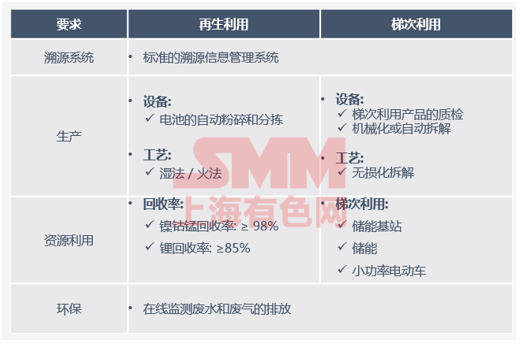
In order to strengthen the utilization of waste batteries of new energy vehicles, the Ministry of Industry and Information Technology issued a whitelist policy.
By 2020, 27 companies had been whitelisted. Whitelist policy is currently through the formulation and recommendation of industry standards, with a view to compliance with battery recycling enterprises to promote the development of market standardization.
Most of the scrapped batteries are waste between production, and the market flow is complex, so it is urgent to regulate the battery.
The sources of scrapped batteries are mainly divided into five parts, including car companies and battery manufacturers, mainly new waste between production, new energy car owners, 3C consumers and small power consumers are mainly decommissioned battery waste.
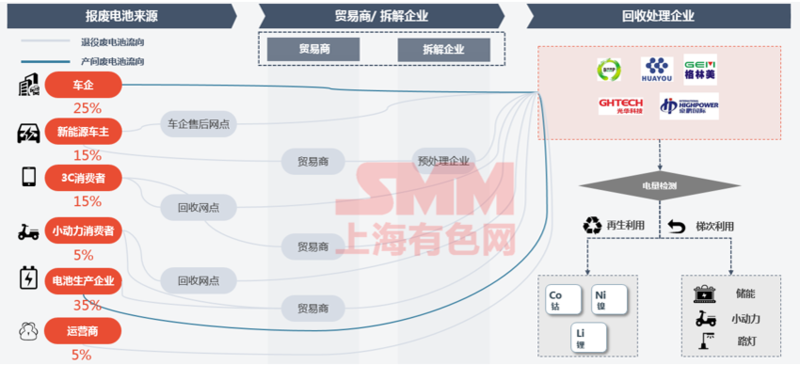
In terms of proportion, new waste between production still accounts for a large proportion, reaching about 60%, while social recovery accounts for only 40%, mainly because the current recovery system is still imperfect, recovery is difficult, and there are too many intermediate links.
From the point of view of the flow direction, new energy car owners mainly sell scrapped cars to post-sale outlets, while recycling companies, such as Grimme, have signed long-term cooperation agreements with car companies to recycle scrapped batteries from 4S stores.
On the whole, BtoB car companies and mainframe factories (the new waste of the test line) for recycling enterprises, power batteries have not reached the explosive period, recycling is difficult: car companies' responsibility system is not perfect, promotion is less, and consumers' awareness of environmental protection is insufficient. In addition, many irregular traders recover from high prices, disturbing the market. Therefore, effective regulation absolutely Brooks no delay.
Analysis of Lithium Recycling Market in China
At present, lithium has not become the main recycled metal for mainstream recyclers, mainly because of its low business attractiveness, inefficient and unsafe technical route.
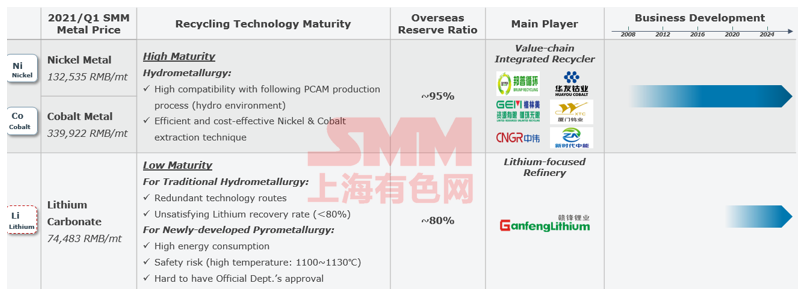
Compared with nickel and cobalt, lithium does not currently serve as a major participant in recycled metals for the following reasons:
Compared with nickel and cobalt, relatively low metal prices and higher processing costs make lithium recovery business less attractive.
The technology maturity is low, so it is difficult to find an efficient and safe technology route.
The reduced dependence on overseas reserves has reduced the motivation of Chinese enterprises to develop the production of waste lithium.
![[Batterie à l'état solide : production d'électrolyte au sulfure 70 t, janvier-août]](https://imgqn.smm.cn/usercenter/Bwmed20251217171726.jpg)
![[SMM Analyse] L'Europe cherche à rendre sa chaîne d'approvisionnement en lithium indépendante, mais ses projets attirent les investisseurs asiatiques](https://imgqn.smm.cn/usercenter/nVnLo20251217171728.jpg)