SMM May 21: at the 2021 (sixth) China International Nickel-Cobalt-Lithium Summit Forum held by SMM, Liu Xiaoyi, senior analyst of lithium industry of Shanghai Nonferrous net Information Technology Co., Ltd., reviewed the situation and development of lithium industry in 2020 for the guests, and made an in-depth analysis of the global lithium industry pattern from 2021 to 2025. She believes that the price of lithium salt will rebound from the bottom in 2020 and remain high in 2021, and the prices of lithium carbonate and lithium hydroxide in China will fluctuate at high levels in the next five years.
Photo plus live recording
Demand-driven recovery of Lithium City in the Post-epidemic era
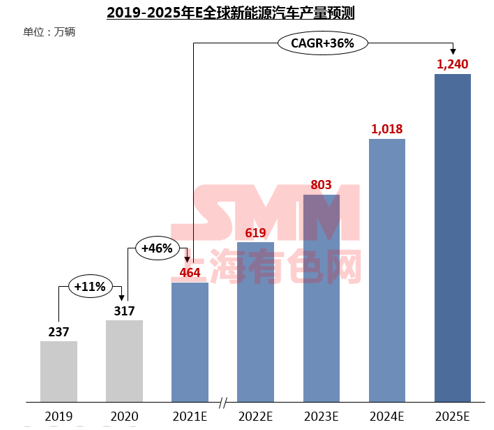
The global output of new energy vehicles will reach 3.17 million in 2020 and will maintain a growth rate of 36% in the next five years.
According to SMM data, the global production of new energy vehicles reached 3.17 million in 2020, an increase of 11% compared with 2019. Global production of new energy vehicles is expected to reach 12.4 million in 2025, a growth rate of about 36 per cent.
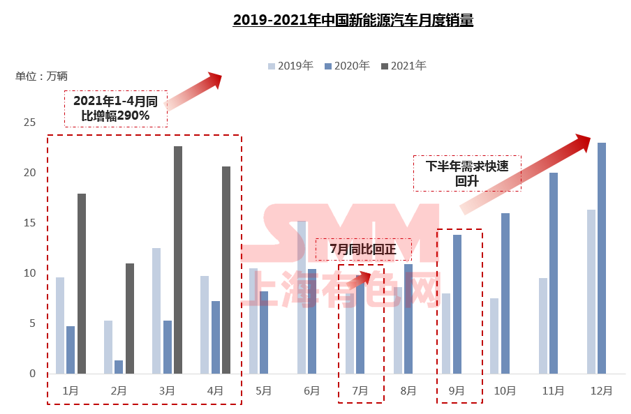
China's new energy vehicle market has picked up significantly in 21 years and will reach 6.18 million in 2025.
From the monthly sales chart of China's new energy vehicles from 2019 to 2021, it is obvious that although domestic new energy vehicle sales have been declining year-on-year before 2020, the domestic demand for new energy vehicles has rebounded rapidly since July 2020 and in the second half of 2020, thanks to the macro-favorable environmental impact.
In 2021, its rising trend is even more unstoppable. From January to April of 2021, the domestic sales of new energy vehicles increased by as much as 290% compared with the same period last year.
Since the fourth quarter of 2020, the installed capacity of power batteries has increased sharply, and the increase is expected to be as high as 55% in 21 years.
According to SMM data, as the core of new energy vehicles, the increase in installed capacity of power batteries is positively related to the monthly sales of new energy vehicles. Since July 2020, the installed capacity has returned to the same period last year, and since the fourth quarter, due to the impact of the consumption growth rate of new energy vehicles, the installed capacity has increased significantly, while the installed capacity of iron and lithium has increased rapidly.
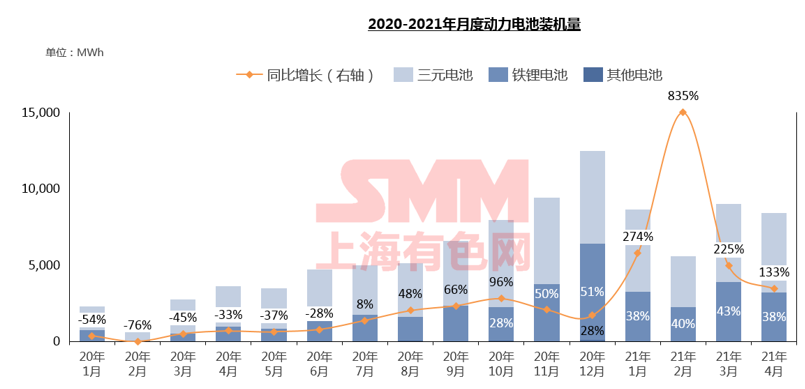
In 2020, the installed capacity of power batteries in China will reach 73 GWh, in 2021, which is expected to reach 114 GWH, an increase of 55%.
The increment of lithium demand mainly comes from electric vehicles and energy storage industry, and the demand of traditional industry is stable for a long time.
According to SMM research statistics, the current increase in lithium demand in the market mainly comes from electric vehicles and energy storage industries, and the demand for lithium in traditional medicine, glass ceramics and grease industries is likely to remain stable for a long time in the future. It is expected that the future growth rate will remain at about 25% from 2021 to 2025, and 1.10 million tons of LCE will be achieved in 2025.
At the same time, by 2025, the demand for lithium for ternary materials will increase from 47% to 59%, the proportion of lithium iron phosphate for lithium will drop slightly from 30% to 28%, and the proportion of lithium manganate batteries will remain unchanged at 8%. Lithium cobalt batteries will be reduced from 15% to 4%.
The price of lithium salt rebounded from the bottom in 2020 and remained high in 2021.
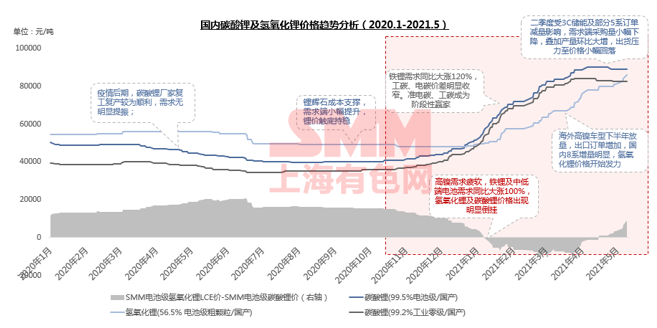
Around May 2020, in the late stage of the domestic epidemic, lithium carbonate manufacturers returned to work and production more smoothly, and there was no obvious boost in demand.
Around October 2020, due to the cost support of spodumene price, the demand side rose slightly and the lithium price bottomed out and held steady.
In January 2021, the demand for high nickel was weak, the demand for lithium iron and medium-and low-end batteries soared 100% compared with the same period last year, and the prices of lithium hydroxide and lithium carbonate were obviously upside down.
In February 2021, the demand for iron and lithium surged 120% compared with the same period last year, and the price gap between industrial carbon and electric carbon narrowed significantly. Quasi-electric carbon and industrial carbon become phased winners;
In April 2021, the volume of overseas high-nickel models was released in the second half of the year, the export orders increased, the domestic 8-series increased obviously, and the price of lithium hydroxide began to rise.
After May 2021, due to the impact of 3C energy storage and the reduction of some 5-series orders in the second quarter, the purchase volume on the demand side decreased slightly, the superimposed output increased greatly compared with the previous month, and the shipping pressure fell slightly to the price.
Analysis of supply and demand structure and Future Price Forecast of Lithium Resources in 2021
Lithium resource supply: reducing the utilization ratio of Australian lithium concentrate and gradually extracting lithium from low-cost salt lakes
Judging from the current global lithium utilization ratio (forecast from 2020 to 2023), the proportion of lithium concentrate utilization in Australia is expected to decrease gradually, from the original 48% to about 39%. Compared with the decline in the proportion of lithium concentrate utilization in Australia in the future, lithium extraction from low-cost salt lakes, such as the four major salt lakes in South America and salt lakes in China, is gradually increasing.
In 2021, the global lithium supply is expected to increase by 11.5%, mainly from salt lakes and lithium mica.
In 2021, the global supply of lithium resources is expected to be about 502000 tons of lithium carbonate equivalent, an increase of 11.5 per cent over the same period last year. Spodumene concentrate production as a proportion of total supply declined, and lithium extraction from lithium mica and salt lakes increased by 43% and 18.2% respectively compared with the same period last year.
Raw material end: the spodumene concentrate in China will obviously go to the reservoir in 2021, and the price has become a foregone conclusion.
Raw material 2020 Australian spodumene concentrate output accounts for about 94% of the global output, reduced to four mines in production: Terlison, Marion, Pilbara and Galaxy Resources, resources are tight; domestic lithium salt production is gradually rising, the concentrate will be obviously removed in 2020, and the price will gradually rise.
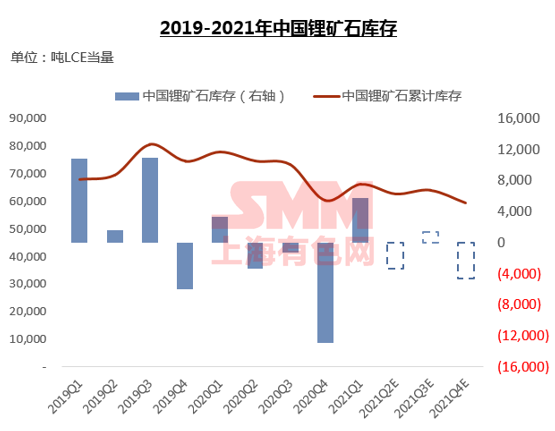
From the SMM survey data, since the second quarter of 2020, China's spodumene concentrate has begun to show a trend of going to the reservoir. In 2021, China's spodumene concentrate is obviously going to the reservoir, and the future price rise is a foregone conclusion.
Distribution of Lithium smelting Enterprises and Raw material usage in China
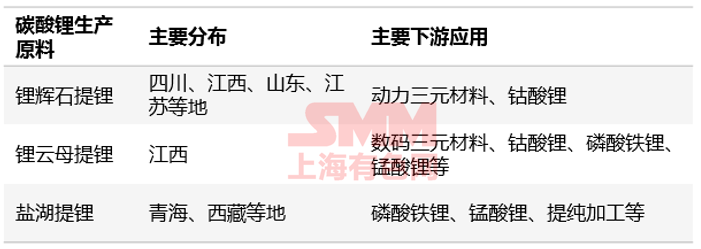
At present, domestic lithium product-related smelting enterprises are mainly distributed in Shandong, Jiangsu, Jiangxi, Sichuan and Qinghai, among which Tianqi lithium industry in Sichuan, Yahua lithium industry and Jiangxi Ganfeng lithium industry are famous in the lithium industry chain.
Specifically, lithium extraction from spodumene is mainly distributed in Sichuan, Jiangxi, Shandong, Jiangsu and other places, and the main downstream applications are power ternary materials and lithium cobalt, while lithium extraction from salt lakes is distributed in Qinghai, Tibet and other places. used in lithium iron carbonate, lithium manganate and purification processing.
Sichuan Jiangxi Lithium Carbonate production release obvious Lithium Ore supply becomes an important variable of Lithium hydroxide capacity release
Taking the representative lithium carbonate and lithium hydroxide as an example, in terms of lithium carbonate, at present, there are a variety of raw materials for the production of lithium carbonate in China, and the operating rate of the ore end is relatively high, but the salt lake system is still in the stage of capacity recovery.
As for lithium hydroxide, the domestic lithium hydroxide production mainly uses spodumene concentrate as raw material, and the smelting end is limited by mineral resources, so the operating rate is low.
Supply and demand structure and Price Forecast of Lithium products in China in the next five years: prices will fluctuate at high levels
There is no doubt that with the continued popularity of the field of new energy vehicles in the next few years, whether it is lithium carbonate or lithium hydroxide, the future demand will rise year by year, corresponding to the high output.
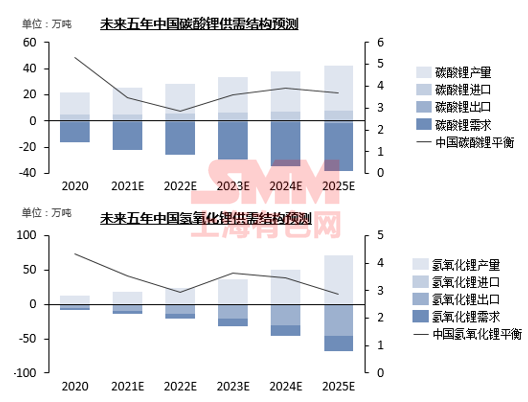
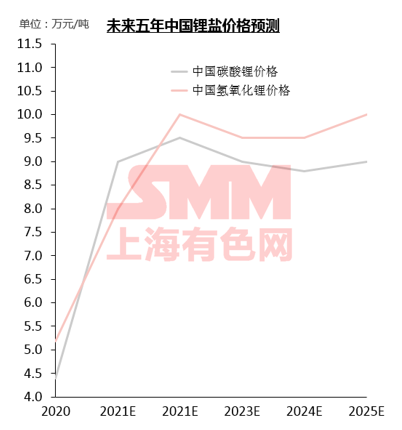
It is expected that the prices of lithium carbonate and lithium hydroxide will fluctuate at high levels in the next five years.
Retrospect and Future Prospect of Lithium Industry in the past 20 years
Reviewing the development history of the lithium industry from 2000 to 2020, from the first salt lake lithium extraction production line with an annual production capacity of 3000 tons / year in Qinghai in 2004 to an annual growth rate of 40% in 2010, the iron-lithium market grew at an annual rate of 40%. Then in 2013, the promotion and subsidy policy for new energy vehicles was introduced, supporting upstream raw materials to expand production, and finally, by 2020, batteries accounted for more than 75% of the demand for lithium resources, and the lithium industry was steadily developing in a better and better direction.
During these 20 years of development, the demand for lithium in different industries has also undergone earth-shaking changes. In 2000, glass ceramics accounted for a much higher proportion of lithium demand than lithium batteries. By 2020, lithium batteries have accounted for 76% of the total demand for lithium, which, on the other hand, vaguely reflects the rapid development of lithium batteries in the past 20 years.
As for lithium products, the whole has not changed much, and it is still dominated by lithium carbonate and lithium hydroxide.
The lithium battery industry broke out in 2015, accounting for more than 75% of the demand.
Specifically, the lithium battery industry began to soar in 2005, from 20% in 2000 to 52% in 2005, and then broke out in 2015. In 2020, the demand for lithium in the lithium battery industry once accounted for more than 75%. There is no doubt about the development potential.
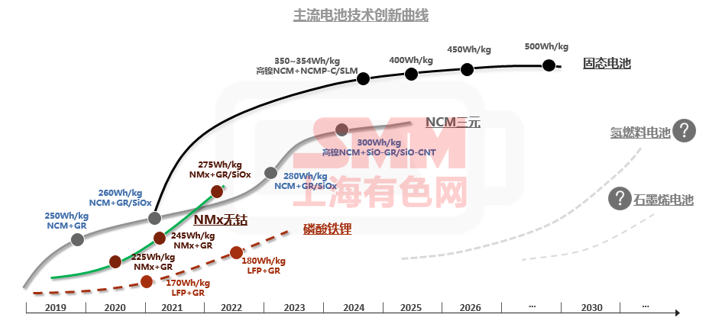
In the past decade, battery cathode materials are still dominated by high nickel ternary, and the demand for lithium will increase significantly.
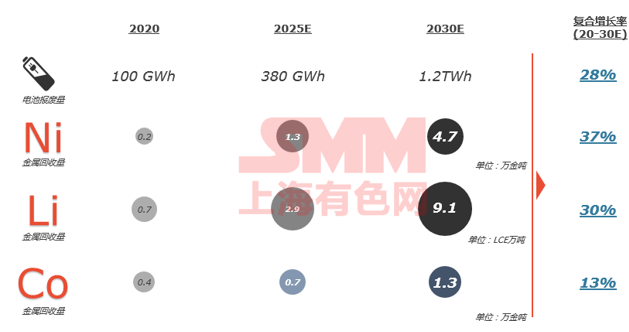
The amount of scrapped batteries will reach 1.2 TWH in 2030, and the metal recycling of nickel and lithium will continue to grow by more than 30%.
According to SMM data, in 2020, the amount of battery scrapped in China will reach 100GWH, the metal recovery of nickel will be 2000 gold tons, the recovery of lithium will be 0.7LCE1000 tons, and the recovery of cobalt will be 0.4LCE.It is estimated that the amount of domestic battery scrapped will reach 1.2 TWH in 2030, of which the metal recycling of nickel and lithium will continue to grow by more than 30%.
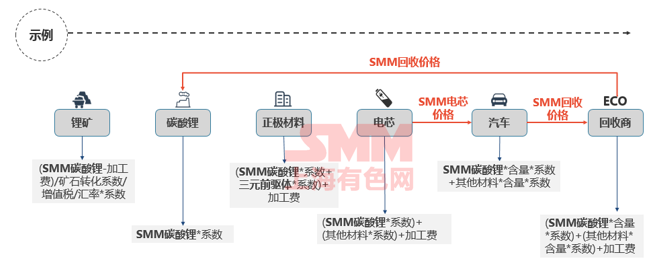
Finally, let's take a look at the pricing of the whole industry chain of SMM: the price of SMM salt is the benchmark of the industry, which extends to the field of battery core and recycling.
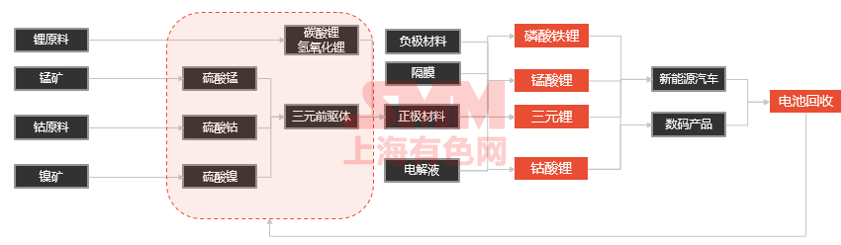
Cell prices include: power square ternary, power soft package ternary, power square iron lithium, small power cylinder ternary, small power square iron lithium, consumer soft package lithium cobalt, etc.
Battery recycling prices include: power ternary waste battery, lithium cobalt waste battery, ternary black powder and lithium cobalt black powder.
Use SMM price to price the whole industry chain to stabilize the risk of price fluctuation.