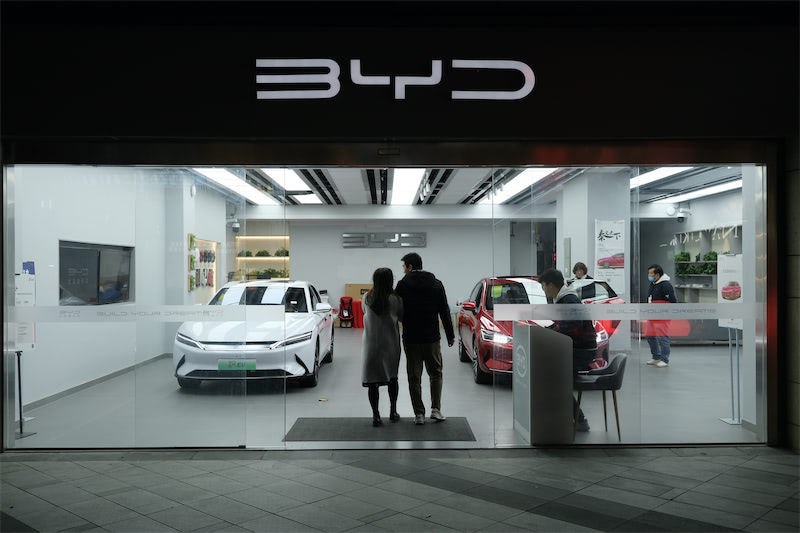
The domestic retail penetration rate of new energy vehicles in April is 10.1%. The penetration rate from January to April is 9%, which is significantly higher than that of 5.8% in 2020. Sales of new energy vehicles reached 206000 in April, the 10th consecutive month of record high for the month.
With the continuous improvement of the product power of new energy vehicles in China, the industry is gradually from policy subsidies to consumer-driven. Li Bin previously said that the increase in sales of electric cars in China in the past few years was mainly due to operating vehicles, taxis or online car-hailing, because there were more subsidies at that time. But after the subsidy fell off the slope in 2020, the demand for personal car purchases has greatly increased. Consumption-driven makes the whole industry enter a new stage of development.
According to previous research by Bloomberg, the penetration of new energy vehicles will rise rapidly after breaking the threshold of 3%. Global sales of new energy vehicles are expected to reach 12 million in 2025, with a penetration rate of 11%. In 2030, global sales of new energy vehicles will reach 30 million, with a penetration rate of 28%.
Chuancai Securities pointed out that although the penetration rate of China's electric vehicle market has increased rapidly, there is still a certain gap compared with Europe. The monthly penetration rate of new energy vehicles in Germany is stable at more than 20 per cent, and the electrification rate of European countries is generally more than 30 per cent if HEV, is included. It is expected that the penetration of electric vehicles in China will accelerate in the future, and the annual sales of electric vehicles are expected to exceed 2.4 million.
In addition to consumption-driven, the driving force of new energy vehicle policy is not reduced. Under the requirements of the goal of carbon neutralization and the transformation of the industrial structure, since the beginning of this year, many provincial units, such as Tianjin, Anhui, Beijing, Shanghai, and Hainan, have issued documents to support the development of the new energy vehicle industry chain. It mainly includes encouraging individual consumers to increase the consumption of new energy vehicles (relaxing individual application qualifications, exempting purchase tax, and going to the countryside), promoting the standardized management of charging stations (motor vehicles are not allowed to occupy the positions of charging stations), and increasing the scale of investment (new charging piles).
According to the New Energy vehicle Industry Development Plan (2021-2035), the penetration rate of new energy vehicle sales will reach 20% by 2025, and the next few years will be years of rapid increase in penetration. Tianfeng International Securities Analysis pointed out that with the clear goal of "carbon neutralization" in 2060, new energy vehicles as an important way of green energy consumption, the demand side of the upward trend has a more clear trend. Corresponding to the whole industry chain will enter the business cycle.
With the rapid improvement of the permeability of new energy vehicles, the demand of lithium power industry chain continues to grow. China Automotive Power Battery Industry Alliance released data on power battery production in April, showing that China's power battery production in April totaled 12.9 GWH, an increase of 173.7 percent year-on-year and 14.6 percent month-on-month.
Western Securities said that in the short term, the marginal impact of price increases in the lithium battery industry chain slows down, and lithium battery profits are expected to usher in an inflection point in the next 1-2 quarters. Positive electrode and lithium copper foil benefit from the cost-plus pricing model, and the profit is more certain under the high demand growth.
Aijian Securities believes that with Huawei, Xiaomi, Baidu, Apple and other major forces to increase the size of new energy vehicles, superimposed smart driving self-driving, the penetration of new energy vehicles will be accelerated. After the last round of reshuffle in the field of power batteries, the head enterprises have made it relatively clear that the growth of new energy vehicles is expected to increase in the next 3-5 years, thus bringing investment opportunities for manufacturers of high-quality batteries and materials.
Among the A-share listed companies, in terms of lithium batteries, German Nano has an annual production capacity of about 30, 000 tons of lithium iron phosphate, and the company plans to invest in the construction of an annual production base of 150000 tons of lithium iron phosphate. Xiangtan Electric and Chemical shareholding Company Hunan Yuneng currently has an annual production capacity of 50,000 tons of lithium iron phosphate and is expanding new production capacity. At present, the production capacity of iron phosphate in Yacheng, Hunan Province, a wholly-owned subsidiary of Hezhong Technology, has reached 30,000 tons, and the company said that at present, the order for iron phosphate products is more full.
With regard to new energy vehicles, Ruihu Mould said that BAIC Langu is one of the company's important customers, and the covering molds for some of its Alpha series models under its polar fox brand are provided by the company. Huawei provides self-driving technology for the aluminum alloy lightweight body mold of the polar fox Alpha S model. Gao Hong already has the full capacity of mass production, supply and deployment of core products such as automotive specification-level module, self-developed RSU, OBU and so on, and the company cooperates with Huawei mainly at the level of standards and industry promotion. The production line of Xiang oil pump new energy automobile electronic pump has been completed, and the cooperation with Huawei is in contact and communication.
![[Batterie à l'état solide : production d'électrolyte au sulfure 70 t, janvier-août]](https://imgqn.smm.cn/usercenter/Bwmed20251217171726.jpg)
![[SMM Analyse] L'Europe cherche à rendre sa chaîne d'approvisionnement en lithium indépendante, mais ses projets attirent les investisseurs asiatiques](https://imgqn.smm.cn/usercenter/nVnLo20251217171728.jpg)