Operating rates at aluminium processors rose slightly on recovering rigid demand, it takes time for downstream producers to accept high aluminium prices

Publié: Mar 23, 2021 13:28
Operating rates across major aluminium processors rose slightly last week as they had to accept high aluminium prices to deliver orders. End-users find it difficult to accept current high aluminium prices. As some end-users adopt quarterly or semi-annual pricing, high aluminium prices will not pass through to end-users until they complete Q2 pricing.
SHANGHAI, Mar 23 (SMM)—Operating rates across major aluminium processors rose slightly last week as they had to accept high aluminium prices to deliver orders. End-users find it difficult to accept current high aluminium prices. As some end-users adopt quarterly or semi-annual pricing, high aluminium prices will not pass through to end-users until they complete Q2 pricing.

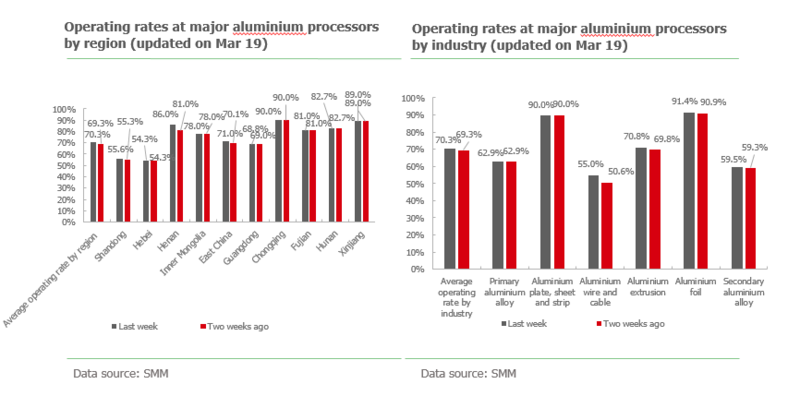
Primary aluminium alloy: Operating rates at major primary aluminium alloy enterprises were flat from the previous week at 62.9%. aluminium wheel plants kept raw material stocks at safe levels and avoided excessive stockpiling amid high aluminium prices. Alloy producers have basically resumed normal operations, except for a large factory in Shandong, whose operating rates were below levels before CNY due to relocation. Operating rates will remain stable this week as the fact that car makers make purchase under long-term orders will continue to constrain alloy consumption.

Aluminium plate and strip: Major aluminium plate and strip enterprises maintained full capacity due to heavy backlog orders. Some producers even rejected orders from clients with slow payment. Despite volatile and high aluminium price, large producers did not reduce purchases, but had stricter control over inventory. Operating rates will remain high this week on the back of backlog orders.

Aluminium wire and cable: Operating rates of major aluminium wire and cable producers increased significantly, mostly driven by producers in Henan, due to approaching delivery of orders. However, the outlook for future new orders is not optimistic. Orders from State Grid decreased on a year-on-year basis due to high aluminium prices. Prices under overseas orders were lower than those under domestic orders, inhibiting enthusiasm for taking overseas orders. Operating rates at major producers may remain stable, but are likely to decline at small and medium-scale producers due to the lack of new orders after previous orders were delivered.

Aluminium extrusion: Operating rates at major aluminium extrusion enterprises rose slightly, but remained below normal level. Some end-users are beginning to accept high aluminium prices, but most remain cautious amid high and volatile aluminium prices. Demand for industrial extrusion outperformed demand from other sectors.  Demand of construction extrusion remained weak. Downstream procurement will continue to be driven by rigid demand before aluminium price see significant downward corrections, and operating rate may remain little changed this week.

Aluminium foil: Operating rates at major aluminium foil enterprises continued to rise. Domestic orders for automotive foil, battery foil and air-conditioning foil are full. Operating rates will continue to rise this week with continued recovery of consumption. Many producers have begun to control export orders as high aluminium prices have eroded export profits, but this had little impact on the overall operating rate. Some small and medium-sized enterprises who did not lock in prices and are short of cash still showed low willingness to take orders, purchase and produce.

Secondary aluminium alloy: Operating rate of secondary aluminium alloy enterprises climbed 0.2 percentage point from a week ago to 59.5%. At present, production is normal. Secondary aluminium prices failed to follow primary aluminium up. Orders remained weak due to high aluminium prices, but improved slightly from the previous two weeks as die-casting plants have basically run out of inventory and gradually accepted high prices. Raw material supply remained tight with limited imports of aluminium scrap. Secondary aluminium companies are facing high costs. Operating rate is expected to stabilise this week.

Déclaration sur la source des données : À l'exception des informations publiques, toutes les autres données sont traitées par SMM sur la base d'informations publiques, d'échanges avec le marché et en s'appuyant sur le modèle de base de données interne de SMM. Ils sont fournis à titre indicatif uniquement et ne constituent pas des recommandations décisionnelles.

Pour toute demande d'information ou pour en savoir plus, veuillez contacter : lemonzhao@smm.cn
Pour plus d'informations sur l'accès à nos rapports de recherche, veuillez contacter :service.en@smm.cn
Actualités Connexes
Aluminum Fluoride Prices to Remain Strong in September Amid Cost Support and Low Supply [SMM Analysis]
il y a 11 minutes
Aluminum Fluoride Prices to Remain Strong in September Amid Cost Support and Low Supply [SMM Analysis]
Lire la suite
Aluminum Fluoride Prices to Remain Strong in September Amid Cost Support and Low Supply [SMM Analysis]
Supported by rigid cost support and a low-supply pattern, combined with the upcoming new round of tender pricing in September and the sentiment boost from successive increases in hydrofluoric acid long-term contract prices, aluminum fluoride prices are expected to consolidate on a strong note in September. However, with downstream aluminum producers pushing for lower prices and making just-in-time procurement, upside room is relatively limited.
il y a 11 minutes
Dingsheng New Energy prévoit de lever jusqu'à 1,216 milliard de yuans via une émission d'actions A pour des projets de feuilles pour batteries
il y a 41 minutes
Dingsheng New Energy prévoit de lever jusqu'à 1,216 milliard de yuans via une émission d'actions A pour des projets de feuilles pour batteries
Lire la suite
Dingsheng New Energy prévoit de lever jusqu'à 1,216 milliard de yuans via une émission d'actions A pour des projets de feuilles pour batteries
Dingsheng New Energy Materials (603876.SH) a annoncé qu'elle prévoyait d'émettre des actions A auprès d'un maximum de 35 investisseurs déterminés, pour un produit total ne dépassant pas 1,216 milliard de yuans. Le prix d'émission ne serait pas inférieur à 80 % du cours moyen de l'action de la société au cours des 20 jours de cotation précédant la date de référence de fixation du prix, et le nombre d'actions à émettre ne dépasserait pas 30 % du capital social total de la société avant l'émission. Après déduction des frais d'émission, le produit serait affecté au projet de production et de construction de feuilles d'aluminium pour batteries d'une capacité de 50 kt/an, au projet de transformation technologique de feuilles d'aluminium pour batteries à revêtement de carbone fonctionnel d'une capacité de 25 kt/an, au projet de transformation technologique de feuilles d'aluminium pour batteries d'une capacité de 30 kt/an, ainsi qu'au renforcement du fonds de roulement.
il y a 41 minutes
Le projet d'anodes de Tiandong Baikuang, d'une capacité de 600 000 t/an, dépasse 1,105 milliard de yuans de production en 7 mois
il y a 1 heure
Le projet d'anodes de Tiandong Baikuang, d'une capacité de 600 000 t/an, dépasse 1,105 milliard de yuans de production en 7 mois
Lire la suite
Le projet d'anodes de Tiandong Baikuang, d'une capacité de 600 000 t/an, dépasse 1,105 milliard de yuans de production en 7 mois
[Flash info aluminium SMM] En janvier de cette année, le projet d’anodes précuites de 600 000 t/an de Tiandong Baikuang Santian Carbon Co., Ltd., situé dans le parc industriel pétrochimique, a démarré sa production d’essai, et sa valeur de production a dépassé 1,105 milliard de yuans de janvier à juillet. Avec un investissement total de 1,42 milliard de yuans, le projet n’a nécessité que 13 mois entre l’entrée sur le site et la production d’essai.
il y a 1 heure