1. Manufacturing Purchasing Managers Index
In February, the Purchasing Managers' Index (PMI) of China's manufacturing industry was 50.6 percent, which was 0.7 percentage point lower than that of last month. It was above the threshold for 12 consecutive months, and the prosperity level of manufacturing industry was lower than that of last month.
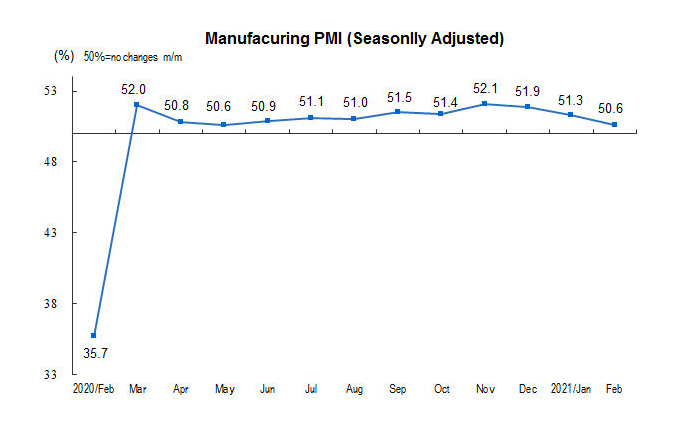
In terms of enterprise scale, the PMI of large enterprises was 52.2 percent, up 0.1 percentage point from last month; the PMI of small and medium enterprises were 49.6 and 48.3 percent, down 1.8 and 1.1 percentage points from last month, both lower than the threshold.
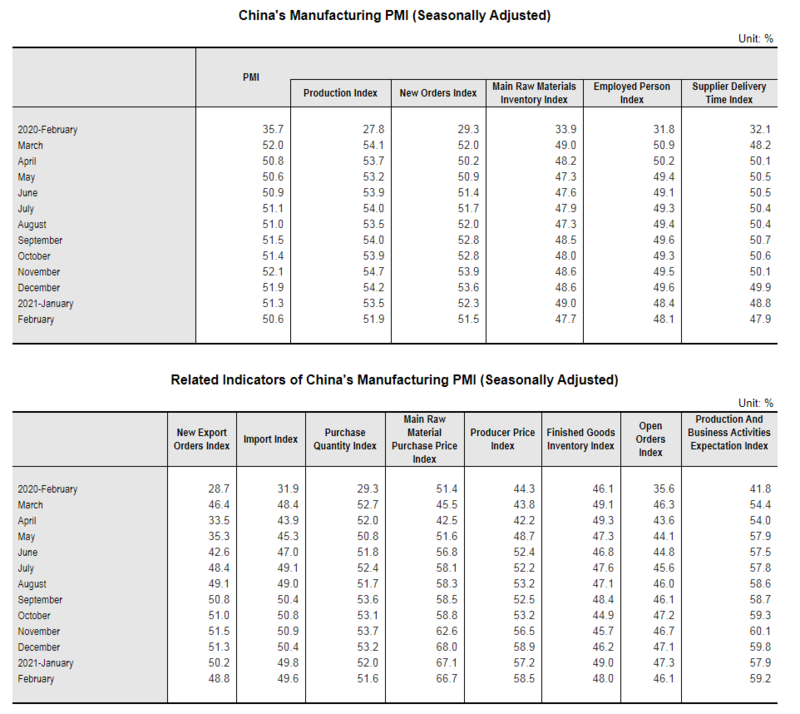
From the perspective of sub index, in the five sub-indexes of manufacturing PMI, production index and new order index were higher than the threshold, while raw material inventory index, employee index and supplier delivery time index were lower than the threshold.
The production index was 51.9 percent, 1.6 percentage points lower than that of last month, higher than the threshold, indicating that the pace of production expansion of manufacturing industry has slowed down.
The new order index was 51.5 percent, down 0.8 percentage point from the previous month, higher than the threshold, indicating that the growth of manufacturing market demand slowed down.
The inventory index of raw materials was 47.7 percent, 1.3 percentage points lower than that of the previous month, lower than the threshold, indicating that the inventory of main raw materials in the manufacturing industry continued to decrease.
The employment index was 48.1 percent, down 0.3 percentage point from the previous month, indicating that the employment outlook of manufacturing enterprises was lower than that of last month.
The supplier delivery time index was 47.9 percent, down 0.9 percentage point from the previous month, indicating that the delivery time of raw material suppliers in manufacturing industry has been extended.
2. Non-manufacturing purchasing managers index
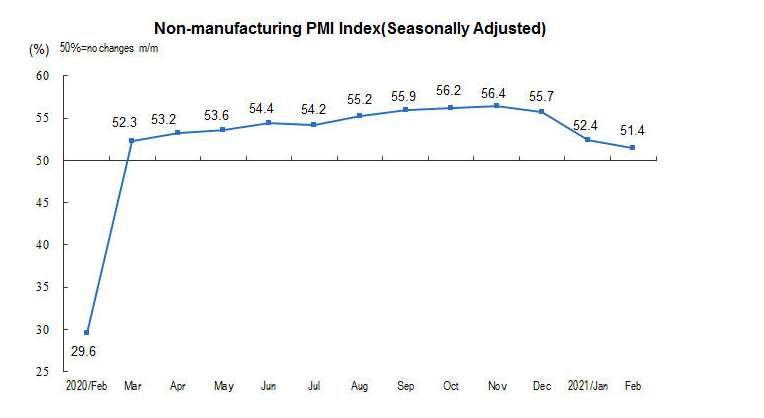
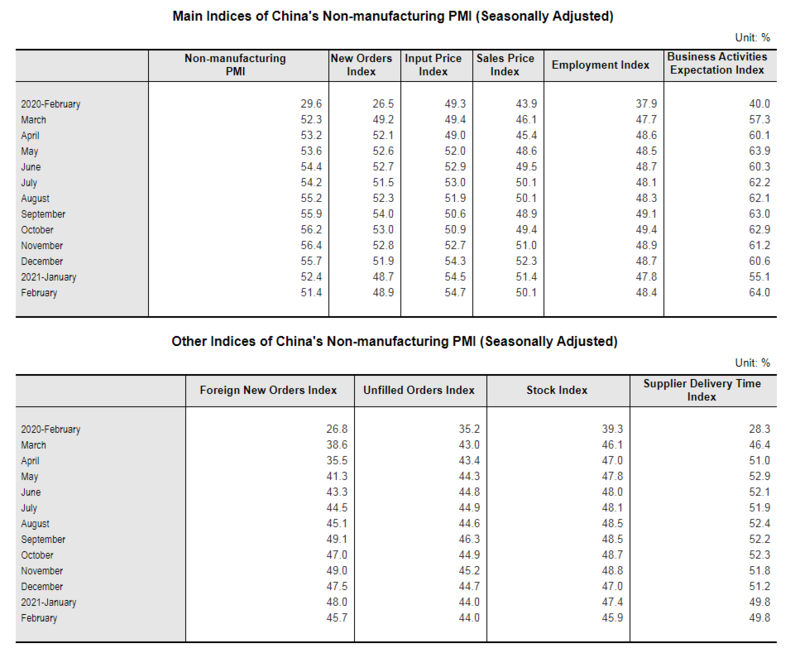
In February, the non-manufacturing business activity index was 51.4 percent, down 1.0 percentage point from last month, indicating that the pace of non-manufacturing expansion has slowed down.
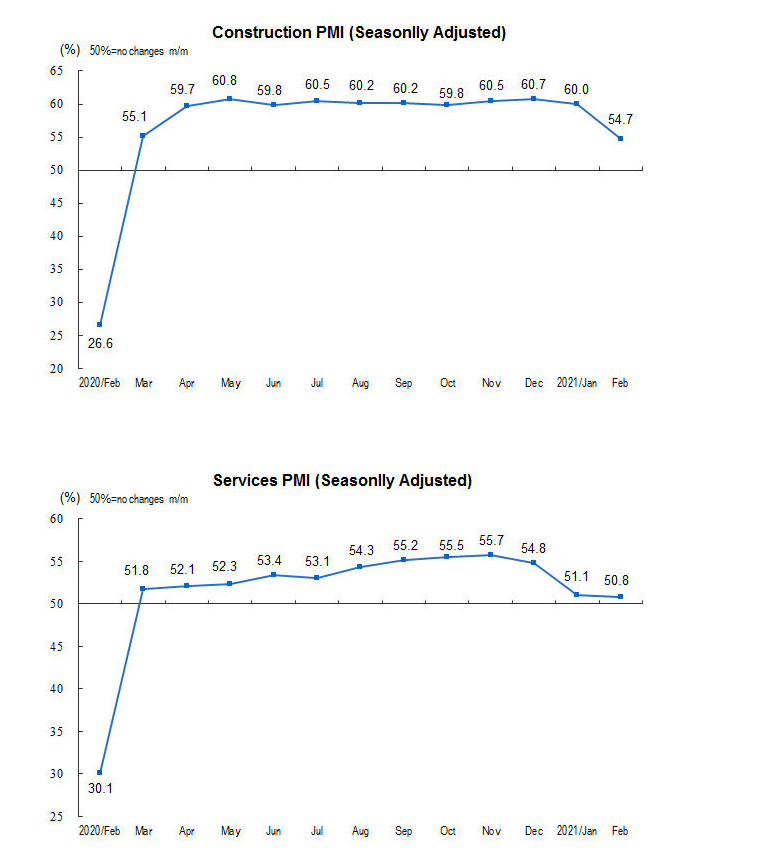
By industry, the construction industry business activity index was 54.7 percent, 5.3 percentage points lower than last month. The business activity index of service industry was 50.8 percent, 0.3 percentage point lower than that of last month. From the perspective of industry situation, the business activity index of railway transportation, telecommunications, radio and television satellite transmission services, Internet software and information technology services, monetary and financial services, ecological protection and environmental governance was in the high prosperity range of 55.0 percent or above; the business activity index of accommodation, capital market services, leasing and business services was below the threshold.
The index of new orders was 48.9 percent, up 0.2 percentage point from last month, indicating that the decline of non-manufacturing market demand narrowed slightly. By industry, the new order index of the construction industry was 53.4 percent, up 2.2 percentage points from the previous month; the new order index of the service industry was 48.1 percent, down 0.2 percentage point from the previous month.
The price index of inputs was 54.7 percent, up 0.2 percentage point from the previous month, indicating that the prices of inputs used by non-manufacturing enterprises for business activities continued to rise. In terms of different industries, the price index of construction inputs was 60.2 percent, up 0.2 percentage point over the previous month; the price index of service inputs was 53.7 percent, up 0.2 percentage point over the previous month.
The sales price index fell by 1.3 percentage points to 50.1 percent, slightly higher than the threshold, indicating that the overall sales price of non-manufacturing industry was basically the same as that of last month. By industry, the sales price index of the construction industry was 52.5 percent, down 0.4 percentage point from last month; the sales price index of the service industry was 49.7 percent, down 1.4 percentage points from last month.
The employment index was 0.6 percentage point higher than that of last month, at 48.4 percent, still below the threshold, indicating that the employment of non-manufacturing industries decreased compared with that of last month. In terms of industries, the employment index of the construction industry was 54.2 percent, up 1.4 percentage points from the previous month; the employment index of the service industry was 47.4 percent, up 0.5 percentage point from the previous month.
The expected index of business activities was 64.0 percent, up 8.9 percentage points over the previous month, returning to the high economic zone, indicating that non-manufacturing enterprises have increased confidence in the development of the industry. In terms of different industries, the expected index of business activities in the construction industry was 68.2 percent, up 14.6 percentage points over the previous month, and the expected index of business activities in the service industry was 63.2 percent, up 7.9 percentage points over the previous month.
3. Composite PMI Output Index
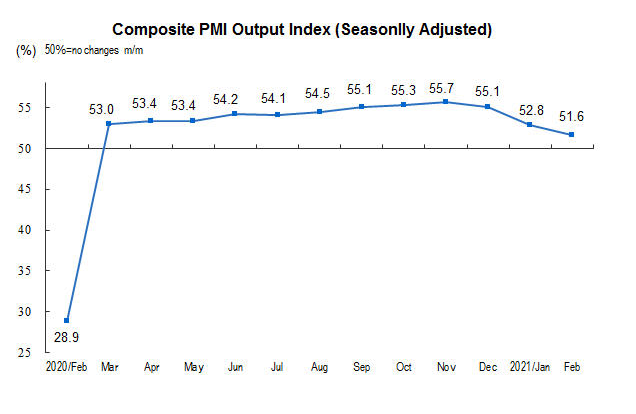
In February, the comprehensive PMI output index was 51.6 percent, 1.2 percentage points lower than that of last month, indicating that the production and operation activities of Chinese enterprises continued to expand in the Spring Festival, but the expansion rate narrowed.


![Les contrats à terme sur le platine fluctuent fortement, le marché au comptant reste modéré [Revue quotidienne SMM]](https://imgqn.smm.cn/usercenter/YKilH20251217171735.jpg)