The monthly output data of SMM China's basic metals is scheduled to be released around the 8th of each month, aiming at starting from the essence, excavating the real fundamental situation, opening up the illusion of the capital market for people in the industry chain and investors, and more clearly grasping the future trend of the non-ferrous market.
Summary of basic Metal production in China in January 2021
Electrolytic copper
In January 2021, SMM China produced 798300 tons of electrolytic copper, a decrease of 7.39 percent from the previous month and an increase of 9.97 percent over the same period last year.
Similar to the seasonal changes in previous years, after copper refineries rushed to complete the annual plan at the end of 2020, the copper smelting operation rate decreased significantly in January, some refineries took the initiative to reduce production, and some refineries carried out maintenance, resulting in a month-on-month decline in domestic copper production. On the other hand, the tight supply of copper concentrate also put pressure on refinery production when shipments in South America were blocked in January. However, compared with January 2020, the year-on-year increase is still significant, mainly due to new capacity.
According to the refinery scheduling plan in February, the output at the beginning of the year is still generally low, but as several refineries recover from maintenance, domestic refineries are basically free of maintenance in February, so copper production will increase slightly in February. SMM expects domestic electrolytic copper production to be 812000 tons in February, up 1.71% from the previous month and 18.86% year-on-year (mainly due to sulphuric acid expansion forcing refineries to reduce production in February 2020). Cumulative electrolytic copper production reached 1.6102 million tons in February, an increase of 14.28% over the same period last year.
Alumina
According to SMM data, China produced 5.9 million tons of alumina in January 2021, including 5.69 million tons of metallurgical grade alumina and an average daily output of 183500 tons, down 1.03 percent from the previous month and an increase of 2.36 percent over the same period last year. From a regional point of view, the contribution of Guodian in southwest China in January has increased and is now in full operation; the alumina plant in the northern Shanxi, Henan and Shandong provinces has been affected by the shortage of coal and the production limit in the heating season has not been relaxed, and the roasting capacity is still limited.
By the first ten days of February, the annual production capacity of metallurgical grade alumina in China was 70.53 million tons, and it is estimated that the output of metallurgical grade alumina in February (28 days) is about 5.41 million tons, and the average daily output rose slightly to about 192300 tons compared with January. The main reason is that the production reduction and roasting capacity in the northern region began to recover one after another in late January, and several alumina plants have plans to increase production, which will contribute to the average daily output in February.
Electrolytic aluminum
According to SMM data, China produced 3.323 million tons of electrolytic aluminum on January 31, 2021, an increase of 8.14% over the same period last year. By the beginning of February, the national operating capacity of electrolytic aluminum had increased to 39.55 million tons / year, the built capacity was 43.2 million tons / year, and the operating rate of national electrolytic aluminum enterprises had increased to 91.6 percent. In January, the second phase of Chuangyuan in Inner Mongolia and the second phase of Shenhuo in Yunnan continued to release. In that month, the domestic average daily output of electrolytic aluminum was 107200 tons, an increase of 1400 tons compared with the previous month. According to SMM survey, aluminum water accounted for 63.3% in January, down 3.3% from December.
In February, it is expected that the new electrolytic aluminum projects in Yunnan will continue to contribute to the increment, with domestic electrolytic aluminum production of 3.02 million tons during the month, while imports are expected to be about 80, 000 tons; demand side consumption will continue to weaken in February affected by the Spring Festival holiday, and inventory days are expected to rise to around 9.5 days in February, it is necessary to continue to pay attention to the implementation progress of Yunnan Hongtai, its Asia and other projects and the speed of demand recovery after the Spring Festival.
Primary lead
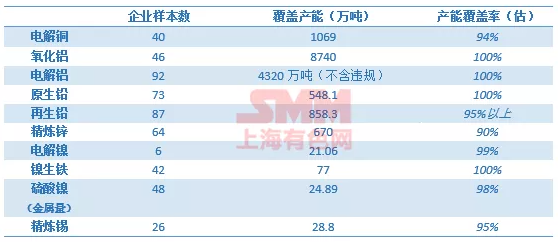
In January 2021, China produced 261300 tons of electrolytic lead, down 8.73 percent from the previous month and up 1.77 percent from the same period last year. The total production capacity of the enterprises involved in the survey in 2021 will be 5.481 million tons.
According to SMM research, the outbreak of the epidemic in Hebei in early January was a drag on logistics in the local and surrounding areas. At the same time, overseas epidemics were also volatile. During this period, such as the upgrading of the epidemic prevention policy of Manzhouli Customs in Inner Mongolia, the import of lead concentrate was blocked, and the tightening of supply led to a reduction in lead concentrate processing fees. Due to the approach of the Spring Festival, electrolytic lead smelting enterprises have more maintenance or holidays, such as Minshan, Henan, Persimmon, Yunnan Mengzi and other enterprises have maintenance, production has been reduced to varying degrees. In addition, smelting enterprises in Inner Mongolia, due to insufficient supply of lead raw materials, homeopathy to carry out equipment maintenance, production has also been reduced. In addition, Anhui Bronze Crown and Yunnan Zhenxing are in a state of recovery after maintenance, and their output contribution is not stable. Therefore, the overall output decreased significantly compared with the previous period, and the decline was greater than that expected in the previous report.
Looking forward to February, due to the traditional Spring Festival holiday, most small and medium-sized smelting enterprises are in a state of maintenance or holiday, which is similar to that in previous years, and the impact on output is limited compared with last year. Large and medium-sized enterprises routinely produce in shifts during the Spring Festival, and production has declined due to shift factors, while enterprises originally overhauled in January, such as Yunnan Zhenxing, Mengzi, Henan Xinling, Persimmon, and Anhui Copper Crown will gradually recover, and the overall production will roughly offset the increase or decrease in overall production. SMM expects electrolytic lead production to drop slightly to 254400 tons in February.
Regenerated lead
In January 2021, China produced 332800 tons of recycled lead, down 4.36 per cent from the previous month and up 106.3 per cent from the same period last year. The total production capacity of the enterprises involved in the survey in 2021 will be 8.583 million tons.
According to SMM research, since January, as the epidemic has spread again in China, the uncertainty of epidemic prevention and control measures has made most migrant workers want to go home early. As a result, most recycled lead smelters in Guangdong, Jiangxi, Inner Mongolia and other provinces have entered the holiday rhythm ahead of schedule in late January, and some refineries in Hubei, Jiangxi, and Zhejiang have begun overhauling since mid-early January, taking advantage of the opportunity to have a holiday. On the other hand, the profits of recycled lead repaired with the recovery of lead prices have boosted the enthusiasm of refineries to expand production. Among them, newly expanded smelters such as Chaowei and Camel in Anhui Province, which were put into production in December, have contributed a substantial increase, while a number of refineries in Anhui and Jiangxi are also actively increasing production. The severe situation of the epidemic is difficult to match the enthusiasm of refineries to expand production, and the national output of recycled lead finally recorded a positive increase month-on-month in January.
In addition, since the Spring Festival holiday was at the end of January last year, and most of the recycled lead smelters were closed in January last year, the output of recycled lead recorded a sharp increase in January compared with the same period last year.
In February, most of the recycled lead smelters stopped production and had a holiday as usual. If the current epidemic situation has not changed significantly, a batch of recycled lead smelters will resume work from the seventh to the tenth day of the first lunar month, and some will resume work after the Lantern Festival. It should be noted that due to the prevention and control of the epidemic in 2020, recycled lead smelters generally delayed their resumption of work due to difficulties in purchasing raw materials. This year, the procurement of waste batteries may still be a major factor restricting the resumption of production of recycled lead smelters in February. Coupled with the small number of natural days in February, the general trend of production reduction of recycled lead enterprises is inevitable. But at the same time, a number of recycled lead enterprises in Anhui, Hubei, Jiangxi and other enterprises are still producing normally during the Spring Festival, especially a number of newly expanded refineries in Anhui will release a large amount of recycled lead capacity to offset some of the reduction. To sum up, SMM expects the national production of recycled lead to be reduced by more than 40, 000 tons to 289200 tons in February compared with the previous month.
Refined zinc
In January 2021, SMM China produced 542000 tons of refined zinc, a decrease of 11200 tons or 2.02 per cent from the previous month, an increase of 2.6 per cent from the same period last year. Among them, the sample alloy output of domestic refining zinc smelter in January was 78600 tons, which was basically the same. Among them, the output of mineral zinc in January was 435000 tons, and the ratio of primary zinc to recycled zinc was about 19.8%.
According to SMM research, domestic refined zinc production decreased slightly more than expected in January. In January, the decline in processing fees for 50-grade zinc concentrate in China slowed down, mainly because the high zinc price fell and the profits of smelters shrank seriously. therefore, zinc smelters in some areas lowered their production plans, while smelters in Hunan began to stop work during the Spring Festival ahead of schedule. Other reductions are mainly concentrated in the routine maintenance of domestic smelters.
In February, SMM expects a month-on-month reduction of 64000 tons to 477500 tons. The reasons are as follows: first, the number of natural months in February decreased by 3 days compared with the previous month; second, domestic small smelting enterprises stopped production and had a holiday during the Spring Festival; third, some domestic refineries were routinely overhauled during the Spring Festival.
Refined tin
The output of refined tin in January 2021 was 15868 tons, 4.66% lower than that in December 2020. Although tin prices showed a strong trend in January, Myanmar's WA State imposed a blockade for about two weeks due to novel coronavirus epidemic prevention, making it difficult for some Yunnan production enterprises to purchase raw materials, thus reducing production; in addition, some enterprises in Jiangxi began their holiday in late January, resulting in a decline in output in January compared with the previous month. February is the Spring Festival holiday, individual enterprises in Yunnan will stop production, the vast majority of enterprises in Jiangxi will stop production, and domestic refined tin production is expected to drop to about 12000 tons in February.
Electrolytic nickel
In January 2021, the national output of electrolytic nickel was about 13000 tons, down 11.63 percent from the previous month and 10.17 percent from the same period last year, and the total output was 1709 tons lower than that in December last year. In January, there were still only two domestic smelters in production, of which Gansu and Xinjiang smelters both had a slight decline in production due to seasonal factors, reaching output of 12000 tons and 981 tons respectively. However, the electrolytic nickel production lines of other smelters are still in a state of shutdown, and the raw materials are put into the nickel sulfate production line.
It is estimated that the national output of electrolytic nickel may be 12000 tons in February 2021. Although smelters in production will continue to produce during the Spring Festival, production may decline slightly due to fewer natural days in February. As for the Jilin smelter, it plans to resume production of the nickel production line in March, with a monthly output of 500 tons per month. While other smelters stop production mainly due to the shortage of overseas raw materials and limited funds, the plan to resume production has yet to be determined.
Nickel pig iron
In 2021, the national output of nickel pig iron increased by 3.27% month-on-month to 38600 nickel tons. In terms of grade, the output of high nickel iron in January was 31600 nickel tons, an increase of 5.74% over the previous month, while that of low nickel iron was 7000 nickel tons in January, down 6.58% from the previous month. The output of nickel pig iron in January was higher than that in December, and the output of high nickel pig iron was different from that of low nickel pig iron. The reason for the sharp rise in high nickel pig iron is that the output of large nickel iron plants in East China rebounded sharply. Steel mills actively replenished stocks in December and mid-early January, and the market transaction mood was hot. Large factories had sufficient stocks of raw materials, and the output increased after the transaction was good. However, the production of factories with tight inventory or year-end maintenance is still more or less reduced. The sharp decrease in the output of low nickel pig iron is related to the shutdown and maintenance of 200 series integrated stainless steel plants in East China and South China.
National nickel pig iron output is expected to drop 6.86% month-on-month to 35900 nickel tons in February, of which high nickel pig iron dropped 6.51% to 29500 nickel tons, and low nickel pig iron decreased 8.45% to 6400 nickel tons. In addition to natural days, the sharp decline in February output of high nickel pig iron continued to decline in February. The continuous output reduction of low nickel pig iron due to the reduction of 200 series stainless steel plant in February is higher than that of high nickel pig iron.
Nickel sulfate
In January 2021, the national output of nickel sulfate was 16000 tons of metal, and the physical amount was 72800 physical tons, a decrease of 6.38 percent from the previous month and an increase of 87.08 percent over the same period last year. Among them, the output of battery grade nickel sulfate is 64500 physical tons, and that of electroplating grade nickel sulfate is 8300 physical tons. In recent months, the new energy vehicle industry is booming, and the new energy battery has a strong demand for nickel sulfate; but the nickel wet intermediate project in New Caledonia has stopped production, and the new intermediate project has not been put into production, resulting in a tight supply of nickel sulfate raw materials. Nickel salt plants try their best to achieve the maximum operating rate under the condition of limited raw materials. As a result, nickel sulfate increased significantly year-on-year, but production decreased slightly from last month.
According to the survey, the output of nickel sulfate in February may be slightly increased by 1.06% compared with January, mainly because the downstream demand continues to be strong, nickel sulfate goes to the warehouse for three months in a row, and it is expected that February will also be in a state of going to the warehouse; it is difficult to get spot, and the profit of nickel sulfate is good. The production power of the nickel salt factory is full, but due to the Spring Festival holiday and the shortage of raw materials, the increase in output is relatively small. National nickel sulfate production is expected to increase by 1.06% month-on-month in February 2021, and 150.02% year-on-year to 16200 metal tons.
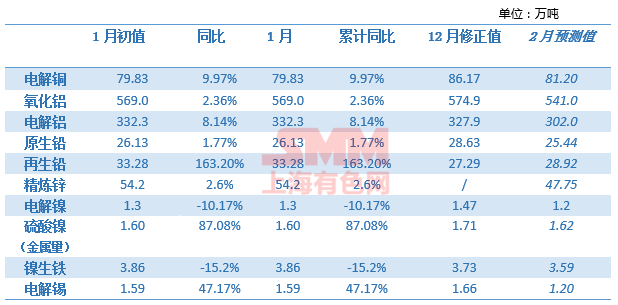
Description:
1. The value with * is the correction value, and the italic value is the predicted value.
2. The output of nickel pig iron refers to the data after the physical quantity is converted into metal.
Research methodology
1. Research methods
SMM production research is conducted by professional analysts by telephone, field research and other methods, regular monthly tracking of Chinese metal production enterprises, and to issue China's metal production report.
In the process of research, ensure the basic coverage proportion of the sample, and continue to expand; at the same time, consider the capacity scale, regional distribution, the nature of the enterprise and other detailed factors to reasonably select and distribute the sample, so that each sub-data is equally representative.
The production data include the output of last month (initial value), the output of the month before last month (revised) and the production schedule forecast of that month's output. In general, SMM makes less correction to the output, that is, the correction value = the initial value, but still retains the possibility of correction.
Before the 10th of each month, it will be released to the public through the official website of SMM (www.smm.cn), Wechat and Subscription account (Nonferrous Today), mobile phone station (m.smm.cn) and other official channels.
2. Sample introduction