Application of Induction heating Technology in batch galvanizing

Publié: Oct 20, 2020 15:42 (GMT+8)

On the 20th of SMM10, at the 2020 China International Hot galvanizing Technology and Market Application Development Forum held by SMM, Kong Guoping, Deputy General Manager of Yingda Industry (Shanghai) Co., Ltd., delivered a keynote speech on "Application of Induction heating Technology in batch galvanizing".

1. Traditional zinc pot

Kong Guoping pointed out that there are several defects in traditional zinc pots. First of all, the life of steel shell can only be used for 1-2 years due to the corrosion of molten zinc and local high temperature oxidation of steel shell, and the service life is very short.

Secondly, in the process of corrosion of molten zinc on steel shell, Fe and Zn combine to form zinc slag. Moreover, the local high temperature of the steel shell accelerates the formation of zinc-iron compounds (zinc slag) and destroys the balance of zinc slag, resulting in the precipitation of zinc slag. There are more zinc dregs, resulting in an increase in zinc consumption.

In addition, there are some problems that need to be improved, such as high energy consumption, local high temperature caused by zinc steam, nitrogen oxides and carbon emissions, and regular maintenance and replacement of burner combustion system and combustion chamber refractories.

Second, induction heating technology

Induction heating theory

Induction heating zinc pot
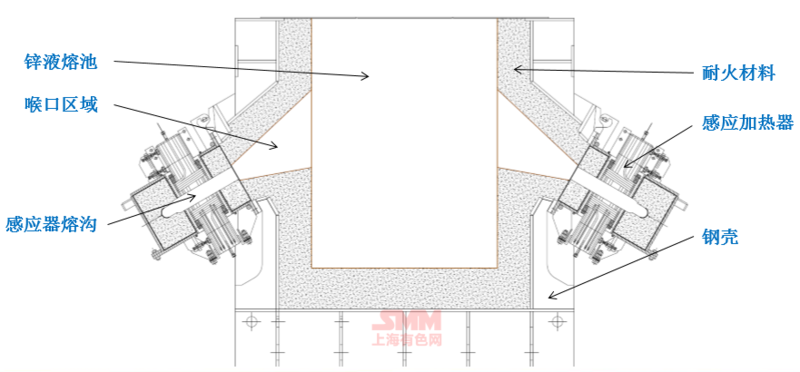
 

The life of induction heating zinc pot is more than 15 years, and the life of inductor body is more than 8-10 years. Because the liquid zinc is not in contact with the steel shell, the corrosion of the steel shell is avoided, and the direct contact between the liquid zinc and the refractory material avoids the chemical reaction between the liquid zinc and the refractory material.

And the amount of zinc slag will be greatly reduced, reducing zinc consumption. Because the liquid zinc is no longer in direct contact with the steel shell, the Fe, from the steel shell is avoided, thus reducing the intake of Fe and reducing the production of Fe and Zn compounds; the liquid zinc adopts induction heating to avoid the local high temperature phenomenon, and the uniformity of the liquid zinc is higher, except for the zinc slag produced by the Fe brought into the normal galvanized parts, the whole molten zinc and zinc slag will reach an ideal balance and there will be no additional zinc slag.

At the same time, no zinc vapor is produced. Using induction heating, there will be no local high temperature; electric energy will be converted into heat energy without any emission problems.

In addition, due to direct heating, no carbon deposition, low energy consumption and high efficiency. Basically maintenance-free, low maintenance cost.

Déclaration sur la source des données : À l'exception des informations publiques, toutes les autres données sont traitées par SMM sur la base d'informations publiques, d'échanges avec le marché et en s'appuyant sur le modèle de base de données interne de SMM. Ils sont fournis à titre indicatif uniquement et ne constituent pas des recommandations décisionnelles.

Pour toute demande d'information ou pour en savoir plus, veuillez contacter : lemonzhao@smm.cn
Pour plus d'informations sur l'accès à nos rapports de recherche, veuillez contacter :service.en@smm.cn
Actualités Connexes
【Flash | Les moteurs optiques IA intégrés InP entrent en production en volume】
il y a 17 heures
【Flash | Les moteurs optiques IA intégrés InP entrent en production en volume】
Lire la suite
【Flash | Les moteurs optiques IA intégrés InP entrent en production en volume】
NewPhotonics et Tower Semiconductor ont annoncé des expéditions en volume de moteurs optiques intégrés laser pour l’infrastructure IA. Les PIC 800G et 1,6T utilisent la plateforme photonique sur silicium PH18DA de Tower avec des composants InP intégrés de manière hétérogène, permettant de réunir lasers, SOA, modulateurs et photodétecteurs sur une seule puce. Des expéditions en volume de chipsets NPO 6,4T sont prévues pour le premier semestre 2027. SMM estime que cela indique que la demande d’interconnexions optiques pour l’IA se traduit par une demande de composants InP, soutenant la consommation d’indium de haute pureté. Toutefois, les volumes d’expédition et l’intensité en InP n’ont pas été divulgués, de sorte que la hausse de la demande d’indium à court terme ne peut pas encore être quantifiée.
il y a 17 heures
Blue Moon va acquérir le gisement SMV de cuivre-or-zinc Turner avec une ressource historique en zinc
il y a 22 heures
Blue Moon va acquérir le gisement SMV de cuivre-or-zinc Turner avec une ressource historique en zinc
Lire la suite
Blue Moon va acquérir le gisement SMV de cuivre-or-zinc Turner avec une ressource historique en zinc
Blue Moon Metals a annoncé la signature d'un accord définitif pour acquérir 100 % du gisement de sulfures massifs volcanogènes (SMV) de cuivre-or Turner, situé en Oregon, auprès de Gold Coast Mining. La contrepartie comprend 4,7 millions de dollars américains en espèces, 4 778 761 actions de Blue Moon évaluées à environ 27 millions de dollars américains sur la base du cours moyen pondéré en fonction du volume sur 20 jours, ainsi que jusqu'à 7 millions de dollars américains en paiements d'étape liés aux permis d'exploration souterraine et de développement, aux permis miniers et à la production commerciale. La clôture est prévue pour novembre 2026, sous réserve de l'approbation de la Bourse de croissance TSX et des conditions habituelles. Turner est un gisement de SMV de type Chypre ayant déjà été exploité, contenant du cuivre, de l'or, du zinc, de l'argent et du cobalt. Son estimation historique de 2010 faisait état de 2,447 millions de tonnes courtes de ressources indiquées titrant 2,65 % de zinc et de 2,084 millions de tonnes courtes de ressources présumées titrant 2,78 % de zinc. La société prévoit que l'obtention des permis pour les forages d'exploration et le développement souterrain prendra de 12 à 18 mois.
il y a 22 heures
Revue hebdomadaire de l'oxyde de zinc SMM : la demande en aval sous-performe, les taux d'exploitation de l'oxyde de zinc reculent
24 Sep 2026 17:22 (GMT+8)
Revue hebdomadaire de l'oxyde de zinc SMM : la demande en aval sous-performe, les taux d'exploitation de l'oxyde de zinc reculent
Lire la suite
Revue hebdomadaire de l'oxyde de zinc SMM : la demande en aval sous-performe, les taux d'exploitation de l'oxyde de zinc reculent
[La demande finale est médiocre, le taux d'exploitation de l'oxyde de zinc baisse légèrement] Du point de vue de la demande finale, dans le secteur de l'oxyde de zinc de qualité caoutchouc, les commandes des fabricants de pneus sont généralement faibles et les achats d'oxyde de zinc restent en flux tendu ; les commandes dans le domaine de la désulfuration sont médiocres et la demande reste atone...
24 Sep 2026 17:22 (GMT+8)