Do a good job in risk control as the long holiday approaches! Three major exchanges

Publié: Sep 25, 2020 09:16 (GMT+8)
Source: Futures daily
"National Day holiday" is approaching, please do a good risk control! The limit range of the three futures exchanges and the adjustment of margin standards are all here.

As the National Day and Mid-Autumn Festival are approaching, in order to do a good job in market prevention during the long holiday, the last period of Energy, Zheng Shang and Da Shang respectively announced market risk control measures during the long holiday.

In terms of trading time, according to the announcements of the three futures exchanges, night trading will not be held on the evening of September 30, and the market will be closed from October 1 to October 8, and all futures and options contracts will be auctioned together on October 9, and night trading will resume that night.

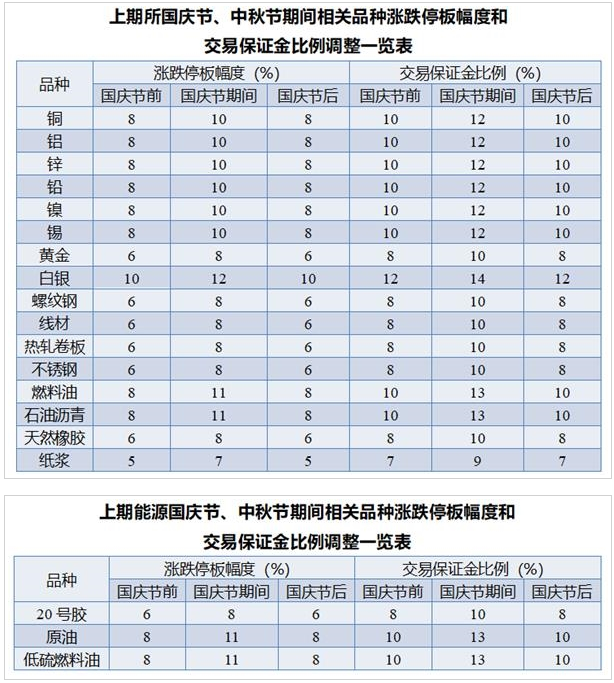
With regard to the last stock exchange and the previous period of energy, at the close of the first trading day when there was no unilateral market since Tuesday, September 29 (Tuesday), the margin ratio of pulp futures contracts was adjusted to 9%, and the limit range was adjusted to 7%. The margin ratio of gold, rebar, wire rod, hot-rolled coil, stainless steel and natural rubber futures contracts was adjusted to 10%, and the range of the limit was adjusted to 8%, and the margin ratio for gold, rebar, wire rod, hot-rolled coil, stainless steel and natural rubber futures contracts was adjusted to 10%, and the limit range was adjusted to 8%. The margin ratio for copper, aluminum, zinc, lead, nickel and tin futures contracts was adjusted to 12%, and the limit range was adjusted to 10%; the margin ratio for fuel oil and petroleum asphalt futures contracts was adjusted to 13%, and the limit range was adjusted to 11%; the margin ratio for silver futures contracts was adjusted to 14%, and the limit range was adjusted to 12%. The margin ratio of the No. 20 glue futures contract was adjusted to 10%, the limit range was adjusted to 8%, and the margin ratio of crude oil and low-sulfur fuel oil futures contracts was adjusted to 13%, and the limit range was adjusted to 11%. After trading on Friday, October 9, the margin ratio and limit range of all futures varieties and contracts returned to their original levels at the close of the first trading day when there was no unilateral market.
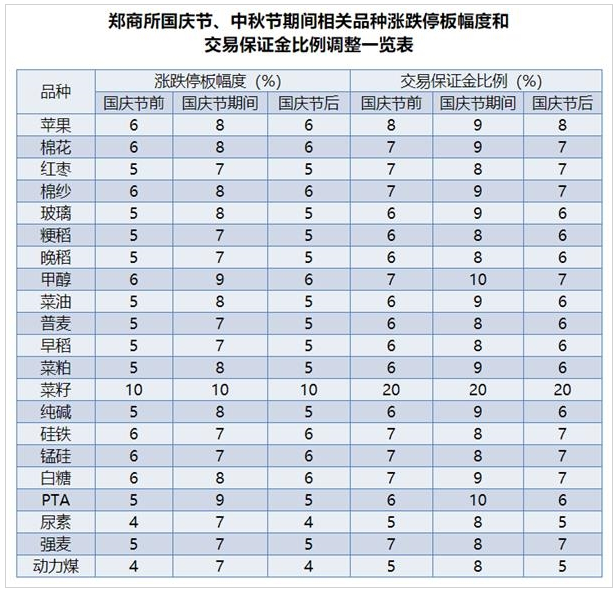
In terms of Zheng Shang Institute, since the settlement on September 29, the margin standard for PTA and methanol variety trading has been adjusted to 10%, and the limit range has been adjusted to 9%; for sugar, cotton, rapeseed meal, rapeseed oil, cotton yarn, apple, glass and soda ash varieties, the margin standard has been adjusted to 9%, and the limit range has been adjusted to 8%. The margin standard for trading varieties of Pumai, Qiangmai, early indica rice, late indica rice, japonica rice, red jujube, thermal coal, ferrosilicon, manganese silicon and urea was adjusted to 8%, and the limit range was adjusted to 7%. After the resumption of trading on October 9, since the contracts with the largest positions of varieties were not settled on the first trading day of the unilateral market, the trading margin standards and limits of all varieties returned to their pre-adjustment levels.
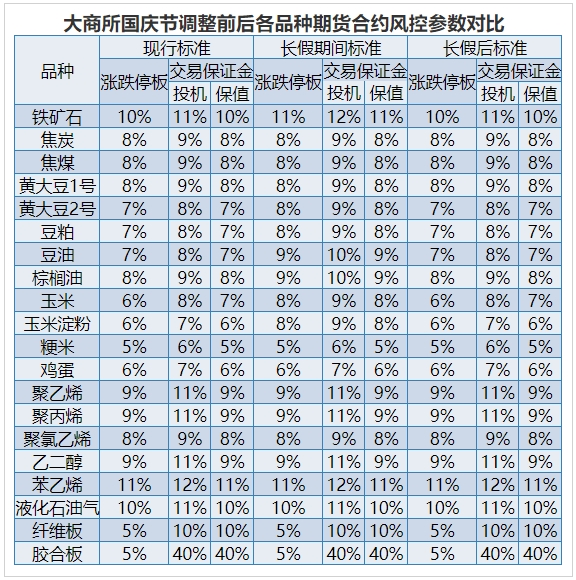
As far as the trading house is concerned, since the settlement on Tuesday, September 29, the rise and fall limit of yellow soybean No. 2, soybean meal, corn and corn starch futures contracts has been adjusted to 8%, and the margin levels of hedging and speculative trading have been adjusted to 8% and 9%, respectively. Soybean oil and palm oil futures contracts have been adjusted to 9%, hedging and speculative trading margin levels have been adjusted to 9% and 10%, respectively, and the margin levels of hedging and speculative trading have been adjusted to 8% and 9%, respectively, and the margin levels of hedging and speculative trading have been adjusted to 9% and 10%, respectively. The limit range of iron ore futures contracts was adjusted to 11%, and the levels of hedging and speculative trading margin were adjusted to 11% and 12% respectively. The limit range and trading margin level of other kinds of futures contracts remained unchanged. After the resumption of trading on Friday, October 9, the trading margin and trading margin level during the holiday period will remain unchanged on the first trading day after the festival. when the contracts with the largest positions of all varieties are not settled on the second trading day after the holiday (October 12), the margin ratio and the range of trading limit of the above futures varieties return to the original level after the settlement of the second trading day (October 12) after the resumption of trading on Friday, October 9, after the resumption of trading on Friday, the first trading day after the holiday, the margin and margin of the trading limit during the holiday period will remain unchanged.

Déclaration sur la source des données : À l'exception des informations publiques, toutes les autres données sont traitées par SMM sur la base d'informations publiques, d'échanges avec le marché et en s'appuyant sur le modèle de base de données interne de SMM. Ils sont fournis à titre indicatif uniquement et ne constituent pas des recommandations décisionnelles.

Pour toute demande d'information ou pour en savoir plus, veuillez contacter : lemonzhao@smm.cn
Pour plus d'informations sur l'accès à nos rapports de recherche, veuillez contacter :service.en@smm.cn
Actualités Connexes
La Tanzanie choisit la voie de traitement d'Imwelo après une hausse de la récupération d'or à 84,5 %
25 Sep 2026 16:02 (GMT+8)
La Tanzanie choisit la voie de traitement d'Imwelo après une hausse de la récupération d'or à 84,5 %
Lire la suite
La Tanzanie choisit la voie de traitement d'Imwelo après une hausse de la récupération d'or à 84,5 %
[SMM Gold Flash] Lake Victoria Gold a annoncé de nouveaux essais métallurgiques pour le minerai altéré de la zone C de son projet Imwelo Gold, entièrement autorisé, en Tanzanie. Le lavage par attrition suivi d'un débourbage a permis d'augmenter l'extraction d'or en 24 heures de 49,99 % à 84,54 % lors des essais de lixiviation agitée. La récupération en bouteille roulante a atteint 88,15 % après prétraitement, tandis que l'or récupérable par gravité a également augmenté. Les travaux ont été réalisés par Nesch Mintech Tanzania à Mwanza. La société a identifié le lavage par attrition et le débourbage comme la voie de prétraitement privilégiée pour une optimisation ultérieure du matériau proche de la surface, riche en argile. Lake Victoria Gold indique que ces résultats complètent les travaux antérieurs sur le matériau plus profond, où des récupérations d'environ 96 à 97 % avaient été rapportées. Il est important de noter que les récupérations annoncées concernent les fractions prétraitées testées et ne représentent pas encore la récupération globale de l'usine sur l'ensemble du minerai ; des travaux supplémentaires de bilan massique et d'optimisation sont prévus.
25 Sep 2026 16:02 (GMT+8)
Le forage d’Aurum livre une teneur de 155 g/t d’or à Boundiali, en Côte d’Ivoire
25 Sep 2026 15:58 (GMT+8)
Le forage d’Aurum livre une teneur de 155 g/t d’or à Boundiali, en Côte d’Ivoire
Lire la suite
Le forage d’Aurum livre une teneur de 155 g/t d’or à Boundiali, en Côte d’Ivoire
[SMM Gold Flash] Aurum Resources a publié de nouveaux résultats d'analyse provenant de 22 forages au diamant totalisant 6 172,8 mètres sur le gisement BST1 de son projet aurifère Boundiali en Côte d'Ivoire. Les résultats comprennent 2,63 mètres à 76,74 g/t d'or à partir de 195,2 mètres, dont 1,3 mètre à 155 g/t, ainsi que 24 mètres à 6,31 g/t à partir de 108 mètres, dont 7 mètres à 19,25 g/t. Plusieurs intersections s'étendent au-delà de l'enveloppe de ressources existante de BST1. Ces résultats alimenteront la mise à jour prévue de la ressource minérale de Boundiali, visée pour le début du quatrième trimestre 2026. La société indique que la minéralisation reste ouverte le long de la direction et en profondeur, tandis que les forages se poursuivent sur l'ensemble du projet. Ces résultats constituent donc une avancée en matière d'exploration et de croissance des ressources plutôt qu'une production supplémentaire. Boundiali dispose actuellement d'une ressource minérale JORC de 3,22 millions d'onces, tandis qu'Aurum fait progresser une étude de faisabilité définitive.
25 Sep 2026 15:58 (GMT+8)
Le platine présente des liens plus forts avec l'inflation et les taux réels que l'or, selon une étude
25 Sep 2026 15:52 (GMT+8)
Le platine présente des liens plus forts avec l'inflation et les taux réels que l'or, selon une étude
Lire la suite
Le platine présente des liens plus forts avec l'inflation et les taux réels que l'or, selon une étude
[SMM Flash Or & MGP] Une nouvelle étude publiée dans le Journal of Commodity Markets révèle que le platine présente une co-variation plus large et plus persistante avec l'inflation et les taux d'intérêt réels que l'or. Les chercheurs Arusha Cooray et İbrahim Özmen ont examiné des données mensuelles de juillet 1999 à décembre 2024 pour les États-Unis, l'Allemagne, l'Italie, la France, la Suisse et les Pays-Bas, en utilisant l'analyse des points de retournement, la cohérence par ondelettes et les méthodes de causalité de Granger variables dans le temps. L'étude a constaté que les relations macroéconomiques de l'or étaient comparativement plus faibles et plus fragmentées, tandis que le platine et l'argent présentaient une synchronisation plus large, en particulier aux États-Unis et en Allemagne. Les chercheurs attribuent la plus forte sensibilité macroéconomique du platine en partie à son exposition industrielle substantielle, ce qui signifie que son prix reflète non seulement les conditions monétaires, mais aussi l'activité manufacturière, l'investissement et les contraintes d'offre. Les résultats n'établissent pas que le platine soit une couverture contre l'inflation universellement supérieure : les relations variaient selon les pays, les périodes et les régimes de politique monétaire. L'étude met plutôt en évidence une différence fondamentale entre les métaux, le rôle monétaire et défensif plus large de l'or produisant une réponse différente aux conditions d'inflation et de taux réels.
25 Sep 2026 15:52 (GMT+8)