SMM9: at the 2020 (2nd) China Industry Expo New Materials Forum-China Automotive New Materials Application Summit held by SMM, and China (8th) Aluminum processing Industry chain supply and demand Trading Summit, and China (second) Copper processing Industry chain supply and demand Trading Summit, Zhang Hai of Suzhou University gave a comprehensive and professional explanation on the development and application of new high-strength and high-toughness cast aluminum alloys.
I. background
Zhang Hai pointed out that it is imperative to protect the environment and alleviate the energy crisis > to save energy and reduce emissions, to develop new energy vehicles (mileage anxiety), and to lighten the weight of cars. For every 100Kg reduction in pure new energy vehicles, mileage can be increased by 10% Mur11%, battery costs can be reduced by 20%, and daily wear and tear costs can be reduced by 20%. However, lightweight needs to be carried out on the premise of ensuring the safety and carrying capacity of the car, and control the cost-the difficulty is!

Second, the application and development trend of die castings in automobile.
Application of Die casting in Automobile
Die castings are mainly used in automotive power systems-non-load-bearing shell parts, automotive structural parts and trucks.
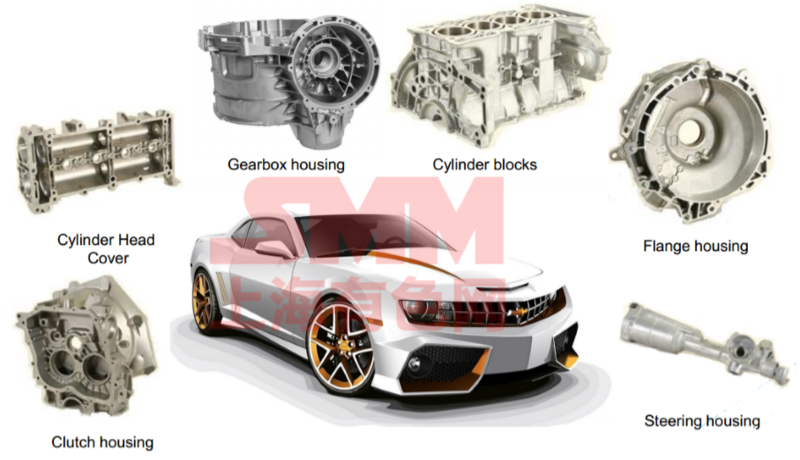
Advantages of die casting production: near-end molding process, low cost preparation, easy to realize automatic production, reduce labor cost, easy to obtain high size precision parts, easy to prepare thin wall and complex shape construction, excellent surface precision; high solidification rate;
Shortcomings of die casting production: high mold cost, a lot of design work, a large number of pores and other defects, die casting alloy for remelting alloy, low fatigue performance;
Characteristics of Die Castings for Automobile structure
(1) the load-bearing parts or load-bearing parts of a motor vehicle, which are used in the body or chassis part of the automobile;
(2) large size, thin wall and complex structure;
(3) structural members with high mechanical properties and toughness: RM ≥ 180 Mpa, δ ≥ 10%, strength-related structural members: Rm ≥ 210MPA, δ ≥ 7%;
(4) Heat treatment and weldability, die casting process is difficult, so it is necessary to control die casting defects and solid solution aging treatment.
Development of cast aluminum alloy with high strength and toughness
High strength and toughness cast aluminum alloy developed abroad in recent years: Rheinfelden Alloys, Alcan (plus aluminum in Germany) and Mercury Marine (Mercury Maritime in USA)
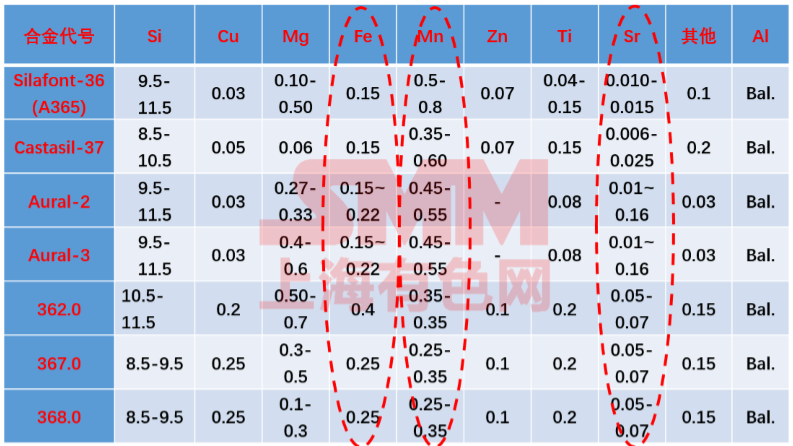
A new type of cast aluminum alloy developed by Alcoa
SupraCast cylinder-excellent high temperature mechanical properties and thermal conductivity, suitable for the manufacture of cylinder block, cylinder head, turbocharger and so on.
EZCast casting-excellent casting performance and thermal stability for thin-walled vacuum die castings.
VersaCast alloy-high strength casting alloy with excellent casting formability.
EverCast parts-High strength and high fatigue strength, suitable for manufacturing brake system safety components, steering wheels, etc.
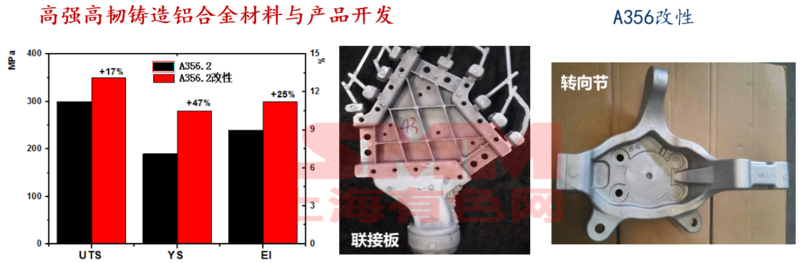
Research results of High strength and toughness cast Aluminum Alloy in Suzhou University: materials and Product Development of High strength and High toughness cast Aluminum Alloy
Alloy element control: strictly control the content of Mg, Si and Fe to ensure mechanical and casting properties.
Application of new modification-refiner: modification of eutectic silicon and refinement of α-Al dendrites at the same time.
Two-stage aging heat treatment: optimize the strength and toughness at the same time.
IV. Summary
Zhang Hai pointed out that attention should be paid to the composition optimization and modification of existing high strength and toughness cast aluminum alloys. The main ideas for the development of new cast aluminum alloys for high strength and toughness structures without increasing cost are: microalloying, heat treatment, etc.; expanding the application of high strength and toughness aluminum alloys in automotive and other fields; with regard to the research and development of new production processes, Zhang Hai said that the key is to explore new processes and new methods to improve the product composition uniformity, microstructure density, grain refinement and other factors to increase strength and toughness; the development of new production equipment.
"SMM online Q & A" has come to the market, price, information if you have any questions, feel free to ask!

Scan the QR code and join the SMM Die casting, Automotive and Alloy Industry Exchange Group

![SHFE : l'aluminium progresse, les transactions d'aluminium au comptant sont freinées et reculent [Revue de mi-journée de l'aluminium au comptant SMM]](https://imgqn.smm.cn/usercenter/wvGIW20251217171655.jpg)