SMM Network News: in the rare earth high-tech zone Wanshuiquan Street, a No. 64 bus has brought a lot of convenience for citizens to travel, it carries the "heart" is the rare earth Ni-MH power battery.
NiMH batteries produced in Japan, Germany, the United States and other foreign countries are mainly used in hybrid vehicles, but capacitive Ni-MH batteries are used in pure electric buses, only Haoming rare earths at home and abroad. At the same time, the core technology and equipment adopted by our company have completely independent intellectual property rights, all of which are Chinese patents, including 31 patented technologies such as' the first fully automatic digital pole core laser welding system in China'. " Yuan Aidong, deputy general manager of Baotou Haoming rare Earth New Power Technology Co., Ltd.
From the most abundant rare earth resources to the most high-end terminal applications, Baotou is on the road of scientific and technological innovation. With the blessing of science and technology, rare earths have been applied in more and more fields, and the rare earth science and technology product matrix with the world's advanced level has begun to take shape.
Scientific development and utilization of production and R & D in the same direction
In the rare earth exhibition hall of Baotou Steel, the bronze statues of Mr. Ding Daoheng, a famous Chinese geologist, and Mr. he Zuolin, a mineralogist, stand quietly. Today, through the scientific development and utilization of Bayan Obo rare earth resources, Baotou City has established a relatively complete industrial production and R & D system. A number of technologies with international advanced levels have been developed in the fields of rare earth mining, mineral processing, smelting, separation and application, which has become the cradle of the development of China's rare earth industry.
"advance in innovation, advance in innovation", the Baotou rare Earth Research and Development Center of the Chinese Academy of Sciences is determined to "write the paper on the product, do the research in the project, and transform the results in the enterprise." Since its establishment more than five years ago, it has jointly built 9 engineering and technological R & D centers such as rare earth permanent magnet materials with local enterprises, and incubated 20 high-tech enterprises, such as China Science Intelligence and China Science and Technology Co., Ltd., and implemented high-tech tracking plans for 15 latest research achievements at home and abroad.
In view of the unfavorable situation of serious environmental pollution caused by Baotou NdFeB surface protective plating, the rare Earth Center tracked and introduced the green environmental protection physical vapor deposition (PVD) method developed by Song Zhenlun of Ningbo Institute of Materials Research, Chinese Academy of Sciences, and built a pilot-scale demonstration line in Baotou Jinmenghui Magnetic Materials Co., Ltd. At present, through the construction of pilot demonstration line, various technical links have been opened, and services such as post-processing of PVD protection and overall scheme design of equipment can be provided for Baotou rare earth permanent magnet material enterprises, which has the conditions for industrialization promotion.
Chi Jianyi, director of the rare Earth Center, said, "in addition, we can also smelt rare earth steel, which cannot be sawed with the most advanced tools in the world; nanometer ultra-smooth rare earth cerium-based polishing solution leads the world in performance; and the technology of nano-multilayer coating on the surface of rare earth permanent magnet materials breaks through the world problems such as the discharge of acid and alkali wastewater from electroplating process and the treatment of nickel, copper, chromium, zinc and chloride ions."
If you want to sit on a bench for ten years, you can't afford to tackle key problems with science and technology.
Baotou has built a platform for transforming technological achievements of rare earth materials, and Baotou rare Earth Research Institute has built the largest pilot test base of rare earth materials in China.
Science and technology leads the industry, and industry promotes the science and technology industry. With a large number of cutting-edge achievements in the development of China's rare earth industry, Baotou rare Earth Research Institute has made great contributions to the development of China's rare earth industry in the fields of rare earth mineral processing, rare earth metallurgy, environmental protection, rare earth functional materials, rare earth application and so on.
In 1984, Baotou rare Earth Research Institute successfully separated lanthanum, cerium, praseodymium, neodymium, samarium, europium and gadolinium from Bayan Obo rare earth resources, which laid a solid foundation for the sustainable development of China's rare earth industry.
Since then, both the long-range rocket launched by China into the Pacific Ocean and the long March 2F carrier rocket that propelled the "Shenzhou 10" into the scheduled orbit have the figure of rare earth permanent magnets developed by Baotou rare Earth Research Institute.
Over the past 50 years since its establishment, Baotou rare Earth Research Institute has undertaken more than 2000 projects at the national, provincial and ministerial level, prefectural and municipal levels, and serving enterprises, and has achieved more than 850 scientific research achievements of all kinds. It has won more than 300 scientific and technological achievement awards at or above the provincial and ministerial level, such as the first prize for national invention and the first prize for national scientific and technological progress, and more than 100 patents authorized by the state.
In the first pilot line of rare earth magnesium alloy with an annual output of 1, 000 tons in China, the new product metal ytterbium particles have been used on the OLED screen of mobile phones such as Xiaomi. The use of this material can greatly reduce the proportion of harmful blue light in mobile phones and improve the rate of good products. Researcher Cheng Zizhou told reporters that taking the mobile phone panel as an example, through the use of this material, the proportion of blue light that is harmful to the human body will probably be reduced by more than 70%. "in the past, the good product rate of the mobile phone panel was about 60% to 70%. Now, after using this particle, the good product rate can be increased to 80%." Cheng Zizhou said.
In addition, Liu Yubao, director of the Institute of Metal Materials of the institute, said that at present, more than 20 of the more than 150 rare earth and magnesium alloy formulations have been selected for practical application, and these rare earth and magnesium technologies will play an important role in aerospace, automotive and other industries in the future.
Aiming at "high precision" and taking a good brand road, Baotou has also successfully developed rare earth steel products such as rare earth wind power steel, rare earth high strength steel, rare earth flange steel, rare earth wear resistant steel and rare earth electrical steel.
The rare earth ferroalloy of Northern rare Earth Group has made a new breakthrough in the application of grade steel, cast steel and special steel. Using rare earth ferroalloy as raw material for the production of rare earth steel, nine continuous casting, ten continuous casting and fourteen continuous casting have been realized successively in the industrial production of rare earth steel, which verifies the unique advantages of the application of rare earth ferroalloy in steel.
Experts said that the new generation of rare earth ferroalloy production of rare earth steel can solve the problems of molten steel flocculation, low yield and instability in the production process, thus raising China's iron and steel production technology to a new level.
After more than 50 years of development, Northern rare Earth Group has 48 branches and wholly-owned, holding and shareholding companies, distributed in 12 provinces (municipalities) and autonomous regions, and has a complete industrial chain of rare earth smelting, functional materials, deep processing and application. Can produce all kinds of rare earth products a total of 11 categories, more than 50 kinds, nearly 1000 specifications. At present, smelting and separation capacity is 80, 000 tons / year, rare earth metal production capacity is 10, 000 tons / year, rare earth raw material production capacity ranks first in the world; among rare earth functional materials, magnetic material alloy is 34000 tons / year, ranking first in the world; polishing material production capacity is 14000 tons / year, hydrogen storage alloy 7800 tons / year, accounting for more than half of the domestic market share.
Bayan Obo in Baotou, Inner Mongolia, known as the "rare Earth Valley of China", has the world's largest symbiotic mine of iron, rare earth, niobium and other elements, and can mine 12 million tons of iron ore every year, calculated according to the 6% grade of rare earths in the original ore. About 720000 tons of rare earths can be mined by the way.
Notice of meeting
Sponsored by SMM, Dongguan Magnetic Materials Industry Association, Ganzhou rare Earth Industry Association jointly sponsored the 2020 China rare Earth permanent Magnet Industry Market Application Development Forum will be held in Ganzhou, Jiangxi Province on October 15-16, when industry experts, business leaders, industry elites, investment circles and other people will gather together to explore the development trend of the rare earth industry and explore potential business opportunities in the industry. SMM sincerely invites you to join us for innovation and resplendence!
"Click to learn more and sign up online
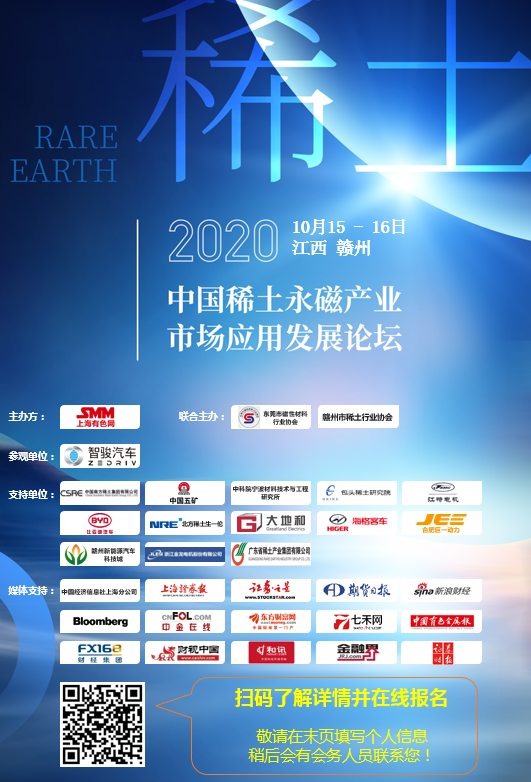
Please fill in your personal information on the last page and the meeting staff will contact you later!

Scan the QR code and apply to join the SMM rare earth industry exchange group
![[SMM Flash Chrome] La production indienne de minerai de chrome augmente de 12 % pour atteindre 3,53 Mt en 2025-2026, selon les données de l'IFAPA](https://imgqn.smm.cn/usercenter/mLwgx20251217171723.jpeg)
![[SMM Chrome Flash] Valterra Platinum dévoilera sa « stratégie chrome complète » en février](https://imgqn.smm.cn/usercenter/LYGyd20251217171725.jpg)
![Rétrécissement du volume : les concentrés de wolframite chutent de près de 5 % en moins d’un mois, que se passera-t-il après être passés sous la barre des 400 000 yuans ? [Commentaire SMM]](https://imgqn.smm.cn/usercenter/NPpAM20251217171723.jpeg)